

Goals matter because they give your life a direction. They transform a vague ambition into a clear, actionable plan. Think of a goal as a mental compass—it helps you filter out distractions and channel your energy toward what you truly want, creating the motivation you need to build consistency.
The Power of Having a Clear Direction
Ever feel like you’re busy but not productive? You’re working hard, but you’re not getting any closer to where you want to be. It’s a common, frustrating feeling that usually isn’t caused by a lack of effort, but a lack of direction.
Without a clear target, your energy scatters across dozens of different tasks, leaving you drained and feeling like you’ve accomplished nothing. This is precisely why goals are so important. They provide the clarity your brain needs to cut through the chaos of daily life.
A well-defined goal shifts your mindset from reactive to proactive. Instead of just responding to what life throws at you, you start making intentional decisions aligned with your ultimate objective. This isn’t about creating a massive to-do list; it’s about building a framework that makes it easier to say "no" to distractions and "yes" to the small, consistent actions that build real momentum.
Turning Intention Into Action
The first step to beating procrastination is understanding why you're doing something. When your daily actions are tied to a meaningful outcome, motivation isn't something you have to force—it shows up naturally. Tasks stop feeling like chores and start feeling like stepping stones toward a future you’re actively building.
The infographic below breaks down the core functions of a goal: providing direction, sharpening your focus, and boosting your motivation.
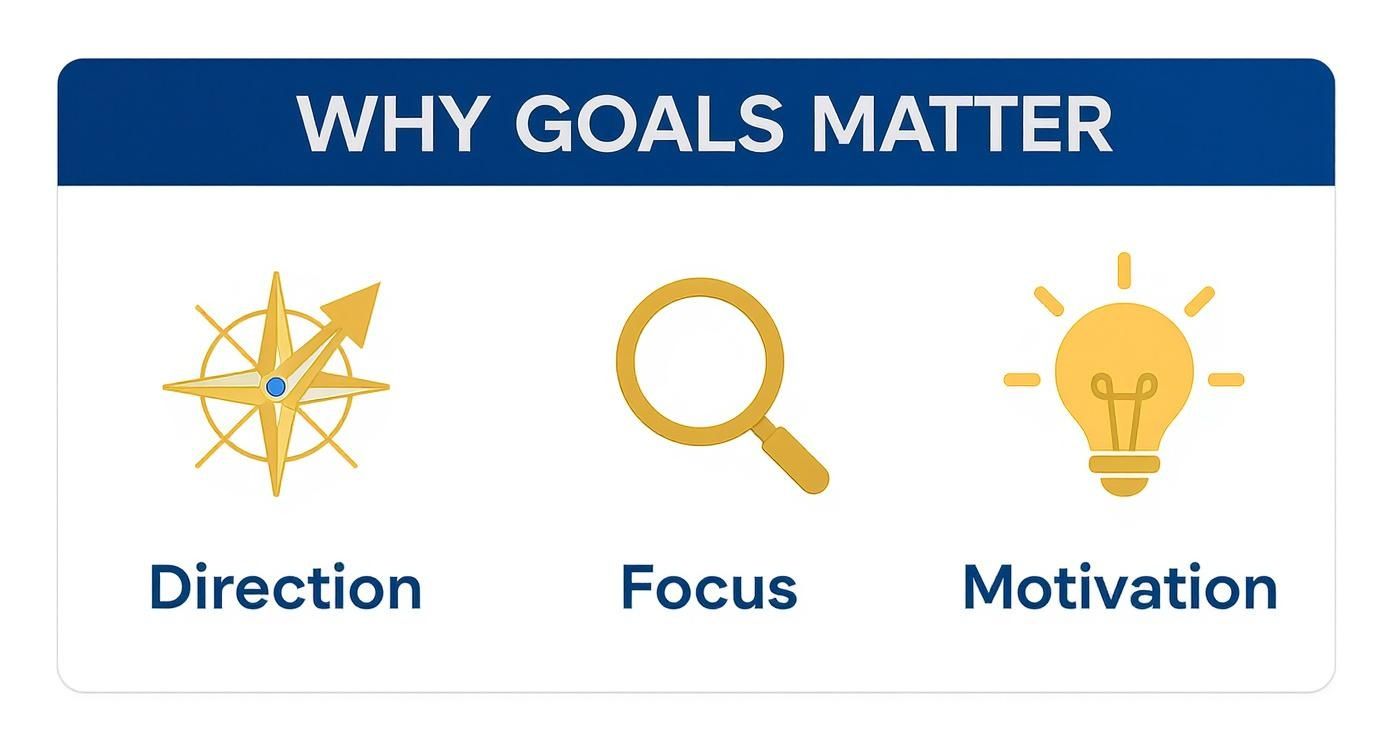
Each of these elements works together, creating a powerful system for personal growth. This structure is the foundation for anyone looking to make real, lasting changes in their life.
This quick table breaks down how goals function on both a practical and psychological level.
Why Goals Matter at a Glance
A quick summary of the primary roles goals play in our psychological and practical lives.
| Function | Psychological Impact |
|---|---|
| Direction | Provides clarity and a sense of purpose, reducing feelings of being lost or overwhelmed. |
| Focus | Helps filter out distractions, making it easier to prioritize tasks that move you forward. |
| Motivation | Creates a compelling reason to act, turning abstract desires into concrete effort. |
| Decision-Making | Serves as a benchmark, simplifying choices by aligning them with your desired outcome. |
| Measurement | Allows you to see progress, which reinforces your commitment and builds momentum. |
Ultimately, a good goal gives you something to aim for, a reason to get started, and a way to know if you're on the right track.
That initial stage of figuring out what you want is absolutely critical. You can dive deeper into setting effective objectives in our guide on what is a personal goal. From there, the real work begins: translating those bigger ambitions into the daily habits that actually lead to success. That's exactly what tools like Tracka are built for—helping you log your progress and turn your intentions into achievements, one day at a time.
How Goals Rewire Your Brain for Motivation

When you set a clear goal, you’re doing more than just making a wish—you’re giving your brain a specific job. A brain without a goal is like a ship drifting with the current, pushed around by every distraction and impulse. But a brain with a clear objective is like a ship with a rudder and a navigation system, moving with purpose toward a destination.
This isn’t just a metaphor; it’s rooted in our neurochemistry. When you define a specific, meaningful target, you activate your brain’s reward system. The simple act of making progress, even a tiny amount, triggers a release of dopamine, the neurotransmitter tied to pleasure and motivation. This is why checking an item off your to-do list feels so good. Your brain is literally rewarding you for moving forward.
This neurological feedback loop creates a powerful cycle. The more you work toward your goal and get those small dopamine hits, the more your brain craves that feeling of accomplishment, making it easier to stay on track.
The Science of Specificity
Vague intentions like “be healthier” almost never work because they don’t give your brain a clear target. This is where Goal Setting Theory, a foundational psychological principle, comes into play. It shows that specific and challenging goals consistently lead to higher performance than easy or ambiguous ones.
When you set a precise goal—like "walk 30 minutes every weekday" instead of "get fit"—you give your brain the clarity it needs to filter out irrelevant information and focus its resources. This clarity doesn’t just improve performance; it also taps into our deep-seated human needs for purpose and autonomy, which are powerful motivators.
This effect isn’t just for personal ambitions. In professional settings, research shows that employees with clear goals are 14.2 times more likely to feel inspired at work. In fact, over 90% of studies on the topic confirm that setting goals improves performance. You can read more about the research behind goal-setting and workplace motivation.
A goal is a neurological trigger that aligns your attention, energy, and actions. It transforms a passive wish into an active pursuit by giving your brain a concrete problem to solve and a reward to anticipate.
Building this kind of focused momentum takes more than good intentions. It demands consistent effort and mental energy. Understanding what willpower is can help you manage your resources more effectively. By pairing a clear goal with consistent daily habits—and using a tool like Tracka to log them—you create a system that works with your brain’s natural wiring, making success feel less like a struggle and more like a natural outcome.
Turning Big Ambitions Into Small Daily Wins

Let’s be honest: one of the main reasons big goals fail is that the finish line feels a million miles away. Grand ambitions like "get fit" or "launch my business" sound great in theory, but they can be completely paralyzing in practice. The sheer size of the task makes it impossible to know where to start, so we often don't. We get overwhelmed and procrastinate.
The solution is to stop staring at the mountaintop and focus on the very next step. The true power of a goal isn’t its size, but the daily actions it inspires. The secret to achieving big things isn't found in massive, heroic bursts of effort. It’s built with small, consistent daily wins.
Consistency beats intensity every single time. Instead of trying to conquer the whole goal today, your only job is to take one small step. This approach lowers the mental barrier to getting started and provides a steady drip of accomplishment that keeps you going.
The Power of Micro-Goals
Breaking a huge ambition into tiny, bite-sized tasks makes your progress feel immediate and real. It turns an intimidating goal into a simple daily to-do. This is a game-changer for anyone who feels overwhelmed, as it reframes the journey as a series of small, achievable wins.
Here’s how that mental shift looks in practice:
-
Vague Ambition: "Get fit and be healthier."
-
Actionable Daily Goal: "Go for a 15-minute walk after lunch."
-
Vague Ambition: "Write a book."
-
Actionable Daily Goal: "Write 150 words today."
This isn't just a nice idea; it’s backed by performance data. Research from PwC on workplace habits found a direct link between small, frequent goals and better outcomes. People who set at least four daily goals per week were 34% more likely to hit their key performance indicators (KPIs) than those who didn't. You can dig into the findings on small goal performance for yourself.
The art of achieving ambitious goals isn't about herculean effort. It’s about making the next step so small and simple that it feels almost effortless to complete.
This is exactly how habit-tracking tools like Tracka turn big dreams into reality. By giving you a simple space to log your daily actions—like that 15-minute walk—it visualizes your progress. Every checkmark is a small victory that builds momentum, reinforcing your self-belief and proving that you are moving forward. It makes the journey feel doable, not daunting, by shifting your focus to the single, manageable step you can take today.
Connecting Your Goals to Daily Productivity
A clear goal is more than a destination; it’s the fuel for the journey. It answers that nagging question that surfaces on a tough day: "Why am I even doing this?" Without a good answer, even simple tasks can feel like a pointless slog.
This feeling of disconnect is at the heart of modern burnout and 'quiet quitting'. When your daily grind feels detached from anything meaningful, your motivation evaporates. Your to-do list becomes a series of chores, not steps toward something you actually want.
This isn’t just a feeling—it has a massive impact. Only about 21% of employees globally report feeling engaged at work. This widespread disengagement costs the world economy an estimated $438 billion annually in lost productivity. You can see a deeper breakdown of the price of low engagement on teamout.com.
Fueling Your Daily 'How' with a Clear 'Why'
The solution isn't just to work harder; it's to forge a clear, undeniable link between what you’re doing right now and where you want to go. When your 'why' is front and center, the 'how' becomes much easier.
This principle applies far beyond your 9-to-5. It’s true for personal projects, health goals, and learning new skills. The same lack of connection that kills your focus at work can kill your motivation to hit the gym or stick to a budget.
A good goal system changes the game. By breaking a huge ambition down into small, trackable daily habits, you draw a straight line from today's tiny action to tomorrow's big win.
When your daily actions are aligned with a meaningful purpose, productivity stops being about managing time and starts being about investing energy.
Building Productive Habits That Stick
Creating that alignment means consciously translating your big-picture goals into consistent, everyday behaviors. For example, if your goal is to "improve focus at work," your daily habit might be to "work in 45-minute blocks with no phone."
This is where a tool like Tracka becomes your ally. By helping you log those small, consistent actions, it provides immediate feedback that reinforces your 'why.' Each checkmark is tangible proof that you’re moving forward, building the momentum you need to see your goals through to completion.
Check out our guide on building good working habits to see how small changes can add up. By making your progress visible, you keep your purpose in sight, turning daily tasks from a drain into a source of motivation.
Common Goal Setting Mistakes to Avoid
Knowing goals are important is one thing. Setting them effectively is another. Most people don't abandon their goals because they lack desire; they give up because they’ve unknowingly walked into a few classic traps that drain their momentum.
The most common mistake? Setting hopelessly vague goals. "Be healthier" or "get organized" sound nice, but they give your brain nothing to latch onto. There’s no target, no finish line, and no way to know if you’re moving in the right direction.
Another classic pitfall is trying to fix everything at once. We get a burst of inspiration and decide to overhaul our entire life—diet, exercise, and work—all in one go. But willpower isn't an infinite resource. Spreading it that thin is a surefire way to burn out, guaranteeing that nothing gets the focus it needs to stick.
From Vague Ideas to Actionable Steps
The fix is to bring sharp, unflinching clarity to what you want to achieve. Instead of a fuzzy, far-off wish, you need a concrete plan your brain can execute. This small shift turns a daydream into a real project.
Here’s how to reframe common vague goals into something powerful and actionable:
-
Instead of: “Be healthier”
-
Try: “Walk for 30 minutes, five days a week, and drink two liters of water daily.”
-
Instead of: “Be more productive”
-
Try: “Work in focused 45-minute blocks with a 15-minute break, three times each morning.”
See the difference? This approach breaks a massive, intimidating objective into small, manageable habits you can track. It’s the core principle behind a tool like Tracka, which is built to help you log these specific daily actions and turn overwhelming ambitions into a series of achievable wins.
Avoiding the All-or-Nothing Trap
Finally, many of us get derailed by all-or-nothing thinking. We miss one workout and decide the whole week is a write-off. This perfectionist mindset is a primary reason that a staggering 80% of resolutions are abandoned within weeks.
A setback is not a failure; it’s a data point. The goal isn’t perfection—it’s consistency over time.
The people who succeed long-term don't see a missed day as a catastrophe; they see it as an opportunity to learn. They live by one simple rule: just get back on track the next day. This resilience is what separates a short-lived attempt from a lasting lifestyle change. It builds a system where progress, not perfection, is the only thing that matters.
Using Technology to Amplify Your Success

Knowing why goals matter is one thing; sticking with them is another. This is where modern tools can upgrade timeless principles. Technology can bridge the frustrating gap between what you intend to do and what you actually do each day.
It’s not about finding more willpower. It's about building a support system that works even on your toughest days. Think of it as an objective partner that helps you see your progress, stay on course, and understand your own patterns in a way that’s nearly impossible to do alone.
Making Progress Visible and Actionable
The single biggest advantage technology offers is making your progress tangible. When a big goal is broken down into tiny daily habits, every action you log becomes a small, concrete win. It's no longer a vague effort; it's a streak you can see.
That visual feedback is a powerful motivator. It triggers the brain’s reward system, delivering the dopamine hits that keep you in the game. Seeing proof that your consistency is adding up is exactly why tools like Tracka are so effective. They turn your small daily efforts into a clear picture of forward momentum.
Technology’s role in goal achievement is to provide the structure, feedback, and insights that our busy minds often miss. It turns abstract goals into a concrete system for daily action.
Uncovering Insights and Building Community
Beyond just ticking boxes, the right tool helps you spot patterns you'd otherwise miss. Ever have a week where you felt unstoppable, but you couldn't figure out why?
Unlike generic apps, Tracka uses AI to help connect the dots between your habits, energy levels, and focus. It provides personalized insights like, "On days you take a 15-minute walk, your focus is 30% better." That’s not just data; it's a personalized instruction manual for your own performance.
Plus, you don’t have to go it alone. Research shows that sharing your goals can dramatically increase your odds of success. Tracka’s community features allow you to connect with a partner or a small group, building a support network that celebrates wins and helps you through setbacks. It’s an intelligent system designed to help you build habits that finally stick.
Your Goal Setting Questions Answered
Even with a solid plan, questions are going to pop up. Here are some quick, practical answers to the most common roadblocks people hit when setting goals.
How Many Goals Should I Focus on at Once?
It’s tempting to try and fix everything at once, but that’s a fast track to burnout. Stick to 1-3 major goals at a time.
Any more than that and you’ll splinter your focus. Concentrating your energy on a few key priorities is what builds momentum and creates lasting change. Each of those big goals should be supported by just a few daily habits.
What Should I Do If I Miss a Day?
First, don't panic. Missing one day is not a failure; it’s a normal, expected part of the process. The most important thing is to get back on track the very next day.
This is where the "never miss twice" rule comes in. All-or-nothing thinking is the number one reason people abandon their goals. So if you slip up, use it as a chance to learn something and refocus on the next opportunity to practice the habit. One missed day is an accident. Two is the start of a new, unwanted habit.
How Long Does It Really Take to Form a Habit?
That old ‘21 days’ idea is a myth. The real timeline depends on the person and how complex the habit is. Instead of fixating on a magic number, just focus on showing up consistently day after day and celebrating the small wins along the way.
Research from University College London found it takes anywhere from 18 to 254 days for a new habit to feel automatic, with the average landing around 66 days.
This huge range is exactly why goals are so important—they provide the structure and motivation you need to stick with it for the long haul, however long that turns out to be.
Ready to turn your goals into consistent, daily actions? Tracka.AI provides the tools you need to build momentum, stay accountable, and make progress you can actually see. Start tracking your habits with intention today.


