

At its core, willpower is your brain's CEO—the part of you that overrides immediate impulses to chase down bigger, better long-term goals. It’s the voice that convinces you to hit the gym when the couch is calling, or to finish a critical report instead of falling down a YouTube rabbit hole.
But we often treat a lack of willpower as a moral failing. That’s a mistake. Think of it less like a virtue and more like your phone's battery. It starts the day fully charged but drains with every decision you make and every temptation you resist. The key to success isn't having more of it; it's learning how to use it less.
So, What Exactly Is Willpower?
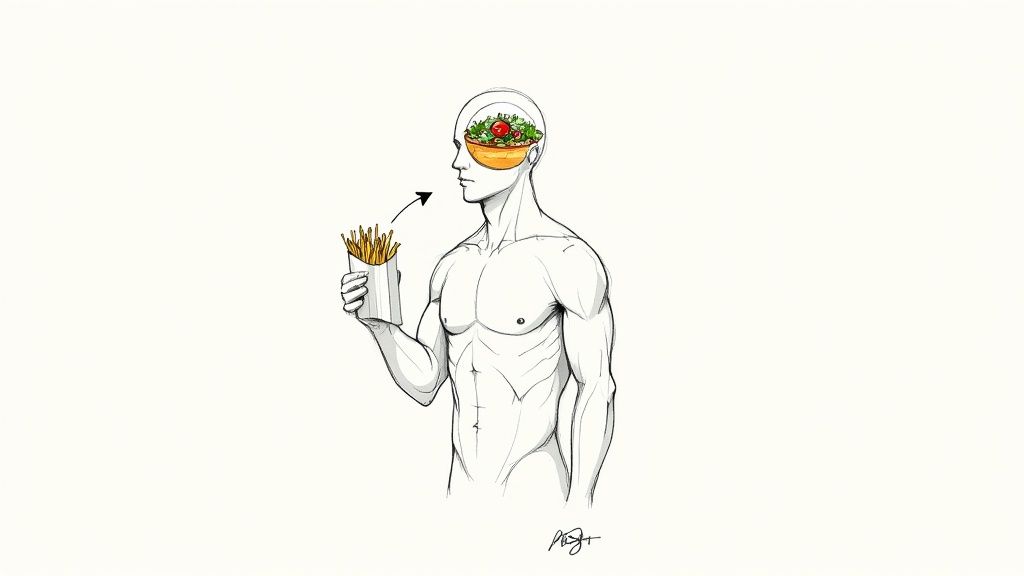
Most of us have a complicated relationship with willpower. We see it as this heroic, all-or-nothing trait. You’ve either got it, or you don’t. This thinking explains why so many people get frustrated when they become one of the 80% who abandon their New Year's resolutions just a few weeks in. They blame a lack of willpower, but the real problem is a flawed strategy.
The reality is far more practical. Scientists often use the “strength model of willpower,” which frames self-control as a limited resource. Every time you resist a cookie, force yourself to focus, or patiently deal with a difficult colleague, you use up a little of that energy.
This concept, known as ego depletion, is why you're much more likely to skip a workout or order takeout after a mentally exhausting day. Your decision-making fuel tank is running on empty. It’s a common experience—and for the millions of people who struggle with consistency, it’s a major barrier to improving focus, health, and productivity. You can read a bit more about the science of willpower as a resource over at Medical News Today.
The Three Pillars of Willpower
So, how does this battle for self-control actually play out? Most willpower challenges we face fall into one of three distinct categories. Understanding them helps you see where your mental energy is really going.
This simple breakdown shows the different "flavors" of self-control we use every day.
| Willpower Type | Description | Everyday Example |
|---|---|---|
| "I won't" power | This is the classic form of self-control—the ability to say no to temptations and impulses that conflict with your goals. | Resisting the urge to check social media notifications while you are trying to complete a work assignment. |
| "I will" power | This involves the ability to do something you would rather put off, like a difficult or boring task. | Committing to a 30-minute workout session even when you feel tired and unmotivated after a long day. |
| "I want" power | This is the ability to remember your long-term goals and what truly matters to you, especially when faced with immediate gratification. | Choosing to save money for a future down payment instead of making an impulsive, expensive purchase. |
Once you can spot which type of willpower a situation demands, you can stop blaming yourself for being "weak." Instead, you can start building smarter systems to manage your energy—a much better strategy than just gritting your teeth and trying harder.
The Science Behind Your Self-Control
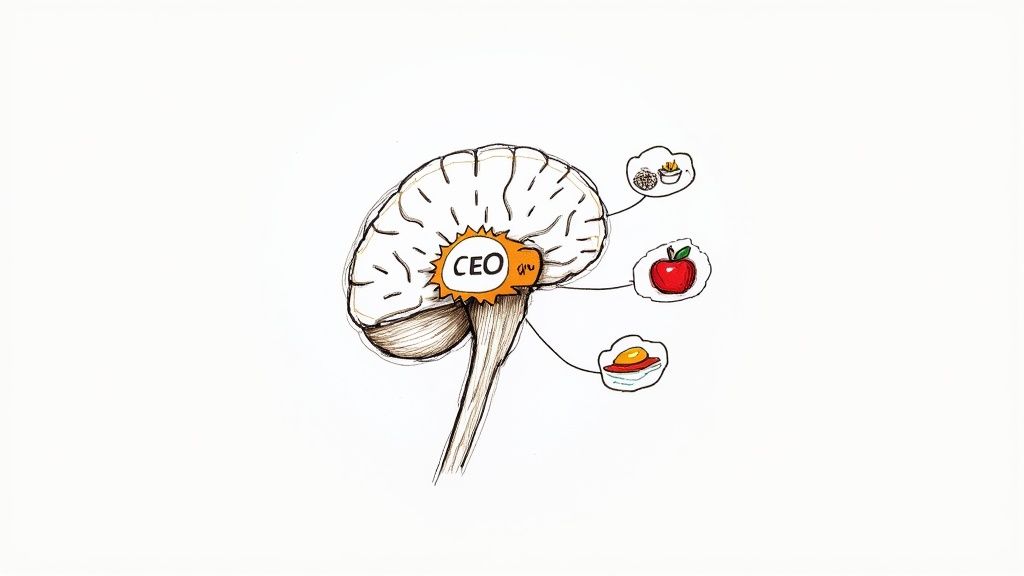
Ever wonder what's actually happening in your brain when you force yourself to finish a boring report instead of scrolling through social media? It's not just a vague feeling of "grit." You're firing up a specific neurological process.
The action starts in your prefrontal cortex, the part of your brain right behind your forehead. Think of it as your brain’s CEO—it's in charge of the big picture, handling long-term planning, complex decisions, and keeping your impulses in check.
This region is the command center for what scientists call the “pause-and-plan” response. While stress floods you with adrenaline for a fight-or-flight reaction, willpower does the exact opposite. It hits the brakes, calming your body and mind so your prefrontal cortex has the space and energy it needs to ignore short-term temptations and focus on what really matters.
Seeing willpower as a mind-body connection is crucial. It's not just about mental toughness; it's deeply connected to your physical state.
Your Brain on Willpower
The performance of your prefrontal cortex depends heavily on your body's resources. When you're rested and fed, your inner CEO has all the fuel it needs to make sharp, forward-thinking decisions. But when you’re stressed out or exhausted, its performance tanks.
We've all been there:
- Sleep Deprivation: Running on empty makes it nearly impossible for your prefrontal cortex to say "no" to impulses. It's why a sleepless night almost always leads to reaching for junk food or hitting the snooze button one too many times.
- High Stress Levels: When you're chronically stressed, your body is stuck in that reactive, fight-or-flight mode. This leaves very little room for the calm, deliberate "pause-and-plan" response to kick in.
- Poor Nutrition: Your brain runs on glucose, but it needs a steady supply. The sugar spikes and crashes from processed foods can wreck your focus and drain your resolve in a hurry.
This isn't about being weak or strong. It's about biology. Your ability to use self-control isn't some fixed character trait—it's a dynamic state you can actively support by managing your physical and mental health.
Willpower is a complex mind-body response, similar to stress but with a very different physiological outcome. While stress triggers an adrenaline rush, willpower activates the 'pause-and-plan response,' which calms the body and directs energy to the brain's prefrontal cortex. You can explore a deeper conversation about the science of willpower from Stanford Medicine researchers here.
By prioritizing basics like sleep, nutrition, and stress management, you're creating the biological foundation for your willpower to flourish. This is a game-changer. Instead of just trying to force self-control, you can learn to support it. This is where a habit tracker like Tracka excels, helping you build consistency with foundational habits—like a consistent bedtime or a short walk after lunch—that have a massive impact on your mental stamina. If you're curious about this process, check out our guide on how long it takes to form a habit for more insights.
Why White-Knuckling It Just Doesn't Work
Ever kicked off your day, resolutions blazing, only to watch your self-control fizzle out by dinner? You’re in good company. This isn't a character flaw—it's a fundamental misunderstanding of how willpower actually works.
We often think of willpower as some infinite, heroic virtue. The truth is, it's more like a muscle that gets tired or a battery that runs down. Relying on sheer grit to power through your day is like trying to sprint a marathon. You might start strong, but you're setting yourself up for exhaustion. It’s a strategy based on constant resistance, and that’s a battle you’ll eventually lose.
The Science Behind "I'm Too Tired to Care"
There's a real, measurable reason why it's so much easier to say no to a donut at 9 AM than it is to resist a pint of ice cream at 9 PM. It’s called decision fatigue.
Every single choice you make, from hitting snooze to picking a font for your presentation, nibbles away at your mental energy. It doesn't feel like much in the moment, but it adds up. By the end of the day, after hundreds of tiny decisions, your brain is simply drained. You haven't gotten "weaker"; you've just run out of the juice needed to make one more good choice.
Your Willpower Battery is Draining
This brings us to a related idea: ego depletion. Think of your willpower as a phone battery. Every time you exert self-control—like ignoring a text to stay focused on a task—you use up a little bit of that charge.
Here’s how a typical day might look:
- Morning: You wake up with a 100% charge. Crushing your morning workout and making a healthy breakfast feels easy.
- Mid-day: After a stressful meeting and navigating a dozen urgent emails, you're down to 60%. You still manage to opt for a salad, but the siren song of the vending machine is getting louder.
- Evening: You walk in the door with just 15% battery left. The thought of chopping vegetables feels monumental. Suddenly, ordering pizza doesn't just feel easier—it feels necessary.
The secret of highly successful people isn’t superhuman willpower. It’s that they structure their lives so they have to use it less. They build systems and routines that put good decisions on autopilot.
Once you grasp this, everything changes. A willpower "failure" isn't a moral failing; it's the natural outcome of a bad strategy. Instead of blaming yourself for running out of steam, you can start building systems that don't depend on it. This is where a tool like Tracka comes in. Unlike generic apps, it provides the structure and the AI-powered insights to help you stay consistent, especially when your motivation inevitably dips. It's about shifting from brute force to smart systems, and that’s the real key to lasting change.
Build Systems to Outsmart Your Limits
If white-knuckling your way through goals with sheer willpower is a losing game, what’s the alternative? The answer is as simple as it is powerful: build smarter systems. Instead of treating every goal as a daily battle of resistance, you can create an environment where the right choices feel like the easiest ones.
The most consistent and successful people aren't superhuman. They don’t have some secret, bottomless well of self-control. They’ve just learned how to use it less often by designing their lives around routines and habits that run on autopilot. This frees up their limited mental energy for the things that truly matter, shifting the focus from momentary strength to long-term structure.
From Brute Force to Autopilot
At the heart of any good system is the habit loop, a simple three-step neurological pattern our brains use to put behaviors on autopilot. If you can understand this loop, you can make your goals happen without the constant mental wrestling match.
It breaks down like this:
- Cue: This is the trigger that tells your brain to run a specific program. It could be a time of day (like 7 AM), a location (the kitchen), or even an emotional state (feeling stressed).
- Routine: This is the action itself—the physical or mental behavior you perform. It’s the habit, good or bad.
- Reward: This is the payoff that signals to your brain, "Hey, this loop was worth it. Let's remember it for next time."
When you turn a desired action—say, a daily walk—into a locked-in habit, you build a reliable engine for progress that doesn't drain your willpower. The goal is no longer about forcing yourself to act; it's about designing a better loop.
Building Trust in Your Own Systems
The power of having a reliable system has been studied for decades. Look at one of the most famous experiments on self-control: Walter Mischel's "Marshmallow Test." Kids were offered a choice—one treat now, or two if they could wait a few minutes. Years later, follow-up studies found that the kids who waited tended to have better life outcomes.
But it wasn't just about raw willpower. Researchers discovered that a child's trust in the situation was a huge factor. Kids who had reason to believe the adults would actually come back with the second marshmallow were far more likely to wait.
This gives us a crucial insight: self-control isn't just about inner strength. It's about building an environment and systems you can actually trust to deliver on your long-term goals.
When you create a system that consistently works for you—like prepping your gym bag the night before (the cue) so you work out first thing (the routine) and feel that great post-exercise energy (the reward)—you build that same trust in yourself. Every time you follow through, you strengthen the loop and make the behavior a little easier. Eventually, you don't need willpower. You just do it.
This is exactly where a tool like Tracka becomes your ally. It does more than just log what you did; it helps you see the cues and rewards that make your habits stick. By creating a visual record of your consistency, you reinforce trust in your new systems. And if you slip up, our guide on getting back on track after a setback gives you practical steps to tweak your system instead of giving up entirely.
Practical Strategies to Build Lasting Habits
Knowing that willpower has its limits is one thing, but putting that knowledge into practice is what actually sparks change. Instead of gritting your teeth and trying to force your way through, you can use proven strategies that help habits stick—even when your motivation takes a nosedive.
The real goal here is to stop treating success like a daily battle. When you design your environment and routines with a bit of intention, you make the right choices the easiest ones. This is where we move from theory to action, turning lofty goals into things you just do.
Design Your Environment for Success
The easiest way to save your willpower is to get temptation out of the picture entirely. Research actually shows that people with great self-control aren't necessarily better at resisting cravings—they just don't have to resist them as often. They set up their world to support their goals from the start.
It all comes down to making good habits easy and bad ones a pain.
- Want to eat healthier? Stop buying junk food. Put a bowl of fruit right on the counter where you can see it.
- Need less screen time? Bury those social media apps in a folder on the last page of your phone. Better yet, charge your phone in another room overnight.
- Trying to exercise more? Lay out your gym clothes the night before. That’s one less decision you have to make in the morning.
Each small tweak like this cuts down on the number of decisions you have to make, freeing up that mental energy for things that really matter.
Use Habit Stacking to Build Momentum
One of the most powerful ways to sneak a new habit into your life is to piggyback it onto an existing one. This is called habit stacking, and it works by linking a new behavior to something you already do on autopilot.
The formula is dead simple: "After I [current habit], I will [new habit]."
For instance:
- "After I pour my morning coffee, I will meditate for one minute."
- "After I brush my teeth at night, I will read one page of a book."
This works so well because your old habit acts as a trigger, a mental cue that tells your brain it’s time for the new routine. It takes the guesswork out of the equation and weaves the new action right into the fabric of your day.
Start Small with Micro-Habits
Let's be honest, the hardest part of starting something new is just getting off the couch. The thought of a 30-minute workout can feel like climbing a mountain, but a two-minute walk? Anyone can do that. That’s the magic of micro-habits: you make the behavior so ridiculously small that it feels silly to say no.
The secret is to prioritize consistency over intensity. A tiny win every day builds momentum and reinforces the identity you want to build. Over time, those small wins naturally scale up.
This is where the idea of building a system, rather than just relying on willpower, really starts to pay off.
Willpower vs. Systems A Comparison
This table breaks down why a systems-based approach to habits almost always beats trying to power through on willpower alone.
| Attribute | Relying on Willpower | Building Systems & Habits |
|---|---|---|
| Reliability | Unpredictable; fluctuates with mood, stress, and energy. | Consistent; works on good days and bad. |
| Energy Cost | High; mentally draining and requires constant effort. | Low; actions become automatic and require little thought. |
| Long-Term Success | Prone to failure when motivation fades. | Creates lasting change that sticks around for good. |
| Foundation | Based on emotion and fleeting motivation. | Based on structure, environment, and consistent cues. |
| Mindset | "I have to force myself to do this." | "This is just what I do." |
Ultimately, willpower is for sprints, but systems are what get you through the marathon of life.
This is also where tracking becomes so powerful. It helps turn an abstract goal into something you can see and measure. All of our behaviors are driven by a simple but powerful "Habit Loop," which you can see below.
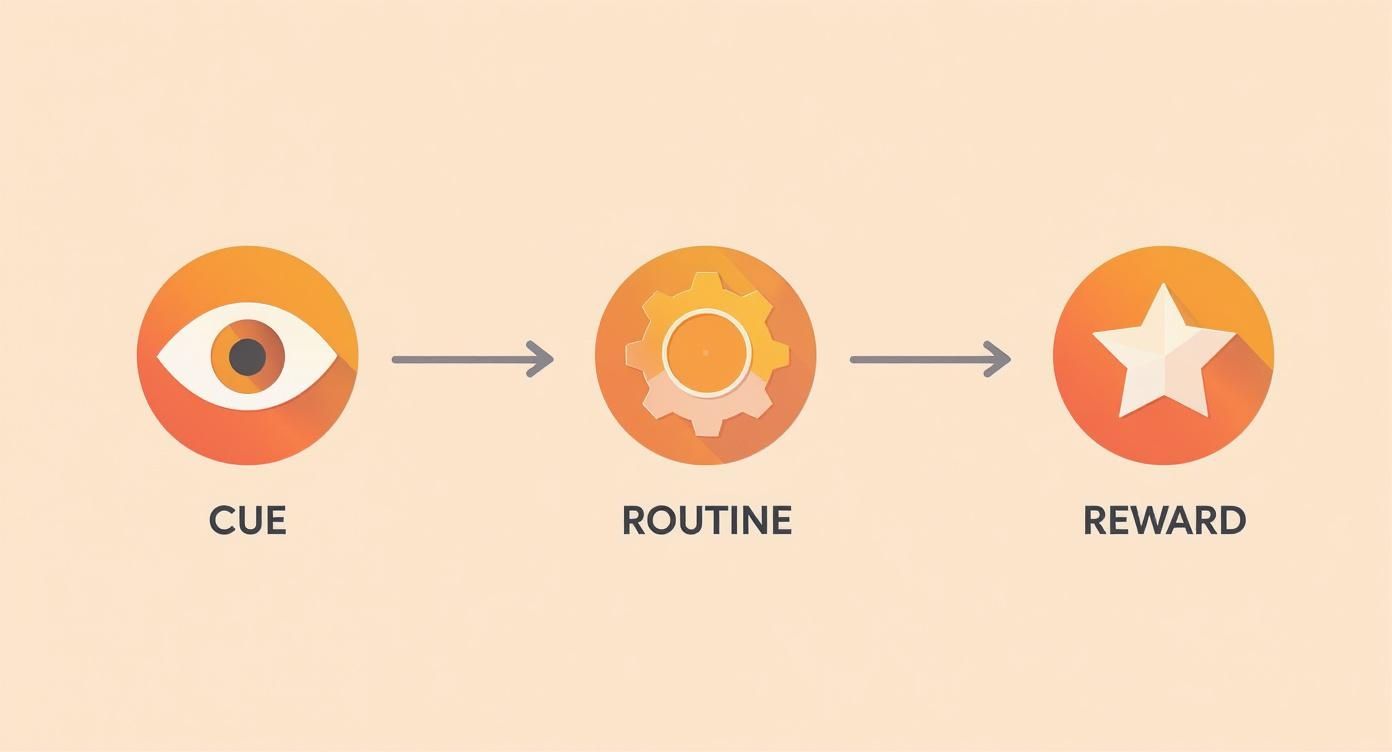
A habit tracker like Tracka gives you that crucial visual feedback—the reward—that closes the loop and makes the new behavior stick. It's not just about ticking boxes; it's about building a reliable system for yourself. If you want to dive deeper, our guide on how to break bad habits by building better ones is a great place to start.
From Willpower to Your Way of Life
https://www.youtube.com/embed/eu1K9-xE42Q
If you take only one thing away from this guide, let it be this: building better habits isn't about finding some hidden well of superhuman willpower. Lasting change comes from building smarter, more compassionate systems for yourself.
It’s time to stop the self-blame cycle over so-called willpower “failures.” These moments aren't a referendum on your character. They are simply the predictable outcome of depending on a resource that was never meant to last forever.
The real secret lies in designing a life where the habits you want are the easiest path to take, not a daily battle you have to win.
Become the Architect of Your Environment
Stop thinking of yourself as a soldier fighting against temptation. Instead, picture yourself as an architect. Your job is to design an environment where good choices are effortless and bad ones are a pain in the neck.
This simple shift from brute force to smart design is everything.
This approach accepts the reality that you won't always feel motivated. Your systems are what kick in on the days when energy is low and resolve is shaky. They provide the scaffolding for consistency, and consistency is the bedrock of any meaningful improvement in life—from more energy and better health to increased focus and productivity.
Your goals are achievable—not through sheer force of will, but through the quiet power of intelligent habit formation and consistent action.
This is exactly where a tool like Tracka becomes your blueprint. It helps you design, build, and refine those personal systems, giving you the AI-powered insights and real-time feedback needed to stay on track.
When you track your progress, you're doing more than just ticking a box. You're reinforcing the very structure that makes your goals feel less like a struggle and more like an inevitability.
So, embrace this new perspective. Start building the systems that unlock better focus, improved health, and a genuine sense of well-being. The life you want isn't waiting for more willpower—it's waiting for a better system.
A Few Common Questions About Willpower
Even when you're armed with the best strategies, it's natural to have lingering questions about how willpower really works. Let's tackle some of the most common ones that pop up when you're trying to make a change.
How Long Does It Actually Take to Form a New Habit?
You’ve probably heard the old "21 days" rule. Well, it's a myth. The real answer, backed by research, is a lot messier and more personal. The average time it takes for a new behavior to feel automatic is about 66 days.
But that's just an average. The actual range is huge, stretching anywhere from 18 to 254 days. It all depends on the person and the habit itself. So, forget the magic number. The goal is just to show up consistently. Don't sweat it if it takes longer than you think it should—that’s just part of the process.
Can You Permanently "Level Up" Your Willpower?
Yes… and no. You can't just flip a switch and get an infinite supply of willpower. It's a finite resource, and it gets drained throughout the day. But what you can do is strengthen your overall capacity for self-control, kind of like building muscle at the gym.
You get there by:
- Practicing small acts of self-control: Start with tiny, manageable challenges and build from there.
- Focusing on recovery: Good sleep, healthy food, and stress management are non-negotiable. They're what refuel your tank.
- Building better systems: The ultimate trick to having more willpower is to design your life so you need to use it less often.
What Should I Do if I Miss a Day?
First, don't panic. A single missed day doesn't wipe out all your hard work. The most important thing you can do is get right back to it the very next day. Avoid the "all-or-nothing" trap, where one little slip-up makes you feel like you've failed and might as well give up entirely.
The goal is consistency, not perfection. Think of a missed day as a piece of data. Why did it happen? Were you stressed? Did you forget? Use that insight to tweak your approach and make your system stronger for next time.
Is It Better to Focus on One Habit at a Time?
For most of us, absolutely. Trying to change everything all at once is a surefire way to get overwhelmed and burn out. Every new habit you’re trying to build is a drain on your mental energy as you work to lock in that new cue-routine-reward cycle.
When you pour all your focus into one keystone habit, you give it the attention it needs to stick. Once it becomes second nature and doesn't require much thought, you can then build on that success by "stacking" a new habit on top. It’s a much more sustainable path to making real, lasting change.
Ready to stop relying on willpower and start building a system that actually works? Tracka gives you the tools to build consistency, gain powerful insights into your patterns, and make progress that lasts. Start tracking your habits with intention today.
Article created using Outrank


