

Juggling lectures, assignments, and a social life can feel like an impossible balancing act. The common advice to "just manage your time better" often fails because it ignores the real challenges: cognitive overload, decision fatigue, and the struggle for consistency. For many students, a simple to-do list quickly becomes a source of anxiety rather than a tool for productivity. It's a widespread problem; research shows that up to 80% of people abandon their resolutions, not from a lack of ambition, but from a lack of a sustainable system. Most of us struggle with consistency, and distractions drain our focus and wellbeing.
This isn't about working harder; it's about building a smarter, more intentional framework for your time. This guide moves beyond generic advice to provide ten evidence-based time management tips for students. We will explore actionable strategies designed to build focus, create lasting routines, and help you regain control of your schedule. Each tip is broken down into a practical system you can implement today. You'll learn how to prioritize effectively, schedule with intention, and build momentum. We’ll also show how a tool like Tracka makes habit change achievable by combining habit tracking with AI-powered insights, helping you log your progress, maintain consistency, and turn these powerful strategies into lifelong habits.
1. Pomodoro Technique
The Pomodoro Technique is one of the most effective time management tips for students because it turns intimidating study marathons into a series of manageable sprints. Developed by Francesco Cirillo, this method involves breaking your work into focused, timed intervals, traditionally 25 minutes long, separated by short breaks. This cycle creates a rhythm that combats mental fatigue and makes it easier to start tasks you might otherwise procrastinate on, directly improving your focus and energy.

This structure is particularly beneficial for students dealing with dense material. A medical student could use one "Pomodoro" to memorize anatomical terms, take a five-minute break, then start another to review cellular processes. The built-in breaks prevent burnout, while the focused sessions maximize knowledge retention.
How to Implement the Pomodoro Technique:
- Set a Timer: Use a physical timer or a digital app to set a 25-minute work interval. The key is committing to a single task during this time.
- Eliminate Distractions: Turn off phone notifications and close irrelevant browser tabs. If a distracting thought arises, jot it down on a notepad to address after your session.
- Take Structured Breaks: After each Pomodoro, take a genuine 5-minute break. After four consecutive sessions, take a longer break of 15-30 minutes.
- Track Your Progress: Logging your completed Pomodoros in an app like Tracka provides a powerful visual of your productivity. Unlike generic apps, Tracka offers personalized insights, showing you trends in your focus patterns and helping you build a consistent routine that sticks.
2. Time Blocking
Time blocking is one of the most powerful time management tips for students because it assigns a specific job to every minute of your day. Popularized by authors like Cal Newport, this method involves dividing your day into distinct blocks of time, with each block dedicated to a single task or activity. This proactive approach eliminates decision fatigue about what to work on next, ensuring that all priorities receive dedicated attention, leading to better life outcomes like reduced stress and higher productivity.
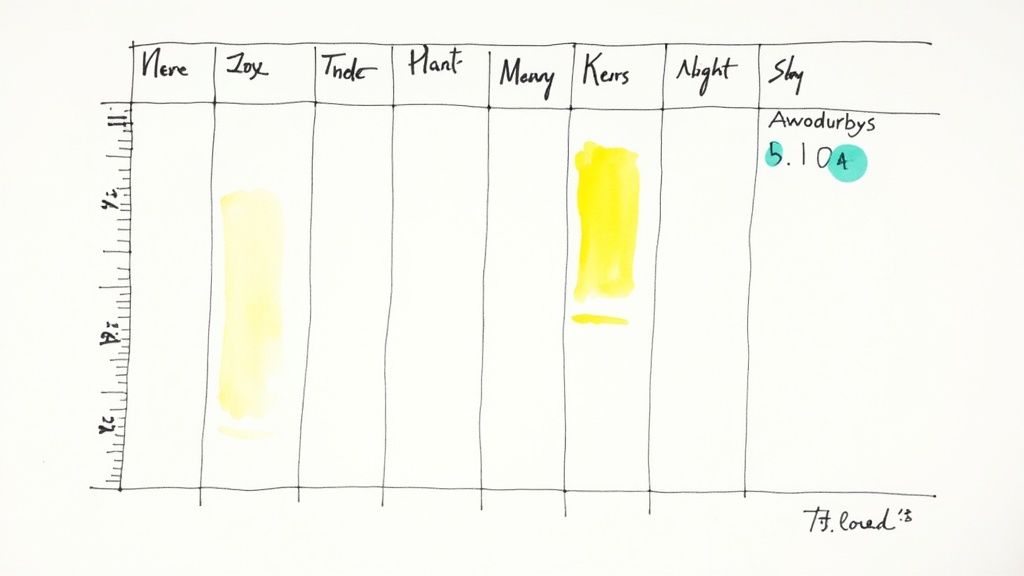
This structure provides clarity and control over a demanding academic schedule. An engineering student, for instance, might block two hours for complex problem sets, followed by a one-hour block for lecture review. By creating a visual plan, you can realistically allocate time for studying, classes, and personal life, reducing overwhelm and preventing last-minute cramming.
How to Implement Time Blocking:
- Schedule with Intention: Use a digital calendar like Google Calendar or a planner to map out your day in advance. Assign specific blocks for classes, studying, meals, and breaks.
- Prioritize Peak Energy: Schedule your most demanding tasks, like studying for organic chemistry, during your peak cognitive hours. Use lower-energy periods for easier tasks like organizing notes or responding to emails.
- Include Buffer Time: Don't schedule every minute back-to-back. Add 10-15 minute buffers between blocks to allow for transitions, unexpected interruptions, or a quick mental reset.
- Review and Adapt: Your schedule is a living document. Using an app like Tracka to log your completed blocks helps you see what's working. If you consistently underestimate the time needed for a task, you can review your log and adjust your blocks for the following week, refining your schedule for maximum efficiency.
3. The Eisenhower Matrix (Urgent/Important)
The Eisenhower Matrix is one of the most powerful time management tips for students because it forces you to distinguish between what feels urgent and what is truly important. This simple framework, popularized by Stephen Covey, helps you categorize tasks into four quadrants: Urgent & Important, Important & Not Urgent, Urgent & Not Important, and Not Urgent & Not Important. By sorting your to-do list this way, you can stop reacting to every small demand and start proactively investing time in activities that support your long-term goals.
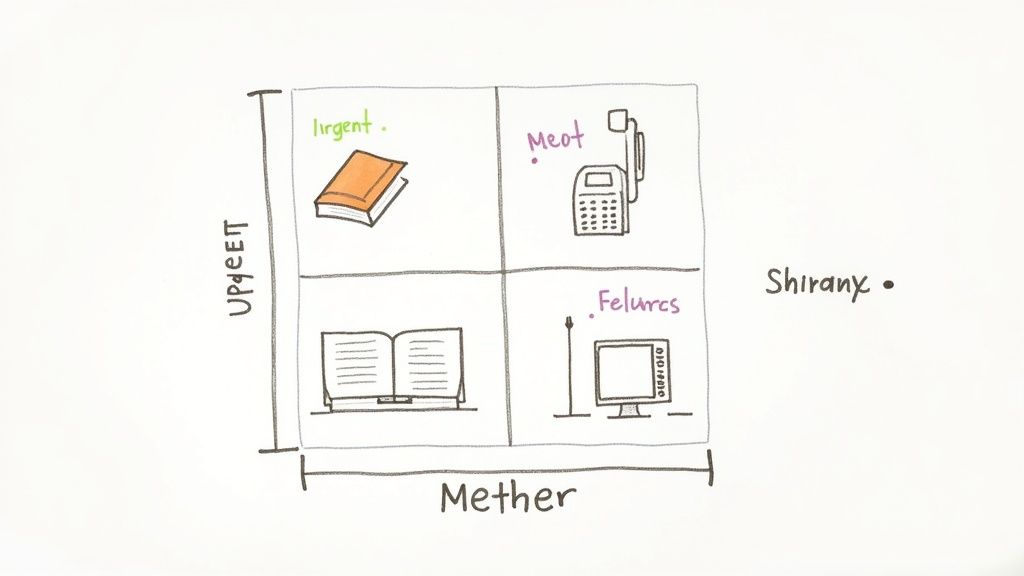
This method is crucial for students who feel perpetually busy but unproductive. For example, answering a group chat message (Urgent & Not Important) might feel pressing, but it distracts from studying for a major exam (Urgent & Important). The real magic happens in Quadrant 2 (Important & Not Urgent), which includes activities like planning your semester, researching for a term paper ahead of time, or networking. Focusing on these tasks prevents future crises and leads to greater academic success and less stress.
How to Implement the Eisenhower Matrix:
- Categorize Your Tasks: At the start of each week, list all your tasks and assign each one to one of the four quadrants. This visual map clarifies your priorities instantly.
- Focus on Quadrant 2: Block out dedicated time in your calendar for Quadrant 2 activities first. This ensures that proactive, high-value work doesn't get pushed aside by daily emergencies.
- Minimize Quadrants 3 & 4: Learn to delegate or say no to Urgent & Not Important tasks. Eliminate time-wasting activities from Quadrant 4, like aimless scrolling, to reclaim valuable focus.
- Review and Reflect: Use an app like Tracka to log where you spend your time. By tagging tasks by quadrant, its AI-powered insights can reveal if your actions align with your priorities, helping you shift more effort toward Quadrant 2 and build a more effective, proactive study routine.
4. The 2-Minute Rule
The 2-Minute Rule is a powerful time management tip for students designed to combat procrastination and reduce mental clutter. Popularized by David Allen and James Clear, the principle is simple: if a task takes less than two minutes to complete, do it immediately instead of deferring it. This prevents small, easy tasks from piling up and becoming an overwhelming source of stress on your to-do list.
This method builds momentum through quick, decisive actions. For a student, this could mean immediately replying to a professor's brief email, tidying up your desk after a study session, or fixing a formatting error in your essay the moment you spot it. Each completed task is a small win that reduces friction for starting larger, more demanding assignments. This simple habit directly impacts your sense of control and reduces background stress.
How to Implement the 2-Minute Rule:
- Identify Quick Tasks: As you go about your day, learn to spot tasks that fit the two-minute window. This could be anything from putting a textbook back on the shelf to confirming a study group meeting time.
- Act Immediately: The core of this rule is to bypass the planning stage for these micro-tasks. Instead of adding "organize lecture notes" to your planner, take 90 seconds to file them right after class.
- Pair with Other Techniques: Use the 2-Minute Rule during your breaks in a Pomodoro session. This allows you to clear away small administrative tasks without interrupting your deep focus blocks.
- Protect Your Focus: Apply this rule strategically. If you are in a deep work session, don't let a two-minute task interrupt you. Save it for a transition period to avoid derailing your concentration. This helps you manage your energy and preserve your willpower for the tasks that need it most. To learn more about this, you can read about what is willpower.
5. The 'Eat the Frog' Technique
The 'Eat the Frog' technique is a powerful time management strategy for students that flips procrastination on its head. Based on a quote by Mark Twain and popularized by author Brian Tracy, the idea is simple: tackle your most challenging, dreaded, or important task first thing in the morning. By completing your biggest "frog" when your energy and willpower are at their peak, you build immediate momentum and a sense of accomplishment that carries you through the rest of your day.
This approach is highly effective for students who find themselves putting off major assignments. A computer science student could use this method to debug a complex piece of code before moving on to easier reading assignments. It prevents your hardest task from casting a shadow over your entire day, leading to reduced stress and better performance.
How to Implement the 'Eat the Frog' Technique:
- Identify Your Frog: The night before, clearly define the one task that is most critical or that you are most likely to avoid. Write it down so it’s the first thing you see.
- Schedule It Early: Plan to work on your frog immediately after your morning routine, before checking emails or social media. This protects your peak focus time from distractions.
- Break It Down: If your frog feels too big, break it into smaller, more manageable steps. Your goal might not be to finish the entire task but to make significant progress.
- Track Your Wins: Completing your most difficult task is a significant achievement. Logging this daily win in a tracker like Tracka reinforces the habit and provides a visual record of your discipline. Its community features can even provide the social accountability needed to tackle those tough "frogs" consistently. You can learn more about overcoming procrastination here.
6. The Getting Things Done (GTD) System
The Getting Things Done (GTD) system, created by David Allen, is one of the most comprehensive time management tips for students because it moves ideas from your mind into an external, trusted system. This method frees up valuable mental energy that would otherwise be spent remembering tasks, allowing you to focus completely on execution. Instead of feeling overwhelmed, you gain clarity and control over all your commitments.
This system is perfect for a student juggling multiple complex responsibilities. For example, a graduate student can use GTD to capture thoughts on their thesis, manage teaching duties, track research deadlines, and organize coursework. By processing everything into clear projects and "next actions," they can confidently tackle what's most important at any given moment without worrying that something will be forgotten, boosting focus and productivity.
How to Implement the GTD System:
- Capture Everything: Use a notebook, app, or inbox to write down every task, idea, or to-do that crosses your mind. Don't filter; just get it all out.
- Clarify and Organize: Process your inbox regularly. For each item, decide if it's actionable. If so, define the very next physical action required and categorize it by project or context (e.g., @library, @computer).
- Conduct a Weekly Review: Set aside time each week to review all your projects, lists, and upcoming deadlines. This keeps your system current and ensures you stay aligned with your priorities.
- Track Your Engagement: Integrating GTD with a tool like Tracka helps you build the core habit of the weekly review. By logging each review, you create a streak that reinforces consistency, transforming a powerful methodology into a reliable personal system.
7. Goal Setting and Breaking Down into Milestones
Effective time management for students isn't just about scheduling tasks; it's about connecting daily actions to long-term ambitions. Goal setting gives your efforts a clear purpose, transforming vague aspirations like "get good grades" into a concrete roadmap for success. By breaking a large goal into smaller, sequential milestones, you make the process less overwhelming and build momentum with each step you complete.
This method provides a powerful sense of direction and makes progress tangible. For instance, a student aiming to write a thesis can break it down into milestones: literature review (month 1), data collection (months 2-3), analysis (month 4), and writing (month 5). Each completed milestone is a victory that fuels motivation for the next, preventing the burnout that often comes with massive, long-term projects. This structured approach helps you see exactly how your work today contributes to your final achievement.
How to Implement Goal Setting and Milestones:
- Define SMART Goals: Ensure your main objective is Specific, Measurable, Achievable, Relevant, and Time-bound. Instead of "do well in Biology," aim for "achieve an A- in Biology by scoring 90% or higher on all exams and assignments."
- Work Backwards: Start from your final deadline and set milestone deadlines along the way. If a research paper is due in eight weeks, set checkpoints for the outline, first draft, and final edits at the two, five, and seven-week marks.
- Use Visual Tools: For complex projects, a simple Gantt chart or a visual timeline can help you see how all the pieces fit together. This is especially useful for managing group projects or a capstone course.
- Track Your Milestones: Logging your progress is crucial for staying motivated. Using a digital journal to document your achievements provides a clear record of how far you've come. For more ideas on how to structure this, explore these bullet journal tracker ideas.
8. The 80/20 Rule (Pareto Principle)
The 80/20 Rule, or Pareto Principle, is one of the most powerful time management tips for students because it forces you to prioritize ruthlessly. It states that roughly 80% of your results come from just 20% of your efforts. Applying this to your studies means identifying and focusing on the high-impact activities that deliver the greatest academic returns, rather than treating every task as equally important.
This principle helps you study smarter, not just harder. For instance, a history student might realize that 80% of their exam questions are pulled from key lecture themes (the 20%), so they dedicate their prime study hours to mastering those concepts instead of getting lost in minor textbook details. It’s about strategically allocating your finite energy to the tasks that truly move the needle on your grades.
How to Implement the 80/20 Rule:
- Identify Your High-Impact 20%: Analyze past exams or ask your professor which topics are most critical. For an essay, the high-impact work is often the thesis and supporting arguments, not minor formatting tweaks.
- Allocate Time Proportionally: If you know certain topics are more likely to appear on a test, dedicate a larger portion of your study blocks to them. Don’t just study what’s easiest; study what’s most important.
- Question Every Task: Before starting an assignment, ask yourself: "Is this part of the vital 20% that drives my grade, or is it in the less important 80%?" Focus your primary energy on the former.
- Track Your Efforts: Use a tool like Tracka to log where your study time goes for a week. The app's AI-powered insights can reveal patterns, helping you see if you're spending too much time on low-impact activities and guiding you to shift your focus to what really counts.
9. Batching Similar Tasks
Task batching is a powerful time management tip for students that combats the high cost of context-switching. Instead of scattering similar activities throughout your day, you group them into a single, dedicated session. This reduces the mental setup and takedown time for each individual task, allowing you to build momentum and operate with greater efficiency.
This method minimizes decision fatigue and helps you enter a state of flow. For instance, a student could batch all their research for a history paper into one three-hour block on a Saturday morning, rather than doing 30 minutes of research every other day. This consolidated effort improves focus and often leads to higher-quality work and more energy for other parts of your life.
How to Implement Task Batching:
- Identify Your Batches: Group tasks by the type of mental energy they require. Common student batches include "research and reading," "problem sets," "writing and editing," or "administrative tasks" like emailing professors and submitting assignments online.
- Schedule Dedicated Blocks: Assign these batches to specific times in your calendar. You might dedicate Tuesday afternoons to all your math homework or spend the first hour of your study session clearing out all communication-related tasks.
- Prepare Your Resources: Before starting a batch, gather everything you need. For a "writing" batch, this means opening your documents, research notes, and citation manager so you can dive straight into the work.
- Track Your Batches for Consistency: Using a habit tracker like Tracka to log your completed batches helps solidify this routine. Marking your "Admin Hour" or "Reading Block" as complete reinforces the habit and provides data on which batching strategies work best for your schedule.
10. The 'No' Strategy and Boundary Setting
Effective time management isn't just about scheduling what you do; it's also about protecting your time by deciding what you don't do. The 'No' Strategy involves setting clear boundaries and declining non-essential commitments that distract from your primary goals. For students, this means preventing overcommitment and ensuring your most valuable resource, time, is reserved for what truly matters.
This strategy, championed by authors like Greg McKeown in Essentialism, is a powerful defense against burnout. A computer science student might politely decline joining a third extracurricular club to protect their weekends for a capstone project. This isn't about being antisocial; it's about making conscious choices that align with your long-term success and wellbeing. Saying 'no' to good opportunities allows you to say 'yes' to the great ones.
How to Implement the 'No' Strategy:
- Define Your Priorities: Know your non-negotiables for the semester, whether it's achieving a certain GPA, finishing a thesis, or maintaining your well-being. This clarity makes it easier to evaluate new requests.
- Practice Polite Refusals: You don't need elaborate excuses. Simple phrases work best: "Thank you for thinking of me, but I can't take that on right now," or "I appreciate the offer, but my schedule is full."
- Set Communication Boundaries: Designate specific times to check emails and messages. Let friends and family know your core study hours to manage their expectations for your availability.
- Track Your Commitments: Regularly review your obligations in an app like Tracka. Logging how you spend your time can reveal which activities align with your goals and which are draining your focus, helping you make informed decisions about what to cut back on.
Comparison of 10 Student Time-Management Strategies
| Technique | 🔄 Implementation Complexity | ⚡ Resource Requirements | ⭐ Expected Outcomes (📊) | 💡 Ideal Use Cases | Key Advantages |
|---|---|---|---|---|---|
| Pomodoro Technique | Low — simple timer-based routine | Minimal — timer or app | Improves short-term focus; reduces fatigue 📊 ⭐⭐⭐⭐ | Short study sprints, attention challenges, exam review | Structured breaks; easy to adopt; momentum builder |
| Time Blocking | Medium — requires planning and estimation | Medium — calendar or planner, time audit | Balanced attention across priorities; fewer switches 📊 ⭐⭐⭐⭐ | Days with many commitments; weekly planning | Visual schedule; reduces decision fatigue |
| Eisenhower Matrix | Low — simple categorization process | Minimal — paper or notes | Clear prioritization; less time on low-value tasks 📊 ⭐⭐⭐ | Task triage, weekly reviews, crisis avoidance | Distinguishes urgent vs important; strategic focus |
| 2-Minute Rule | Low — single quick decision rule | Minimal — timer optional | Clears small tasks quickly; reduces list clutter 📊 ⭐⭐⭐ | Short emails, quick fixes, during breaks | Fast wins; reduces mental clutter when used selectively |
| Eat the Frog Technique | Low–Medium — needs discipline to commit | Minimal — planning the top task | Tackles hardest tasks early; boosts momentum 📊 ⭐⭐⭐⭐ | High-difficulty assignments, morning routines | Uses peak energy; reduces procrastination on major tasks |
| Getting Things Done (GTD) | High — multi-step system and reviews | Significant — tools, setup time, weekly reviews | Comprehensive task control; reduced mental overhead 📊 ⭐⭐⭐⭐ | Complex schedules, multi-project students, grad-level work | Scalable system; externalizes tasks; improves execution |
| Goal Setting → Milestones | Medium — upfront planning and breakdown | Medium — tracking tools, time for reviews | Visible progress; better long-term goal attainment 📊 ⭐⭐⭐⭐ | Theses, capstone projects, semester planning | Converts goals to actions; motivates with milestones |
| 80/20 Rule (Pareto) | Medium — analysis to identify high-impact tasks | Low–Medium — time tracking, outcome review | Higher results from focused effort; less wasted time 📊 ⭐⭐⭐⭐ | Exam prep, prioritizing course topics, project planning | Maximizes impact; encourages honest prioritization |
| Batching Similar Tasks | Medium — grouping and scheduling batches | Minimal — planning and consistent blocks | Reduced context-switching; improved flow and quality 📊 ⭐⭐⭐ | Repetitive work, readings, email/admin sessions | Efficient setup; deep-focus for similar task types |
| "No" Strategy & Boundary Setting | Medium — habit and communication skills | Minimal — clarity of priorities, routines | Protected time; less overcommitment and burnout 📊 ⭐⭐⭐⭐ | Exam periods, heavy-project semesters, focus windows | Preserves priorities; reduces distractions and guilt |
From Tips to Habits: Making Time Management Stick
You've just explored ten powerful techniques, from the focused sprints of the Pomodoro Technique to the strategic clarity of the Eisenhower Matrix. Each one offers a unique solution to the universal student challenge: a calendar full of deadlines and only 24 hours in a day. However, the real game-changer isn't just knowing these strategies; it's embedding them into your daily life until they become second nature. This is where the most effective time management tips for students transition from theory into a sustainable, life-altering practice.
The journey from a scattered, reactive approach to a proactive, organized one is not about a massive, overnight overhaul. It's about a gradual, intentional process of building systems that support your goals. The secret is to stop relying on inconsistent bursts of motivation and start building reliable habits. Think of each tip in this guide not as a rule, but as a building block for your own personalized productivity system. Better habits lead to better life outcomes, including more energy, sharper focus, and improved health.
Your Action Plan for Lasting Change
The key is to start small and build momentum. Overhauling your entire schedule at once is a recipe for burnout. Instead, follow a simple, iterative process:
- Choose Just One Technique: Don't try to implement everything at once. Pick the one strategy that resonated most with you. Was it the immediate action of the 2-Minute Rule? Or the clear prioritization of 'Eating the Frog'? Commit to trying only that one technique for the next seven days.
- Track Your Effort, Not Just Results: The goal for the first week isn't perfection; it's consistency. This is where a dedicated tool is invaluable. Using an app like Tracka allows you to log each successful Pomodoro session or each day you use Time Blocking. Seeing that streak grow provides a powerful visual reward that reinforces the new behavior.
- Reflect and Iterate: At the end of the week, review your progress. Did the technique work for you? Did you discover your peak focus hours? Did you notice specific distractions? This is the data you need to refine your approach. Tracka's AI-powered insights can help identify trends and suggest adjustments, transforming a temporary fix into a permanent skill.
Beyond the Classroom: Building a Foundation for Life
Mastering these time management tips for students does more than just help you pass exams and submit assignments on time. It equips you with a foundational skill for life. You're learning how to reclaim your focus in a world full of distractions, how to set meaningful boundaries, and how to align your daily actions with your long-term ambitions. By turning these strategies into habits, you're not just managing your time; you are investing in your future self, building the discipline and clarity needed to thrive in any career or personal endeavor you pursue.
Ready to turn these tips into lifelong habits? Stop relying on willpower and start building a system that works. Download Tracka.AI | Habit Tracker App to log your new routines, get personalized insights, and build the consistency you need to conquer your academic and personal goals. Tracka.AI | Habit Tracker App


