

Let’s be honest. For entrepreneurs, "time management" isn't about fancy productivity hacks or color-coding your calendar. It’s a survival system. It’s about building a framework that protects your energy and focus from the constant, swirling demands of running a business so you can actually get high-impact work done.
Why Traditional Time Management Fails Founders
If you've ever ended a 12-hour day feeling like a professional firefighter—putting out one blaze after another while your real goals gathered dust—you're not alone. Most time management advice was cooked up for structured corporate roles, not the beautiful chaos of building something from scratch. The struggle is real; research shows a staggering 80% of people abandon their resolutions, often because they lack a system for consistency.
Founders don't just manage tasks; they juggle entire identities. You're the strategist, the marketer, the bookkeeper, and the customer service rep, often in the same afternoon. This relentless context-switching makes standard advice like "just prioritize your to-do list" feel laughably inadequate. The problem isn't your work ethic. The problem is you're trying to use a map of Manhattan to navigate the Amazon rainforest.
The Reality of an Entrepreneur's Schedule
The data paints a pretty stark picture of the pressure cooker founders live in. While some manage to keep it lean, 19% are putting in 50 hours or more per week. Worse, a huge chunk of that time—about 36%—gets eaten up by administrative busywork, not the core activities that actually move the needle.
This relentless pace takes a serious toll. A staggering 87.7% of small business owners report facing mental health challenges, with 34.4% experiencing burnout tied directly to long hours and the inability to switch off. These aren't just numbers; they're a clear signal that the entrepreneurial journey is as much a mental marathon as it is a business one. You can see more on how entrepreneurs are spending their time in Clockify's recent statistics.
We see this imbalance all the time. Founders are so deep in the day-to-day grind that the strategic, high-leverage work gets pushed to "later." But "later" rarely comes.
Here’s a quick breakdown of where all those hours tend to disappear.
The Entrepreneurial Time Trap: Where Hours Really Go
This table shows the common split between the urgent tasks that consume a founder's day and the important work that actually drives growth. The gap between them is where burnout lives and potential dies.
| Activity Type | Average Time Spent | Ideal Time Allocation | Impact of Imbalance |
|---|---|---|---|
| Reactive Work | 60-70% | 20-30% | Constant firefighting, low strategic progress, high stress. |
| Administrative Tasks | 25-35% | 10-15% | Drains creative energy, little direct impact on growth. |
| Strategic Growth | 5-10% | 40-50% | Stagnation, missed opportunities, feeling stuck in the business. |
| Rest & Disconnection | <5% | 15-20% | Leads directly to burnout, poor decision-making, and health issues. |
The takeaway is clear: you cannot outwork a broken system. Simply cramming more into your day is a fast track to burnout, not a path to sustainable success. The only way out is to build a new operating system for yourself—one based on powerful, consistent habits that deliver real-life impact like more energy and reduced stress.
As a founder, your time is your most valuable and finite asset. Guarding it isn't about being rigid; it's about being strategic. Every 'yes' to a low-impact task is an implicit 'no' to an activity that could actually grow your business.
This is where building the right habits becomes a complete game-changer. Instead of relying on motivation, which comes and goes, you create automatic behaviors that pull you toward your goals.
A tool like Tracka isn't just another app to manage; it's a framework for installing the discipline you need. Unlike generic habit apps, Tracka combines habit tracking, AI-powered insights, and social accountability to help you stick to new routines. By focusing on just a few key habits—like dedicating your first hour to deep work or shutting down at a set time every day—you build the consistency that turns reactive chaos into proactive control.
Find Your Time Drains with a Personal Audit
You can't manage time you can't measure. So, before you can build a better system, you need a brutally honest picture of where your hours are actually going. This isn’t about feeling guilty; it’s about gathering data. A good time audit reveals the small, seemingly harmless habits that quietly sabotage your productivity.
Lots of entrepreneurs skip this part, thinking they already know their weaknesses. But let’s be honest—our perception of time is usually way off. That "quick email check" can easily spiral into a 45-minute distraction, and those "five-minute" social media breaks add up faster than you’d believe.
I worked with one founder who was convinced his biggest time suck was meetings. After a one-week audit, he discovered that reactive email management was costing him nearly 15 hours a week. That’s almost two full workdays lost to his inbox. Without that baseline data, any new time management strategy is just a shot in the dark.
How to Conduct a Lightweight Time Audit
The goal here isn't to create more work for yourself. A simple, one-week audit is more than enough to uncover some powerful insights. You can use a basic notebook, a spreadsheet, or a dedicated app. The tool doesn't matter nearly as much as consistency.
For seven days, just log your activities in 30-minute intervals. Be specific but brief. Instead of "work," write "drafting investor pitch deck" or "answering customer support tickets."
- Note the Task: What were you actively doing?
- Track Interruptions: Did an unscheduled call or a Slack notification pull you away?
- Record Your Energy Level: When did you feel most focused? When did you hit a wall?
This process illuminates the gap between your intentions and your reality. This infographic shows the vicious cycle that begins when time is mismanaged, leading from that initial feeling of overload to full-blown burnout.
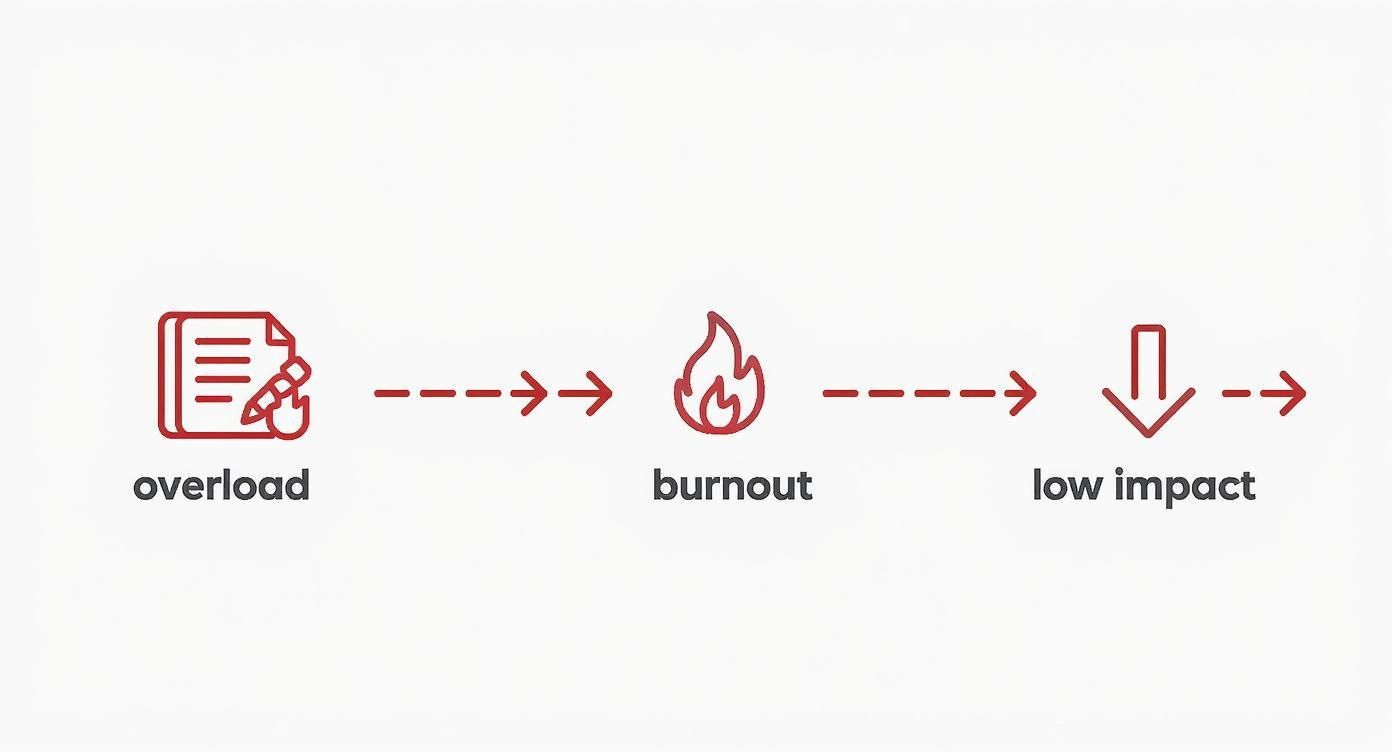
As you can see, unchecked task overload directly contributes to burnout, which in turn results in low-impact work. It's a frustrating loop for any founder.
From Data to Diagnosis
After a week, it’s time to review your logs. Look for patterns and ask yourself some tough questions:
- Where are my biggest time drains? Pinpoint the top 2-3 activities that ate up the most time with the lowest return. This could be excessive meetings, context switching between tiny tasks, or administrative busywork.
- When am I most productive? Identify your peak focus hours. This is gold. You'll use this information later to schedule your most important deep work.
- What are my most common distractions? Are notifications derailing your flow? Are you getting pulled into unscheduled conversations?
Your audit isn't a judgment—it's a diagnostic tool. The data you gather is the foundation for building a system that works with your natural rhythms, not against them.
This is where an app like Tracka can be a game-changer. While a manual audit is fine, Tracka helps automate the process by letting you log specific work habits. For example, creating a habit for "Deep Work" or "Email Batching" gives you clear, objective data on how consistently you're protecting your focus.
You can learn more about which life-changing habits to track in your daily routine to start building a more intentional schedule. It transforms the abstract goal of "better time management" into a concrete, measurable practice. With its AI-powered insights, Tracka doesn't just show you what you did; it provides personalized insights into the trends behind your most productive days.
Prioritize Tasks That Actually Grow Your Business
Once you have a clear picture of where your time is going, the next move is the most important one you can make as a founder: shifting from working in your business to working on it.
Working in the business is all the daily grind stuff—answering emails, handling customer service fires, running payroll. It's the operational hamster wheel. Working on the business is steering the ship—mapping out a new product, building a sales funnel, or forging a strategic partnership. It’s the work that actually creates growth.
Most entrepreneurs get stuck on the hamster wheel. They spend all day putting out fires and clearing their inbox, feeling incredibly busy but getting nowhere. The real skill is learning to separate the urgent noise from the truly important signals.
This isn't just a feeling; it's a well-documented problem. One recent report found that founders spend a staggering 68.1% of their time bogged down in daily operations, leaving just 31.9% for strategic work. And with 63% of founders clocking in over 50 hours a week, it's no wonder growth stalls. The most valuable activities get the scraps of our time, often because nearly 40% of entrepreneurs admit they don't have a solid operating plan. You can dig into all the numbers in the 2025 survey on business owners' time management.
Using the Eisenhower Matrix for Founder Focus
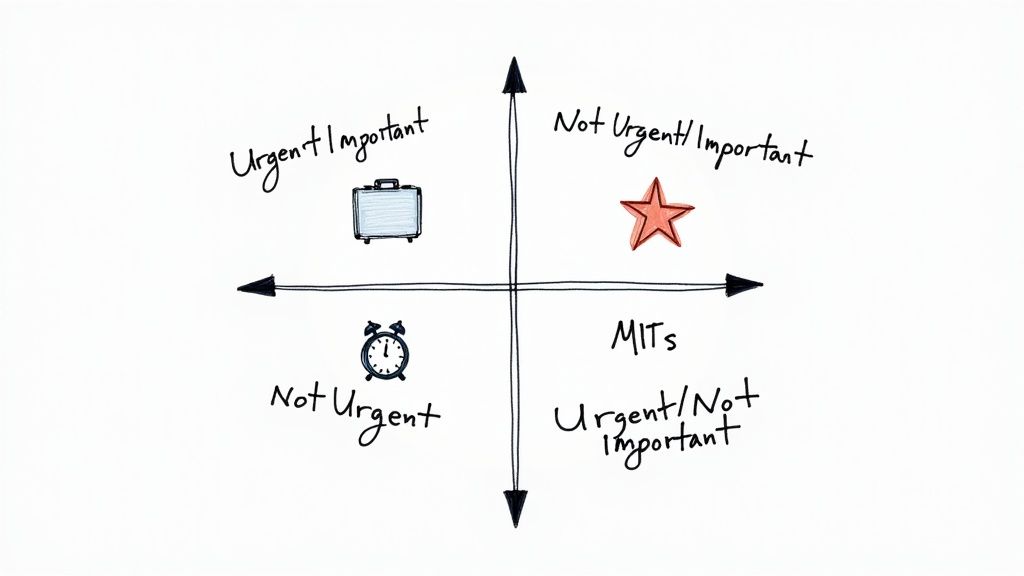
A brutally effective tool for this is the Eisenhower Matrix. It’s a simple framework that forces you to sort tasks into four boxes based on their urgency and importance. Instead of reacting to whatever dings next, you start making conscious choices about where your energy goes.
Here’s how it looks through the eyes of a founder:
- Urgent & Important (Do First): This is crisis mode. A critical server crash, a make-or-break client deadline, a massive PR issue. You have to drop everything and handle these now.
- Not Urgent & Important (Schedule): This quadrant is where your business grows. Think: developing a new marketing strategy, networking with potential investors, or refining your core product. These are the things that need to be proactively scheduled or they will never happen.
- Urgent & Not Important (Delegate): These are the tasks that feel pressing but don't move the needle on your biggest goals. Think: scheduling meetings, answering routine customer inquiries, posting standard updates to social media. These are prime candidates to delegate or automate.
- Not Urgent & Not Important (Eliminate): This box is for the time-wasters. Mindlessly doomscrolling social media, checking emails every five minutes out of habit, or sitting in meetings that have no clear agenda. Cut these out without mercy.
The goal isn't to get rid of all urgent tasks—that's just part of running a business. The real magic happens when you shrink the 'Urgent & Not Important' box and aggressively expand the 'Not Urgent & Important' one. This single shift will change everything.
Define Your Most Important Tasks Daily
Once you can tell the difference between what feels urgent and what's actually important, it’s time to get ruthlessly intentional with your daily schedule. This is where the concept of Most Important Tasks (MITs) comes in.
An MIT isn't just another thing on your to-do list. It's a high-impact task that, if you get it done, makes the entire day a win, no matter what else happens.
Every morning—or the night before—pinpoint just 1-3 MITs for the day. These should almost always be pulled straight from your "Not Urgent & Important" quadrant.
What Founder MITs Look Like in the Wild:
- Draft the outline for our new sales webinar.
- Reach out to five potential strategic partners.
- Finalize the Q4 financial projections and budget.
By committing to knock out your MITs first thing, before the chaos of the day derails you, you guarantee you’re always chipping away at the things that truly matter. This is what strategic focus feels like.
This is also where a simple tool can make a huge difference. A notebook works, but an app like Tracka helps you turn this idea into a non-negotiable discipline. You can create a daily trackable habit called "Complete Daily MIT," which gives you a tangible record of your commitment to high-impact work.
Over time, Tracka’s AI-powered insights can start connecting the dots. You might discover you’re far more likely to nail your MITs on days you also stick to your morning workout. Suddenly, prioritization stops being a daily chore and becomes a data-driven system for building unstoppable momentum.
Design a Daily System for Peak Performance
Knowing your high-impact work is a huge win, but even the best intentions fall apart without a daily system to make it happen. So many founders thrive on spontaneous creativity but get tripped up by the sustained focus needed to see big projects through. This is where you build your personal operating system—a flexible structure that protects your energy and kills decision fatigue.
The goal here isn't to lock yourself into a rigid, military-style schedule. Far from it. It's about building a reliable framework that automates the mundane stuff. That way, you can save your precious mental bandwidth for the complex problems that only you can solve. A well-designed day smooths out the friction between knowing what to do and actually doing it.
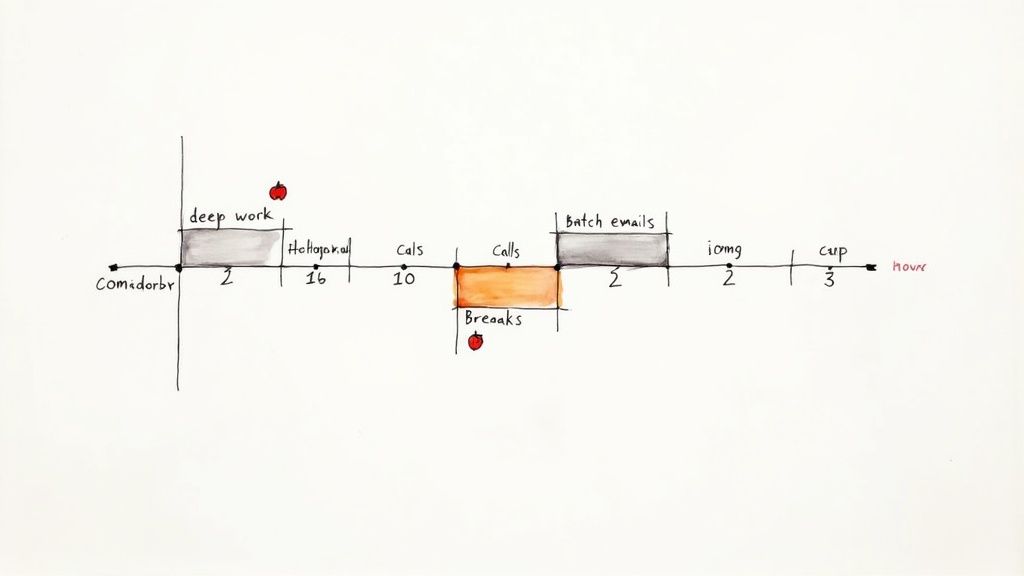
This structure is built on a few core, battle-tested scheduling tactics that really click with the entrepreneurial mindset.
Create Focus with Time-Blocking
First up is time-blocking. This is the simple practice of scheduling your entire day into specific blocks of time dedicated to particular tasks. Instead of reacting to a chaotic to-do list, you proactively give every minute of your workday a job.
This approach is a game-changer for founders because it forces you to be realistic about how long things actually take. More importantly, it carves out and protects your most valuable asset: deep work time.
For instance, you might block out 9:00 AM to 11:00 AM for "Drafting Q3 Marketing Strategy"—a high-focus MIT. During that two-hour block, notifications go off, Slack gets snoozed, and you commit only to that task. This simple act builds a powerful wall against the constant flood of interruptions.
Boost Efficiency by Batching Similar Tasks
Every time you switch between different types of tasks—say, from writing code to answering emails—your brain pays what’s called a "cognitive switching cost." It takes time and energy to reorient and get back into a state of flow. Task batching is the perfect antidote.
It’s just what it sounds like: grouping similar, low-focus tasks together and knocking them all out in one dedicated block.
Examples of Effective Batching for Founders:
- Email Management: Instead of checking your inbox every 15 minutes, schedule two 30-minute blocks per day to process all your emails at once.
- Calls and Meetings: Try to group all your check-in calls into one afternoon block. This keeps your entire day from being chopped up by constant interruptions.
- Content Creation: Dedicate one morning a week to writing all your social media posts or blog content for the entire upcoming week.
When you batch tasks, you stay in the same mental mode for longer, which dramatically improves both your speed and the quality of your work.
Maintain Energy with the Pomodoro Technique
Even with the best schedule, trying to maintain intense focus for hours on end is a surefire recipe for burnout. The Pomodoro Technique is a beautifully simple method for managing your energy and concentration. You just break your work into focused 25-minute intervals, separated by short breaks.
This method works because it aligns with our natural attention spans. It gives you a clear start and end point for a burst of intense focus, followed by a guilt-free moment to step away and recharge. For founders with a hundred things pulling at their attention, these short, structured sprints can make daunting tasks feel much more approachable.
The most effective entrepreneurs don't have more willpower; they have better systems. Their daily routine is a carefully designed machine that produces focus and minimizes wasted energy.
Here’s a quick look at how these techniques stack up and where they fit best in an entrepreneur's day.
Time Management Techniques At A Glance
These methods are the building blocks of a productive day. This table breaks down what they are, when to use them, and how to make them work for you.
| Technique | Best For | How It Works | Pro-Tip for Founders |
|---|---|---|---|
| Time-Blocking | Structuring your entire day and protecting deep work time. | Assign a specific task or category to every block of time on your calendar. | Schedule a 30-minute "buffer block" in the afternoon to handle unexpected issues without derailing your day. |
| Task Batching | Handling repetitive, low-focus administrative or communication tasks. | Group similar activities (e.g., all emails, all calls) into one dedicated session. | Create a "Founder Admin" block on Fridays to batch process invoices, payroll, and other operational tasks. |
| Pomodoro Technique | Overcoming procrastination and maintaining focus on a single, large task. | Work in focused 25-minute sprints, followed by a 5-minute break. Repeat. | Use your short breaks to get up, stretch, or grab water—avoid checking your phone, which can hijack your focus. |
Once you've got these tactics in your toolkit, the final piece of the puzzle is turning them into ingrained habits. A calendar is great for planning, but a habit tracker like Tracka is what really drives execution and consistency.
You can set daily habits like "Complete 2 Pomodoro Sprints" or "Follow Time-Blocked Schedule." Logging your progress each day creates a powerful feedback loop. Over time, Tracka's AI-powered insights can reveal connections you might miss, like how consistently batching your emails correlates with higher energy levels at the end of the day. It turns an abstract concept like time management for entrepreneurs into a concrete, trackable skill you can build on, day after day.
Review and Refine Your System Weekly
A great time management system isn't something you set up once and then forget about. Just like your business, it has to adapt. The most successful entrepreneurs I know treat their productivity system less like a rigid set of rules and more like a living framework that needs regular check-ins. This is where you build a simple but powerful feedback loop to make sure your methods are actually working for you, not against you.
This process of constant iteration is your best defense against the slow, creeping inefficiency that leads straight to burnout. It’s what keeps your daily actions aligned with your ever-changing goals. Without it, even the most perfectly crafted schedule will eventually become irrelevant.
The 5-Minute Daily Review
At the end of each workday, right before you shut down your laptop, take just five minutes to reflect. This isn't about judging yourself or grading your performance. It's a quick, objective scan designed to capture immediate insights while the day is still fresh in your mind.
This tiny habit pays huge dividends over time. It gives you clarity and helps you start the next day with a massive advantage. Instead of waking up and reacting to whatever’s screaming for attention in your inbox, you’ll already have a proactive plan.
Actionable Prompts for Your Daily Review:
- What was my biggest win today? Acknowledge what went right. This builds momentum.
- Where did I get stuck or distracted? Identify a specific roadblock, but do it without judgment.
- What is the single most important thing I need to accomplish tomorrow? Define your top priority for the next day.
This little ritual turns the end of one day into a launchpad for the next. It’s a habit that takes minutes but can save you hours of wasted effort down the line.
The 30-Minute Weekly Review
While the daily check-in is for small, tactical adjustments, the weekly review is where you do your strategic thinking. Block out 30 minutes every Friday afternoon to look at the bigger picture. This is your dedicated time to analyze trends, see how you’re tracking against your quarterly goals, and make larger tweaks to your schedule and priorities.
In the context of the modern workweek, this review is non-negotiable. The global view on work has shifted dramatically. Back in 1850, a typical worker might have logged over 3,000 hours a year. Today, many founders still pull intense schedules, with 69% working more than 39 hours a week—far beyond the average. A weekly review ensures those long hours are actually moving the needle.
Your weekly review is your CEO meeting with yourself. It's the non-negotiable appointment where you stop working in your business and start working on your business—and on your own effectiveness.
This is the habit that helps you spot recurring issues, like consistently underestimating how long certain projects take, or noticing that your energy always tanks on Wednesday afternoons. These are the insights that lead to real, system-wide improvements.
Key Questions for Your Weekly Review:
- Progress Check: Did I complete my weekly MITs? How much closer am I to my quarterly goals?
- System Analysis: What parts of my schedule felt effortless? What created friction?
- Future Planning: What are the top 1-3 priorities for next week? Are there any meetings I can cancel or delegate?
This consistent reflection is where the magic really happens. It’s how you build a system that truly serves you, rather than just becoming another list of things to do. If you want to dive deeper, you can learn more about how long it takes to form a habit like this in our detailed guide.
An app like Tracka can automate a huge part of this process. By tracking habits like "Daily Review" and "Weekly Planning," you're creating a simple record of your consistency. But more than that, Tracka’s AI-powered insights can analyze your data for you, spotting trends in your productivity and showing you how your daily actions connect to your energy and focus. It moves you from just guessing what works to knowing, making the whole process less of a chore and more of a data-driven strategy.
Sustain Your Momentum and Avoid Burnout
You’ve done the hard work of auditing your time, setting your priorities, and building a system that works for you. Fantastic. But here’s the thing most guides forget to mention: the most effective time management system is the one you actually stick with after that first jolt of motivation wears off.
This is where the real work begins. We’re not just trying to cram more tasks into a day; we're building a system that actively prevents burnout. It’s a shift in mindset. You start treating your downtime with the same respect you give a client meeting. Breaks, evenings off, and actual vacations aren't luxuries—they’re non-negotiable parts of your strategy for high performance.
Protect Your Most Valuable Asset
As the founder, you are the engine of your business. If you sputter out, the whole machine grinds to a halt. This means you have to be absolutely relentless in protecting your energy and personal time. It’s about setting firm boundaries and getting comfortable saying "no" to things that don’t align with what truly matters.
It also means you have to learn to delegate before you become the bottleneck. So many entrepreneurs fall into the trap of thinking they have to do it all themselves. But offloading tasks that feel urgent but aren't actually important is the only way you'll ever free up the mental space for the deep, strategic work that only you can do.
An entrepreneur's greatest achievement isn't just building a successful business, but building a sustainable life. True success means having the energy and passion to enjoy the rewards of your hard work without sacrificing your wellbeing.
Ultimately, your habits define your life. Better habits equal better life outcomes. Consistently making time for deep work leads to better business performance. Scheduling real downtime leads to more energy and less stress. We explore this further in our guide on how to maintain work-life balance.
Your Support System for the Long Haul
Going it alone is tough. Your internal drive will eventually waver—that’s just human. This is where accountability becomes your secret weapon. Sharing your goals and your progress with a mentor, another founder, or a small group can give you that external nudge you need to stay on track.
This is exactly why a tool like Tracka was designed to be more than a simple to-do list. It’s your long-term support system. When you start tracking habits like "End Workday at 6 PM" or "Complete Weekly Review," you create a visible record of your commitment to yourself and your own well-being.
The community-driven features in Tracka let you share that progress with partners you trust, adding a layer of social accountability that makes new habits stick. The AI-powered insights take it a step further, showing you how these new routines are directly impacting your focus, energy levels, and even health. It closes the loop, turning abstract goals into tangible results and ensuring you build a more productive, focused, and—most importantly—sustainable life as an entrepreneur.
Got Questions? Let's Get Them Answered
Even with the best system in place, reality has a way of throwing curveballs. Here are a few of the most common questions I hear from entrepreneurs trying to get a handle on their time.
“My Day Is Just a String of Fires to Put Out. How Can I Plan for That?”
This is the classic entrepreneur’s dilemma. The trick is to stop thinking of your schedule as a rigid, fragile thing and start seeing it as a flexible framework.
Yes, you should absolutely use time-blocking for your most important deep work. But you also need to build in some breathing room. I call these "buffer blocks" or "flex time"—scheduled chunks of white space on your calendar. This is your designated time for dealing with the inevitable chaos without having your entire day go off the rails.
Face it: interruptions are part of the job. By planning for them, they lose their power. And if you’ve already knocked out your Most Important Task (MIT) first thing in the morning, you can handle the rest of the day’s madness knowing you’ve already made real progress.
“I Feel So Guilty When I’m Not Working. How Do I Switch Off?”
Oh, this one hits home for so many founders. The guilt is real, and it’s a fast track to burnout. The solution lies in treating your downtime with the same respect you give a meeting with your biggest client.
Schedule it. Put "Dinner with family" or "Read a book" on your calendar and honor that commitment. You’re not being lazy; you're being strategic.
The goal is to be 100% focused when you’re working so you can be 100% present when you’re not. Protecting your personal time isn’t a luxury; it’s a critical part of a sustainable business strategy.
If you struggle to draw that line, an app like Tracka can be a game-changer. Setting a simple, trackable habit like "End workday at 6 PM" gives you a concrete finish line and the accountability to actually cross it.
“I’m Drowning. What’s the Absolute First Thing I Should Do?”
When you’re completely overwhelmed, the instinct is to try and fix everything at once. Don’t. That’s a recipe for failure.
The most powerful first step you can take is the simplest: the time audit we talked about earlier.
Just for one week, track where your time actually goes. No judgment, no immediate changes—just observe. This single, simple action will give you the clarity you’ve been missing. It will shine a spotlight on your biggest time-waster, whether it's endless email checking or social media rabbit holes.
Once you’ve identified the culprit, pick one thing to change. For example, if email is the problem, try batching it into two 30-minute blocks per day. Master that one change, feel the win, and then move on to the next. Small, sustainable steps are how you win this game.
Ready to stop feeling overwhelmed and start taking control of your time? Tracka provides the framework you need to build consistent, high-impact habits that stick. With AI-powered insights and a supportive community, you can turn these strategies into a sustainable system for success. Start your journey with Tracka today.


