

Ever find yourself staring at a task you know you need to do, but instead, you're doing literally anything else? That experience isn't a personal failure. It’s a universal human response, hardwired into our brains' deep-seated desire to avoid negative feelings. The dynamic between productivity and procrastination is a constant battle between our best intentions and our immediate emotions.
The Hidden Battle Between Your Brain and Your To-Do List
Have you ever laid out a perfect to-do list for the day, only to spend hours on trivial things while the most important item sits there, untouched? If that sounds familiar, you're not alone. This is the procrastination paradox in action.
It’s not about laziness or poor time management. At its core, procrastination is an emotional regulation problem. Your brain is built to seek pleasure and dodge discomfort, which makes choosing the instant reward of a distraction feel a whole lot better than the delayed gratification of finishing a complex or boring task.
This internal struggle has massive real-world consequences. Global productivity growth has been crawling along, increasing by just 0.4% in a recent year. This reflects a huge, persistent challenge where low employee engagement—with only 21% of workers globally feeling engaged—leads to staggering losses. This widespread disengagement is often a direct result of procrastination and burnout. You can discover more about these employee productivity statistics and see just how deep the impact goes in the modern workplace.
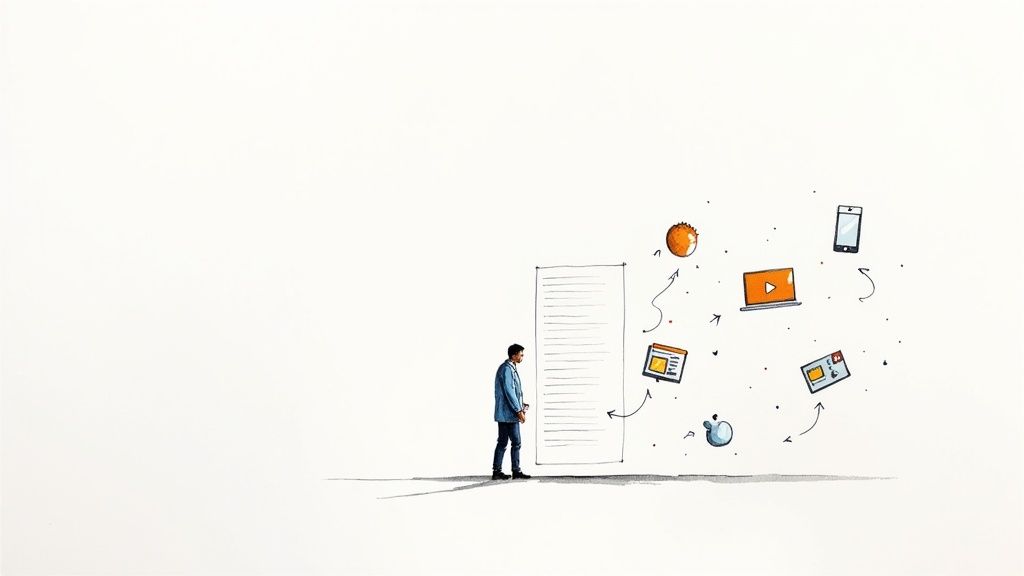
Why Mindset Matters More Than Motivation
Most of us think we just need more motivation or stronger willpower to beat procrastination. But motivation is notoriously flaky, and willpower is a finite resource. As you can learn more about what willpower is and how it works, you'll see that relying on it is a losing game.
A much more effective, evidence-based approach is to reframe the problem.
Instead of viewing procrastination as a character flaw, see it as a signal. It’s your brain telling you that a task is triggering feelings of anxiety, boredom, self-doubt, or confusion.
Once you understand this, you can shift from self-criticism to strategic action. The goal isn’t to eliminate procrastination entirely. It's to build systems that make it easier to start and maintain momentum, even when you don't feel like it.
This mindset shift is the crucial first step. It empowers you to stop fighting against your brain and start working with it. This is where tools designed for consistency, like Tracka, become invaluable. By making your progress visible and breaking huge goals into tiny, manageable steps, you create a positive feedback loop. You slowly retrain your brain to associate action with a small reward, not with dread, leading to better focus, more energy, and real-life impact.
Why Your Brain Chooses Distraction Over Duty
Ever wondered why scrolling social media for five minutes feels so easy, but starting that big project feels like pushing a boulder uphill? The answer isn't a lack of willpower; it’s baked into your brain's wiring. Understanding this internal tug-of-war is the first step to managing procrastination for good.
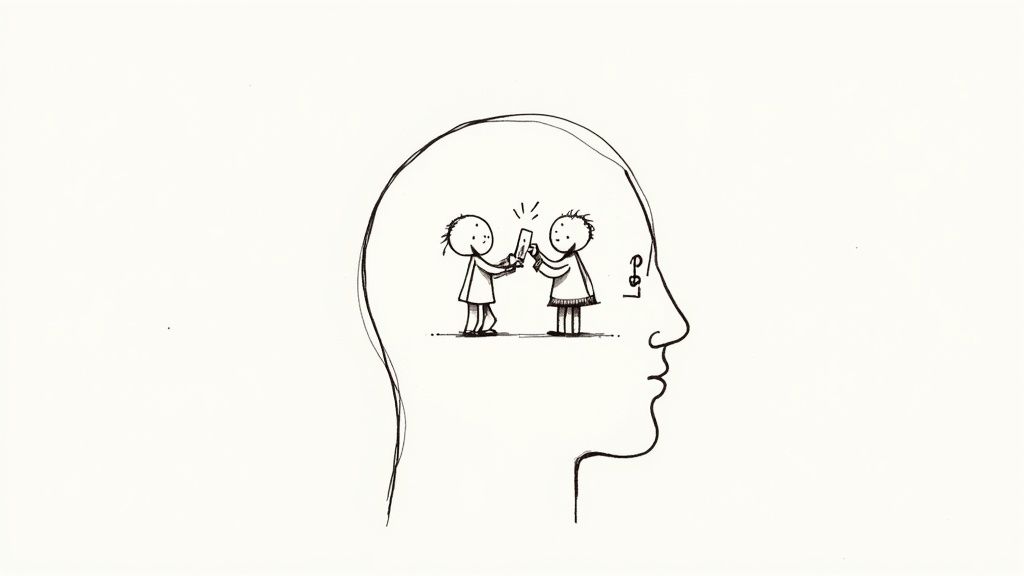
At its heart is a battle between two parts of your brain. Think of it as an impulsive toddler versus a seasoned strategist.
The Toddler and The Strategist
The "toddler" is your amygdala, the emotional, instinctual part of the brain. It craves immediate rewards and wants nothing to do with tasks that feel boring, hard, or stressful. It's the part that screams for the quick dopamine hit from checking a notification.
The "strategist" is your prefrontal cortex, responsible for planning, decision-making, and impulse control. This is the part that understands the long-term benefits of finishing your work. The problem is, when you're tired or stressed, the toddler's tantrum for instant gratification drowns out the strategist's calm, rational voice.
Procrastination happens when the amygdala's demand for immediate emotional relief wins out over the prefrontal cortex's plan for future rewards. Your brain isn't broken; it's simply following its programming to seek pleasure and avoid pain.
This biological reality is a huge reason why so many people—a staggering 80%—abandon their resolutions and long-term goals. The delayed payoff of a finished project just can’t compete with the instant pleasure of a distraction.
The Role of Dopamine and Executive Functions
Dopamine, the "feel-good" chemical, plays a starring role. Every time you give in to a distraction, your brain gets a small, satisfying hit of dopamine. This creates a powerful feedback loop that trains your brain to seek out these easy rewards again and again, draining your focus and wellbeing.
This dynamic can be especially intense for people with conditions like ADHD, which directly impacts the brain's executive functions. These are the mental skills managed by the prefrontal cortex, including:
- Task Initiation: The ability to get started on something without getting stuck.
- Sustained Attention: The capacity to stay focused amid distractions.
- Emotional Regulation: The skill of managing feelings like frustration or boredom that trigger procrastination.
When these functions are challenged, the effort to start and stick with a task feels enormous, making the pull of distraction even stronger. This is a common struggle for students, and understanding these mechanics is the first step in learning how to stop procrastinating on homework and other critical tasks.
Recognizing that procrastination is a biological response, not a character flaw, is freeing. It means you can stop blaming yourself and start building systems that work with your brain's wiring. Instead of muscling through with sheer willpower, you can use tools to create a better reward system. By breaking huge projects into tiny, trackable habits, you give your brain the small, steady dopamine hits it craves for doing productive things. This is exactly how an app like Tracka helps redirect your brain’s reward-seeking behavior, turning the cycle of procrastination into a flywheel of progress.
The True Cost of 'I'll Do It Later'
Procrastination feels harmless at first, like a small debt you can pay back tomorrow. But it's a debt with compounding interest, and the currency is your career, your well-being, and your potential. Putting something off once in a while is just being human. Making it a habit is a silent drain on a fulfilling life.
The first thing you’ll notice is the procrastination-anxiety loop. When you delay an important task, it lingers in the back of your mind, creating a low-grade hum of anxiety that makes the task feel even more intimidating. Naturally, that makes you want to avoid it more.
This cycle is a slow-motion attack on your self-confidence. You start to doubt your ability to see things through, creating a story in your head that you're unreliable. That narrative is incredibly damaging to your self-esteem and, eventually, your professional reputation.
The Professional Price of Delay
In the workplace, the cost of putting things off is real and immediate. It leads to rushed, sloppy work as deadlines loom, forcing you to cut corners. This doesn't just tank your own performance; it creates a ripple effect of stress for colleagues who depend on you.
The modern workplace is a perfect breeding ground for this habit. We're bombarded with interruptions—workers are disrupted roughly every three minutes, and it takes an average of 23 minutes to get back into a state of deep focus after each one. This constant context-switching shatters your attention, making it nearly impossible to do the kind of complex, thoughtful work that drives real impact. You can read more about these 2025 workplace statistics to see the full picture.
The constant state of "catching up" that procrastination creates is a direct path to burnout. It saps your mental energy, leaving you perpetually overwhelmed and making the next big task feel even more impossible to start.
The Hidden Personal Toll
Beyond frantic work sessions and missed deadlines, procrastination quietly sabotages your personal life. The real costs often show up in ways that are subtle at first but incredibly significant over time. Better habits lead to better life outcomes, and letting procrastination win means missing out on crucial improvements.
Here’s what that looks like in the real world:
- Missed Growth Opportunities: That online course you bookmarked, the side project you outlined—they all represent doors you never opened. Procrastination keeps you from investing in your future self.
- Strained Relationships: Always being late or forgetting promises damages trust with friends, family, and partners. It unintentionally sends the message that their time and needs aren't a priority.
- Financial Consequences: Putting off bills leads to late fees. Delaying financial planning means missing out on investment growth. Over time, these small delays add up to serious financial strain.
- Declining Well-being: Avoiding that dentist appointment or putting off a new fitness routine has direct, serious consequences for your physical and mental health.
Ultimately, the true cost of "I'll do it later" is the gap between the person you are today and the person you have the potential to become. Breaking this cycle isn't just about getting more done. It's about reclaiming your time, your energy, and your capacity for a healthier, more accomplished life. Using a tool like Tracka.AI to build small, consistent habits is the first step toward closing that gap.
Actionable Frameworks to Reclaim Your Focus
Understanding the psychology of procrastination is one thing; real change happens when you put that knowledge to work. The battle between getting things done and putting them off is won with smart systems, not just sheer willpower. Fortunately, there are simple, proven frameworks you can use to bypass your brain's resistance and build momentum.
These strategies work because they cut to the heart of what causes procrastination—that feeling of being overwhelmed, bored, or dreading the start. They make the first step so easy that it’s hard to say no, creating a positive feedback loop that builds your confidence and focus.
The Two-Minute Rule: Dissolving Resistance
The biggest hurdle for any task is just getting started. The Two-Minute Rule, popularized by author James Clear, is designed to smash that initial barrier. The idea is brilliant in its simplicity: when you start a new habit, it should take less than two minutes to do.
Instead of a vague goal like "read a book," the habit becomes "read one page." Instead of "clean the kitchen," it becomes "put one dish in the dishwasher." The psychology here is genius; it lowers the activation energy so much that the emotional resistance just melts away. Anyone can do something for 120 seconds.
This tiny action often kicks off a snowball effect. Once you’ve read one page, you might feel like reading another. But even if you don't, you’ve still reinforced the identity of someone who follows through. You’ve won the most important battle of the day: the one against doing nothing.
The Two-Minute Rule isn't about the results you get in two minutes. It’s about mastering the art of showing up. It’s the gateway to building larger, more significant habits.
You can put this to work directly in Tracka. Instead of adding a huge goal like "Write Project Report," create a recurring daily habit called "Open report document for 2 mins." Checking that off gives you a small dopamine hit, reinforcing the behavior and making it easier to show up again tomorrow.
The Pomodoro Technique: Building Focused Sprints
Once you’ve started, the next challenge is staying focused. The Pomodoro Technique is a time management method that uses a timer to break your work into focused intervals—traditionally 25 minutes long—separated by short breaks.
This framework is a procrastination killer for a few key reasons:
- It Reduces Overwhelm: "Work on the presentation for 8 hours" sounds awful. "Work for just 25 minutes" feels completely doable.
- It Creates Urgency: The ticking clock gives you a gentle nudge to stay on task and ignore distractions, especially when you know a break is just around the corner.
- It Prevents Burnout: Those regular, scheduled breaks are critical. They let your brain rest and recharge, which is essential for maintaining mental energy throughout the day.
The process is simple. Pick a task, set a timer for 25 minutes, and work without interruption. When the timer dings, take a 5-minute break. After four of these "pomodoros," you take a longer break of 15-30 minutes.
This technique is incredibly effective for anyone whose focus gets hijacked by distractions. Tracka's built-in timer features make managing these sprints a breeze. You can start a Pomodoro session right inside the app, helping you log your focused work time and build a visual record of your productive sessions. This turns abstract "effort" into tangible progress you can see and feel proud of.
Task Batching: Eliminating Mental Drain
Every time you switch between different kinds of tasks—like jumping from answering emails to writing a report—your brain pays a "cognitive cost." This context switching is a huge, hidden drain on your mental energy and a major cause of low productivity and procrastination.
Task batching is the perfect fix. It’s about grouping similar tasks together and doing them in one dedicated block of time.
- Example 1: Instead of checking emails every 15 minutes, you process your entire inbox just twice a day, at 10 AM and 4 PM.
- Example 2: You block out every Tuesday afternoon to make all your phone calls for the week.
- Example 3: You write all your social media content for the week in a single two-hour session on Monday morning.
This approach minimizes context switching, allowing your brain to stay in a single "mode" for longer, resulting in deeper focus and higher-quality work. It’s one of the most effective ways to establish good working habits that protect your most valuable resource: your attention.
To make this happen, use your calendar and an app like Tracka. Schedule these batches as recurring events. Then, in Tracka, create a corresponding habit like "Complete daily email batch." Tracking this habit reinforces the system and helps you see the direct, positive impact on your productivity. By turning these frameworks into trackable habits, you’re not just hoping to be more productive; you're building the system that guarantees it.
Building a Procrastination-Proof Routine with Tracka
One-off tricks provide a temporary boost, but the real battle against procrastination is won by building better systems. Most people struggle with consistency, and relying on willpower alone is a losing game—it fades under stress. A well-designed routine, on the other hand, acts as a scaffold for your focus, helping you show up even when you don't feel like it.
Tracka.AI is designed to be your partner in this process. Unlike generic habit apps, Tracka combines habit tracking, AI-powered insights, and social accountability to make habit change achievable and rewarding. The game is about shifting from overwhelming, vague goals to a series of small, satisfying daily wins.
From Overwhelming Projects to Daily Wins
That feeling of being completely overwhelmed is a primary trigger for procrastination. When a task feels too big, our brain’s self-protective response is to avoid it. Tracka helps you push back by focusing on habit atomization—breaking down daunting projects into small, manageable actions you can track every day.
So, instead of a goal like "Finish the quarterly report," you create a few micro-habits inside the app:
- "Research data for 15 mins"
- "Write one paragraph of the intro"
- "Review feedback on Section A"
Each time you check one off, your brain gets a small dopamine hit. This creates a positive feedback loop, retraining you to associate progress with a reward, not dread. You’re building real momentum, one checkmark at a time.
This infographic breaks down a few powerful productivity frameworks perfect for turning into trackable habits.
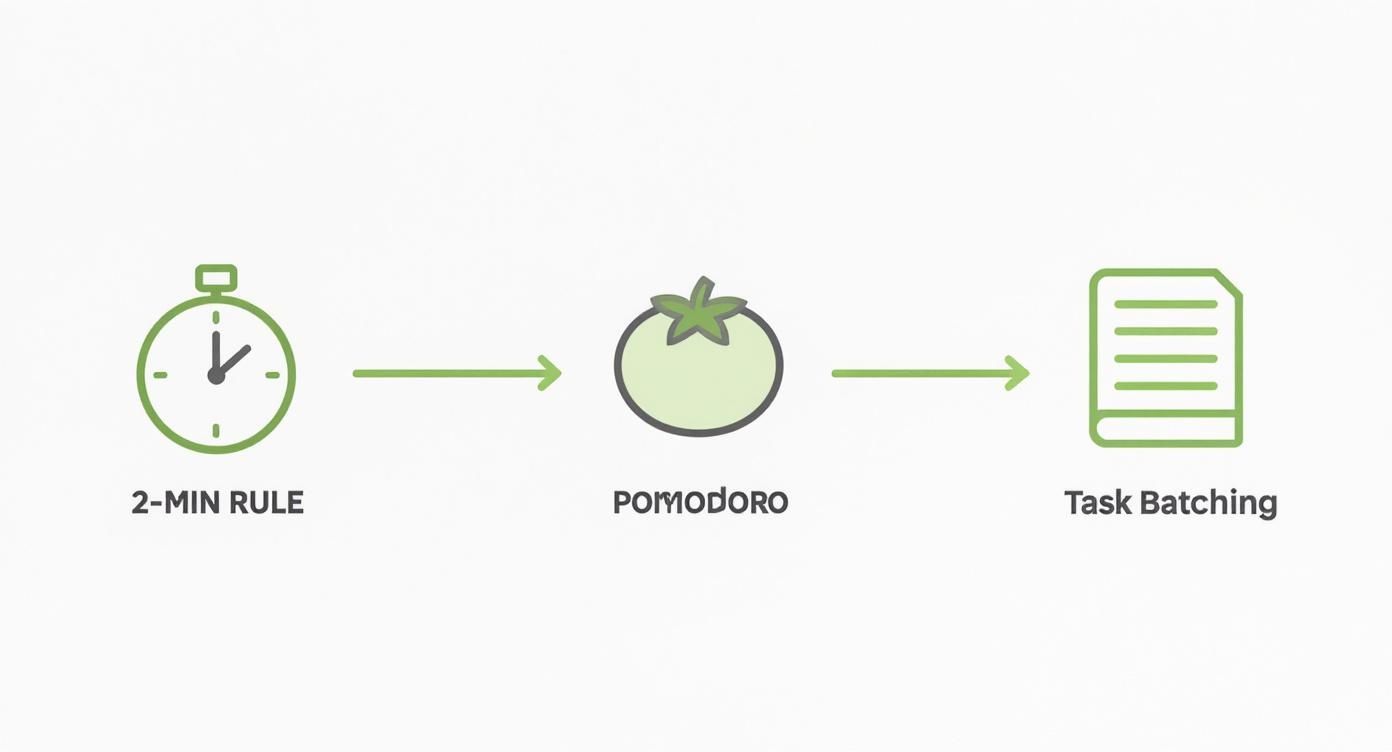
As you can see, techniques like the 2-Minute Rule and the Pomodoro Technique are all built on this same principle: making action feel less intimidating.
Your Personal AI-Powered Coach
Many of us procrastinate without even realizing why. We might consistently put off certain types of tasks or stall at specific times of day, but the pattern is invisible to us. Tracka’s AI-powered insights act as your personal coach, surfacing these hidden behaviors so you can finally see them.
The app analyzes your logged habits and consistency streaks, offering personalized observations and links to your overall wellbeing. You might get an insight like: “You consistently skip your ‘review analytics’ habit on Friday afternoons. Try scheduling it for Tuesday morning when your energy is higher.”
This is where Tracka provides personalized insights that generic apps lack. It transforms your raw data—your daily wins and slips—into an actionable roadmap for improvement, helping you make smarter decisions about how to structure your day for peak productivity.
By understanding your unique procrastination triggers, you can proactively design a routine that works with your natural energy cycles.
Making Consistency a Shared Journey
Procrastination loves to thrive in isolation. When you’re the only one holding yourself accountable, it’s easy to let things slide. This is exactly why Tracka integrates social accountability features that create positive social pressure.
You can share your progress on specific habits with a small group of friends or colleagues. This isn't about judgment; it's about shared encouragement. Just knowing that someone else will see your progress can provide the gentle nudge you need to stay on track, especially on days when motivation is low.
A simple "kudos" from a friend for maintaining a five-day streak can be a surprisingly powerful motivator. This community-driven approach turns the solitary struggle against procrastination into a collaborative journey, reinforcing the idea that building better habits is a shared goal.
Tracka Features vs Procrastination Triggers
| Procrastination Trigger | Tracka Solution | How It Works |
|---|---|---|
| Task Ambiguity ("I don't know where to start.") | Habit Atomization | Breaks down huge goals into clear, tiny, daily actions. Each step is obvious and manageable. |
| Overwhelm ("This is too much to handle.") | Daily Check-ins & Streaks | Shifts focus from the giant final outcome to simply winning the day. One small checkmark at a time builds momentum. |
| Lack of Immediate Reward ("I won't see results for months.") | Instant Feedback Loop | Every checked-off habit provides a small dopamine hit, creating a short-term reward that reinforces the new behavior. |
| Hidden Behavioral Patterns ("I don't know why I keep doing this.") | AI-Powered Insights | The AI analyzes your data to spot patterns, like when and why you procrastinate, offering actionable advice to adjust your routine. |
| Isolation & Lack of Accountability ("No one will know if I skip it.") | Social Accountability Groups | Sharing progress with a trusted group creates positive social pressure and a supportive environment to keep you on track. |
By weaving together these different elements, you create a system that addresses procrastination from multiple angles. Whether you’re tracking fitness, nutrition, screen time, or personal growth, Tracka is designed for a global audience to make better habits stick.
Common Questions About Productivity and Procrastination
Even with the best game plan, questions and roadblocks will pop up on your journey to kick procrastination. That’s normal—it’s part of the process. Here are some quick, practical answers to common sticking points.
Is Procrastination Always a Bad Thing?
Not always, but you have to be honest about which kind you're doing. "Active procrastination" is when you strategically put off a big, intimidating task by knocking out smaller, useful ones. This can build momentum and clear your mental runway.
But most of us get stuck in "passive procrastination." That’s when you delay important work by getting lost in things that don't move the needle, like scrolling social media. This is the kind that kills your productivity, sends your stress levels soaring, and chips away at your confidence.
The difference is intention. Using a tool like Tracka forces you to get clear on your priorities. When your big goals are staring you in the face, you can consciously decide if you’re making a strategic shuffle or just running from the hard stuff.
How Long Does It Actually Take to Break the Procrastination Habit?
There's no magic number, but studies suggest it takes an average of 66 days of consistent effort to form a new habit. Shaking off something as deeply wired as procrastination is a gradual process of retraining your brain's default responses. It's not an overnight switch.
The goal isn't to be perfect from day one; it's to build steady momentum. This is why celebrating small wins is non-negotiable for long-term success.
Focus on consistency, not perfection. A single missed day doesn't erase your progress. What matters is getting back on track the next day.
Tools like Tracka are effective here because they make your consistency visible. Watching your "streaks" grow gives your brain the positive feedback it needs to make new, productive behaviors stick. The app helps you zero in on the small daily actions that build a new routine, making the long game feel more manageable.
What if I Try These Strategies and I'm Still Procrastinating?
First, don't see it as a failure. See it as data. If a specific technique isn't clicking for you, it’s a golden opportunity to figure out why and tweak your approach. Self-awareness is the engine of any sustainable productivity system.
Here are a few questions to ask yourself:
- Is the work block too long? If a 25-minute Pomodoro feels like a marathon, shrink it. Try 15 minutes. Or 10. The goal is to make it so easy to start that you can't say no.
- Is the task still too vague? If you’re avoiding "write the report," you're tackling a monster. Break it down into something tiny, like "outline the introduction" or "find one key statistic."
- Are you fighting your own energy levels? You might be trying to do your most brain-draining work at 3 PM when your focus is at its lowest.
This is where Tracka's AI-powered insights can be a game-changer. The app helps you spot the hidden patterns behind your behavior—like when and why you tend to put things off. By analyzing your logged habits, it can offer personalized suggestions to help you adapt your strategies to your unique rhythm.
If procrastination is seriously getting in the way of your life, it might be worth talking to a professional to rule out underlying conditions like anxiety, depression, or ADHD. These strategies work best as part of a bigger picture of your overall well-being. The key is to stay curious, be kind to yourself, and keep tweaking until you find the system that works for you.
Ready to stop fighting procrastination and start building a system for consistency? Tracka.AI gives you the tools to break down your goals, track your progress, and get AI-powered insights to keep you moving forward. Turn small daily actions into lasting personal growth by visiting https://tracka.ai to get started.


