

Journaling for personal growth is far more than just scribbling down your thoughts. It’s a strategic practice for building self-awareness, clarifying your goals, and creating actionable steps toward the life you want. Think of it as a feedback loop for your own development—a powerful method for turning vague feelings and half-formed ideas into tangible insights that drive real change.
The Real Power of Journaling Your Path to Growth
Let’s be honest: staring at a blank page can feel more like a chore than a breakthrough. Many people start journaling with the best intentions, only to abandon the habit when it feels aimless. The problem isn't the writing itself; it’s the lack of a clear purpose. But when you start treating your journal less like a diary and more like a strategic tool, everything changes.
This isn’t just about recording what happened today. It’s about digging into why it happened and deciding what you’re going to do next. Journaling for personal growth acts like your own personal data analyst, revealing the hidden patterns connecting your actions, thoughts, and outcomes.
From Vague Ideas to Concrete Goals
Most of us walk around with a cloud of fuzzy aspirations—"I want to be healthier," "I need more focus," "I wish I were less stressed." These are noble thoughts, but they’re not effective because they lack clarity. Journaling forces you to translate these abstract desires into concrete language.
The simple act of writing something down transforms it from a fleeting idea into a solid concept you can examine. This is where real progress begins. To get a sense of just how deep this goes, the transformational benefits of journaling for mental health show how this one practice can uplift your entire well-being.
The data backs this up. A significant 74% of people who journal report enhanced mental clarity, and 78% say it helps them clarify their thoughts. That newfound clarity has a direct impact on hitting your targets, with 65% of journaling users reporting a better understanding of their personal goals. It's clear: writing is a direct path to defining what you want. You can see more insights on this in a comprehensive statistical report.
Creating a Strategic Feedback Loop
Your journal is more than a record of the past; it's a roadmap for the future. By consistently engaging with your own thoughts on paper, you create an incredibly powerful feedback system.
- Process Complex Emotions: Writing gives you a safe space to untangle feelings of frustration, anxiety, or excitement, which reduces their power over you.
- Identify Limiting Beliefs: You start to spot recurring negative self-talk or self-sabotaging patterns that have been holding you back.
- Clarify Your Core Values: By exploring what truly matters to you on the page, you can start making decisions that align with your authentic self.
Think of your journal as a conversation with your wisest self. It’s the one place where you can be completely honest without fear of judgment, leading to breakthroughs you simply couldn't achieve by thinking alone.
This is a great place to start understanding the core advantages of a consistent journaling practice. Here’s a quick breakdown of the link between the activity and its outcome.
Key Benefits of Journaling for Personal Growth
| Benefit | Impact on Personal Growth |
|---|---|
| Increased Self-Awareness | Understand your emotional triggers, thought patterns, and behaviors. |
| Improved Mental Clarity | Cut through mental clutter to focus on what truly matters. |
| Enhanced Problem-Solving | Work through challenges and find creative solutions on your own terms. |
| Better Goal Attainment | Translate abstract goals into concrete, actionable steps. |
| Reduced Stress & Anxiety | Externalize worries and process emotions in a healthy, constructive way. |
Ultimately, journaling is the bridge between introspection and action. It helps you understand yourself on a deeper level, set intentional goals, and build the discipline required for lasting personal growth. This practice isn't just for writers; it's for anyone committed to building a more intentional and fulfilling life, one entry at a time.
Find a Journaling Style That Actually Works for You
The biggest myth about journaling is that there's a "right" way to do it. The truth? The best method for personal growth is the one you’ll actually stick with. Most people who struggle with consistency give up because they force themselves into a style that doesn’t fit their personality or schedule. Forget the one-size-fits-all advice. Let's find a technique that feels less like a chore and more like a tool you’re genuinely excited to use.
The key is to match your journaling style to your main goal. Are you looking to untangle complex emotions, get your tasks and goals organized, or just build a quick, positive daily habit? Each objective has a method that aligns with it perfectly.
If you're brand new to this, our complete beginner's guide on how to start journaling is a great place to get your bearings before you pick a specific style.
This simple decision flow can help you find a starting point based on what you want to get out of the practice.
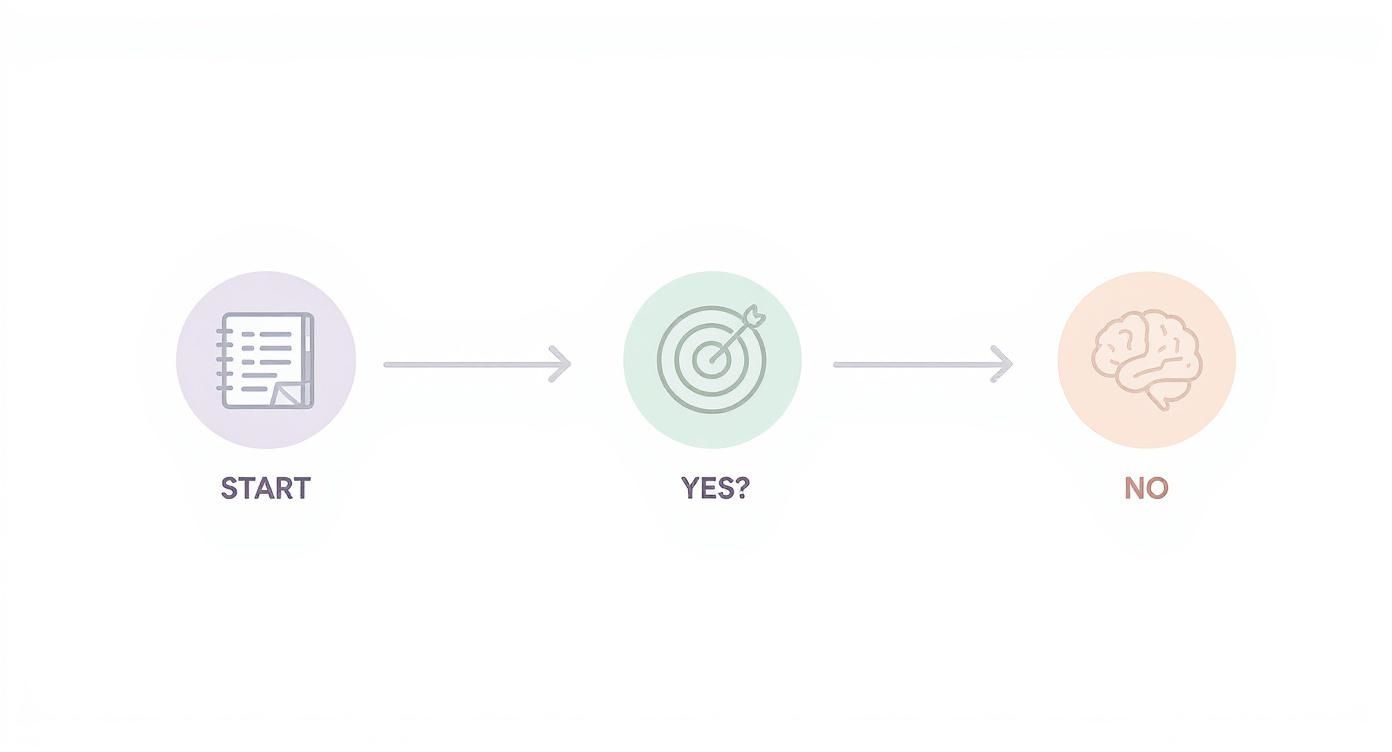
As the chart shows, just knowing whether you have a specific goal or simply need to get thoughts out of your head is the first step toward finding a style that will actually work for you.
Structured Journaling for Clarity and Gratitude
If you thrive on structure or are always pressed for time, a guided format can be a game-changer. These methods take the guesswork out of the equation, so you're not just staring at a blank page wondering what to write.
- The Five-Minute Journal: This popular method is built for speed and positive reinforcement. You just answer a few simple prompts in the morning (like "I am grateful for…") and a few in the evening (like "What went well today…"). It’s perfect if you want to build a mindset of gratitude and intention without a huge time commitment.
- The Bullet Journal (BuJo): Ideal for the organized, data-driven person, bullet journaling is a hybrid to-do list, planner, and diary. You use a system of symbols to log tasks, events, and notes. This style is fantastic for tracking habits, monitoring progress, and seeing exactly how your daily actions are moving you toward your long-term ambitions.
By focusing on gratitude and accomplishments, structured journals literally train your brain to notice the positive. This simple shift can have a profound impact on your overall mood and resilience, making it a powerful tool for personal growth.
For anyone who struggles with consistency—a challenge for the 80% of people who abandon resolutions—structured journaling lowers the barrier to entry. The predefined format makes it easy to start and feel a sense of accomplishment almost immediately.
Unstructured Journaling for Deep Self-Exploration
On the other hand, if your goal is to understand your emotions, work through a tough problem, or unlock creativity, a more free-flowing style might be a better fit. These methods prioritize raw authenticity over tidy organization.
Stream-of-Consciousness Writing
This technique, also known as freewriting, is exactly what it sounds like. You set a timer—maybe for 10 or 15 minutes—and just write whatever comes to mind without stopping, censoring, or worrying about grammar.
This approach is incredibly powerful for a few reasons:
- Emotional Processing: It lets you get raw, unfiltered thoughts out of your head and onto the page, which can help you finally understand the root of your anxiety or frustration.
- Uncovering Hidden Beliefs: By writing without a filter, you can stumble upon insights and limiting beliefs you didn't even know you had.
- Boosting Creativity: It helps you bust through creative blocks by silencing your inner critic and just letting ideas flow freely.
The real beauty of this style is its honesty. It's a direct conversation with your subconscious. You might start by writing about your day and end up exploring a childhood memory that’s been subtly influencing your decisions for years.
Ultimately, the goal is to experiment. Try a structured method for a week, then switch to an unstructured one. Pay attention to how each one makes you feel. Does it feel energizing or draining? Insightful or superficial? The right journaling style for your personal growth is the one that invites you back to the page day after day. Once you find it, you can pair it with an app like Tracka to turn your reflections into measurable actions, creating a powerful system for real-world change.
Effective Prompts for Deeper Self-Reflection
Knowing what to write is often half the battle. A blank page can feel like a test you didn't study for, but the right question acts as a key, unlocking thoughts and feelings you didn't even realize were there. To get the most out of journaling for personal growth, you have to move beyond just recapping your day.
Prompts are the tools that help you do that. They're not just generic questions; they’re designed to challenge your assumptions, clarify what you value, and help you understand how you tick. A good prompt can turn a routine entry into a genuinely productive session of self-discovery.

The real goal here is to shift from just describing your life to actively designing it. Instead of just noting, "I felt stressed today," a targeted prompt pushes you further: "What specific thought pattern fed my stress today, and is that pattern actually helping me?" This move from passive observation to active inquiry is where the real change starts.
Prompts for Understanding Your Present Self
Before you can build something better, you need a clear blueprint of where you are right now. These prompts are all about boosting your self-awareness, helping you pinpoint the core beliefs and emotions that are running the show day-to-day.
- Values Check-In: What are three of my non-negotiable values in this season of my life? When did my actions recently align perfectly with them?
- Energy Audit: When did I feel most drained this week? What was happening, who was I with, and what story was I telling myself in that moment?
- Natural Strengths: What’s a skill that comes so easily to me that I’m surprised when others struggle with it? How can I put that skill to use more deliberately?
Asking yourself these questions regularly creates a baseline of self-knowledge. You start to see the patterns in your own behavior and thinking, which is the essential first step to making conscious choices instead of just reacting on autopilot.
Questions to Uncover and Challenge Limiting Beliefs
We all operate on a set of internal rules and beliefs about ourselves and the world. The problem is, a lot of these beliefs were formed a long time ago and might not even be true—or helpful—anymore. Journaling is one of the best ways to drag these subconscious scripts out into the light so you can actually examine them.
If you’re looking for a more structured way to tackle unhelpful thoughts, a cognitive therapy thought record can be a fantastic tool to use alongside your journaling. It provides a systematic framework for dissecting and reframing those sticky thought patterns.
A limiting belief is really just a thought you've kept thinking on repeat. Journaling gives you the space to question that habit and choose a new, more empowering thought instead.
Try these prompts to start digging:
- Finish the Sentence: "I can't achieve [a specific goal] because…" Then, ask yourself: Is this reason an objective fact, or is it a story I'm telling myself?
- Challenge the "Shoulds": What is something I feel I "should" be doing but consistently resist? What is that resistance trying to tell me about what I actually want?
- Investigate Your Fears: If I was absolutely guaranteed not to fail, what’s one bold action I would take this month? What’s the specific fear that's really holding me back?
Prompts for Designing Your Future
Once you have a clearer picture of who you are now and the beliefs holding you back, you can start looking forward with real intention. These prompts are about connecting with your aspirations and breaking them down into something you can actually act on.
And if you find these helpful, we've got a whole list of journaling prompts for self-growth to keep your practice fresh and insightful.
Different areas of your life need different questions. Here are a few prompts to get you thinking about what’s next.
Journaling Prompts for Different Growth Areas
This table breaks down some specific prompts you can use to target different parts of your life, from your career to your well-being.
| Growth Area | Example Prompt 1 | Example Prompt 2 |
|---|---|---|
| Career & Ambition | What does my ideal workday look like five years from now, from the moment I wake up to when I go to sleep? | What is one professional skill that, if mastered, would have the biggest impact on my career trajectory? |
| Relationships & Connection | Describe a relationship where I feel completely myself. What are the key ingredients of that connection? | How can I be a better friend/partner/family member this week? What is one specific action I can take? |
| Wellbeing & Self-Care | What activity consistently leaves me feeling more energized and centered? How can I schedule more of it? | If my body could talk, what would it tell me it needs right now? |
Using these prompts consistently transforms your journal from a simple diary into a strategic life-planning tool. You stop just hoping for growth and start actively creating the conditions for it by asking the right questions and listening closely to your own answers.
Turning Your Journal Insights Into Action
A journal full of profound thoughts is a fantastic start. But if those insights stay locked on the page, they're just well-written observations. True personal growth happens when you close the notebook and apply what you’ve learned to your actual life. This is where reflection becomes real-world progress.
After a few weeks of writing, you’ll start to see patterns. Maybe you keep writing about feeling wiped out after certain meetings, or the same desire for more creative work keeps bubbling up. These aren't random thoughts. They're signals pointing directly to the areas of your life that are ready for a change.
The key is turning those qualitative feelings into something you can do and measure. It’s one thing to know you feel better on days you get some fresh air; it’s another thing entirely to build a system that makes sure it happens.
From Vague Desires to Specific Habits
First, you have to distill those journal entries into clear, actionable goals. An aspiration like "I want to be less stressed" is impossible to track and feels overwhelming. You need to break it down into the tiny, specific behaviors that actually lead to less stress.
For example, you notice your journal entries about stress almost always mention that sinking feeling you get when you open your morning inbox. The insight is clear: "My day goes off the rails when I start it by reacting to other people's demands."
From that simple observation, you can create a specific, trackable habit:
- Insight: "My mornings feel chaotic and stressful."
- Actionable Habit: "No checking email for the first 30 minutes of the day."
This process—spotting a theme, defining a clear action—is what turns your journal from a passive log into an active tool for growth. You stop just documenting your life and start intentionally designing it.
Your journal shows you the 'what' and the 'why'—what you need to change and why it matters. A habit tracking system provides the 'how' and 'when'—the structure to make it happen consistently.
Creating a System of Accountability With Tracka
This is where pairing your journal with a smart habit tracker like Tracka.AI becomes a game-changer. Your journal is perfect for the messy, nuanced, qualitative stuff. Tracka provides the clean, quantitative data and accountability to make those changes stick. It’s the bridge between your inner world and your outer actions.
Let's walk through a real-world example. You've been journaling for a month about feeling unfocused and creatively stuck. As you review your entries, you spot a pattern: on the days you feel most inspired, you happened to read a book the night before.
Here’s how you turn that insight into a powerful growth loop with Tracka:
- Identify the Insight: "Reading before bed seems to boost my creativity and focus the next day."
- Create a Trackable Habit: Inside the Tracka app, you set up a new daily habit: "Read for 20 minutes before sleep."
- Log and Reflect: Each day you do it, you mark it complete in Tracka. You can even use the app's built-in journal to add a quick note: "Felt much sharper today after reading last night."
- Review the Data: After a couple of weeks, Tracka’s AI-powered insights will start showing you a clear correlation. You'll see a chart mapping your reading habit against your daily focus levels, reinforcing the connection.
Unlike generic habit apps, Tracka provides this personalized feedback loop. It connects your actions to outcomes, helping you see what truly works for your focus, energy, and wellbeing. You’re no longer just guessing; you’re building a personalized system for your own growth.
The Psychology Behind Making It Stick
This method of breaking big goals into tiny actions is grounded in solid behavioral psychology. Research consistently shows that clarifying your personal values—something journaling is fantastic for—is a crucial first step in setting goals you’ll actually achieve. When you break a huge ambition into small, manageable tasks, you increase your motivation and self-regulation.
By turning a vague desire like "be more creative" into a tiny, daily action like "read for 20 minutes," you dramatically lower the barrier to entry. This makes consistency not just possible, but probable. And that's vital when you consider that a staggering 80% of people abandon their resolutions, usually because their goals were too big and they had no system for execution. With a tool like Tracka, you build momentum one small, intentional step at a time, turning the wisdom from your journal into lasting personal growth.
Overcoming Common Journaling Roadblocks

Starting a journaling habit is one thing; sticking with it is another game entirely. Let's be honest, building new habits is tough. Studies show a staggering 80% of people abandon their new resolutions, usually because they hit a wall and don't have a strategy to push through it. Journaling is no different.
You might feel a huge surge of motivation at first, but then life happens. You get busy, you feel like you've run out of things to say, or the blank page just feels intimidating. These hurdles are completely normal. Overcoming them is what separates a short-lived attempt from a powerful, lasting practice.
The “I Don’t Have Time” Problem
This is probably the most common roadblock of them all. When your schedule is packed, finding even ten minutes to sit down and write can feel like an impossible ask. The key isn't to magically find more time—it's to lower the barrier to entry so drastically that it feels almost effortless.
- The Five-Minute Rule: Commit to writing for just five minutes. Seriously. Set a timer and stop when it goes off. More often than not, you'll find you want to keep going, but even if you don't, you've still kept the habit alive.
- Embrace Voice-to-Text: On truly hectic days, just use the voice memo app on your phone. Speak your thoughts on your commute or while making coffee. You can transcribe it later or simply listen back to your own insights.
- Habit Stacking: Link your journaling to a habit you already do without thinking. For instance, decide to write one paragraph right after you finish your morning coffee or just before you turn off the lights at night.
By making the habit incredibly small and tying it to something you already do, you remove the friction that leads to procrastination. The goal here is consistency, not volume.
The “I Don’t Know What to Write” Problem
Staring at a blank page can trigger a surprising amount of anxiety. When you feel you've run out of ideas or that your thoughts aren't "deep" enough, it’s easy to just close the notebook and walk away. This is where having a fallback plan is absolutely crucial.
First, you can always revisit the prompts we covered earlier. Having a go-to list of questions can instantly get your pen moving. But if even prompts feel like too much work, simplify your approach even further.
When you don't know what to write, write about not knowing what to write. Describe the feeling of being stuck, the pressure you feel, or the blankness in your mind. This act of meta-journaling often breaks the logjam and leads to unexpected insights.
If you’re still stuck, try one of these dead-simple entry points:
- Describe Your Surroundings: Write about what you can see, hear, and smell. This grounds you in the present moment and gets words flowing without any pressure to be profound.
- One-Sentence Summary: Challenge yourself to summarize your entire day in a single, powerful sentence.
- The "High, Low, Buffalo": A classic for a reason. Write down your high point of the day, your low point, and one random, interesting "buffalo" fact or thought.
The “I Keep Getting Stuck in Negativity” Problem
Sometimes, a journal can accidentally become a container for only our darkest thoughts. While it’s a healthy place to vent, exclusively focusing on the negative can create a draining feedback loop, making you want to avoid writing altogether.
If you notice your journal is becoming a constant bummer, it's time to intentionally pivot. This doesn't mean ignoring your struggles, but rather balancing them with a more constructive perspective. You can learn more about building resilience in our guide on how to stay consistent even when things get tough.
The solution is to pair every negative observation with a forward-looking question. For example, if you write about a frustrating meeting at work, follow it up with: "What is one small thing I can control in this situation?" or "What did this experience teach me about my own boundaries?"
This simple shift moves you from just ruminating to active problem-solving. It turns your journal back into a tool for growth instead of a catalog of grievances. Consistency, in journaling and in life, is about adapting your strategy when the old one stops working for you.
Common Questions About Journaling for Growth
Starting a journaling practice for personal growth always brings up a few questions. Getting straight answers can be the difference between a habit that sticks and another good intention that fades away. Let’s tackle some of the most common ones so you can get started with confidence.
Digital vs. Physical Journal: Which Is Better?
The debate between typing on a screen and writing with a pen is a big one, but honestly, the best choice is whatever you'll actually use. There’s no right answer here, only what’s right for you.
A physical journal offers a tactile, screen-free experience that many people find almost meditative. The simple act of writing can slow your thoughts down, helping you process things more deeply and remember your insights. It’s a completely private, distraction-free space.
On the flip side, a digital journal is incredibly convenient. You can add an entry on your phone during your commute, on a tablet at a coffee shop, or on your laptop at home. Digital tools are searchable (a huge plus!), easy to back up, and can often link up with other apps, like adding quick notes to a habit tracker.
The best tool is the one you will actually use consistently. If you love the feel of pen on paper, get a notebook. If you live on your devices and value convenience, go digital. Don’t let the choice paralyze you; just pick one and start.
How Often Should I Journal for Personal Growth?
Consistency beats intensity every single time. It’s far more powerful to write for five minutes every day than for an hour once a month. Daily journaling builds momentum and lets you capture your thoughts and feelings in real-time, creating a rich log of your personal patterns.
But let's be realistic—daily writing isn't always possible. A weekly reflection can be just as powerful. Setting aside 20-30 minutes each weekend to review the past week, celebrate wins, and set intentions for the week ahead is a fantastic way to stay on track.
The key is to set a goal that feels doable. If daily seems like too much, start with three times a week. The whole point is to create a sustainable rhythm that doesn't feel like another chore on your to-do list.
What if I Miss a Day or a Week?
Life happens. You’re going to miss a day, or maybe even a whole week. The most important thing is to ditch the "all-or-nothing" mindset that derails so many good habits. Missing an entry doesn't erase your past progress or mean you've failed.
Instead of feeling guilty, just pick up where you left off. Don't try to "catch up" by writing massive entries for the days you missed. Just open to a fresh page and write about today. Journaling is a tool for the present moment, so treat it that way.
Remember, this is a practice, not a performance. The goal is progress, not perfection. Every entry you write is a win, regardless of any gaps in between. By approaching your habit with a bit of self-compassion, you build the resilience you need for long-term growth.
Ready to turn your journal insights into measurable progress? Tracka.AI helps you connect your reflections to real-world actions. Stop letting good ideas stay on the page—start building the habits that create lasting change. Learn more and begin your journey at https://tracka.ai.


