

So, you want to start journaling? The easiest way to begin is to just… start. Grab a notebook or open an app, set a timer for five minutes, and write whatever comes to mind. Don't worry about it being good; just get the words out.
How to Write Your First Journal Entry
Staring at a blank page can feel surprisingly intimidating. A lot of us get stuck right here, tripped up by common mental roadblocks like the pressure to write something brilliant or the simple fear of not knowing what to say.
These hurdles are a big reason why research shows that up to 80% of people abandon their resolutions. Without a clear, simple system, consistency feels impossible, and good intentions fade.
The trick is to reframe journaling. This isn't a performance. Your journal isn't for an audience—it's a private, practical tool built just for you. It doesn't need poetic prose or life-changing revelations. The real win is creating a small, consistent space to improve your focus and wellbeing.
Aim for Consistency, Not Perfection
Forget about writing the perfect entry. Instead, focus on creating a consistent one.
Committing to just five minutes a day is more powerful than planning for a glorious hour-long session that never happens. This minimalist approach removes the pressure and makes the habit feel manageable, even on chaotic days.
This is where pairing your new habit with a tracker can be a game-changer. When you log your five-minute session in an app like Tracka, you get an instant visual reward. That small checkmark reinforces the behavior, making it easier to show up again tomorrow. It turns a vague goal into a concrete, satisfying win.
The real power of journaling isn't in crafting the perfect sentence. It's in the cumulative effect of showing up for yourself, one messy, honest thought at a time. Visualizing that progress is what makes the habit stick.
The data backs this up. The rise in journaling's popularity is tied to compelling health benefits. A stunning 86% of people report feeling more relaxed after writing, and a regular practice can slash cortisol (a key stress hormone) by up to 35%.
It’s also linked to a 25% boost in self-awareness, and 70% of mental health professionals recommend it for emotional well-being. You can dig into more of the science behind journaling's benefits on Zipdo.co. By focusing on these small, daily actions, you're investing in significant improvements for your long-term mental health and focus.
Choosing Your Journaling Toolkit
So, you're ready to start journaling. The first big question you need to answer is: what are you going to write in? This isn't just about picking something pretty; the tool you choose can genuinely make or break your new habit. Your options really boil down to two main camps: a classic pen-and-paper notebook or a modern digital app.
There's something incredibly powerful about a physical notebook. The simple act of putting a real pen to actual paper feels intentional and mindful. It's a fantastic way to create a screen-free ritual and take a break from the constant ping of notifications. Plus, it offers total creative freedom—you can doodle in the margins, try different handwriting styles, and lay out your thoughts however you want, without being boxed in by a pre-set format.
The Rise of Digital Journaling
On the other hand, digital journaling apps are built for our modern, on-the-go lives. They offer convenience, security, and smart features that a simple notebook can't match. Having your journal on your phone means you can capture a thought the moment it strikes, whether you're on the train or waiting for your coffee. That kind of accessibility removes one of the biggest roadblocks to staying consistent.
This infographic breaks down some of the core emotional wins you get from a regular journaling practice, like feeling more relaxed, understanding yourself better, and dialing down stress.
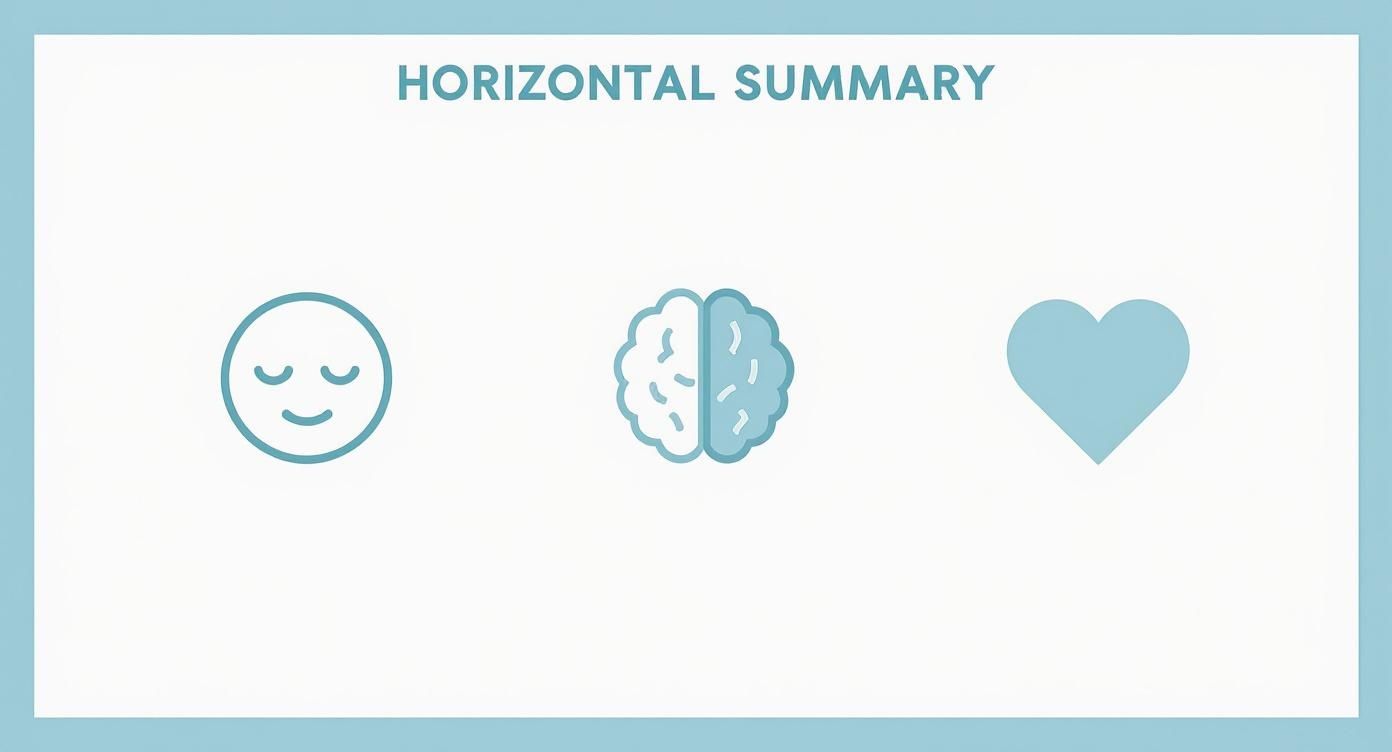
Whatever tool you pick, its main job is to help you achieve these benefits by making the process as easy and seamless as possible. The goal is to create an experience so frictionless that you actually want to show up for it every day.
Integrating Journaling with Your Lifestyle
The real key is to choose the method that slots most naturally into your life. If you genuinely love the tactile sensation of writing and crave a way to disconnect from technology, a beautiful notebook might just be the perfect partner to keep you on track.
Despite our screen-obsessed world, traditional journaling is still a huge and growing habit. The global market for diaries and planners was valued at $1.2 billion in 2025 and is expected to climb to $1.74 billion by 2035. That’s a clear sign that many people still deeply value the analog experience. You can dig into the full research about the diaries and planners market to see the trends for yourself.
But if what you're after is speed, privacy, and the ability to see patterns in your thoughts, a digital app is the undeniable winner. Unlike generic apps, Tracka is designed to turn your entries into actionable insights, showing you how your habits directly impact your wellbeing.
Physical vs Digital Journaling: A Practical Comparison
To help you decide, let's break down the pros and cons of each approach in a side-by-side comparison. Think about which of these features matter most for your personality and lifestyle.
| Feature | Physical Journal | Digital Journal (with Tracka) |
|---|---|---|
| Accessibility | Portable, but can be forgotten or cumbersome. | Always on your phone, ready anytime, anywhere. |
| Privacy & Security | Vulnerable to being lost, damaged, or read by others. | Password-protected, encrypted, and backed up to the cloud. |
| Searchability | Difficult to find specific entries from the past. | Instantly searchable by keyword, date, or tag. |
| Creative Freedom | Unlimited. You can draw, sketch, and format freely. | Often structured, but allows for photos, voice notes, and different templates. |
| Integration | A standalone activity. | Can be linked directly to habit tracking, mood logs, and AI-powered insights. |
| Mindfulness | The physical act of writing is naturally mindful. | Requires more intention to avoid digital distractions. |
| Cost | Requires purchasing new notebooks and pens. | Often a one-time purchase or a small subscription, but many free versions are available. |
| Long-Term Storage | Takes up physical space and can degrade over time. | Takes up zero physical space and is preserved indefinitely. |
Ultimately, neither option is "better"—it's about what's better for you. A digital journal simply offers a different set of tools designed for a different kind of workflow.
With a digital app, your journal is password-protected, automatically saved, and incredibly easy to search. You'll never have to worry about losing years of thoughts or someone snooping through your private entries.
This level of security creates a safe space where you can be completely honest with yourself. Even better, an app like Tracka connects your journaling directly to your habit tracking. This means you can jot down a quick note about why you skipped the gym or what triggered a sugar craving, linking your actions to your feelings in real-time. Over time, these connected entries reveal powerful insights, turning your journal from a simple diary into a genuine tool for self-improvement.
Journaling Techniques That Fit a Busy Life

Let's bust the biggest myth about journaling right now: you do not need to write long, soul-searching essays for it to "count." Meaningful reflection can happen in the small gaps of even the most packed schedule. Minimalist, high-impact techniques are your best friend here, especially when you're short on time or struggling with focus.
These methods are all about getting mental clarity in just a few minutes, linking directly to better life outcomes like reduced stress and improved performance. When you make the entry fee for a new habit incredibly low, you don't have to lean so hard on willpower, which we all know is a finite resource. If you want to go deeper on that, you can learn more about what willpower is and see why good systems beat raw effort every time.
Seriously, logging even a single sentence in an app like Tracka is a win. It reinforces the habit with almost zero friction, building the consistency that eventually leads to real self-awareness and less stress.
The One-Sentence Journal
If you’re looking for the most sustainable method out there, this is it. The one-sentence journal is exactly what it sounds like. At the end of the day, you write a single sentence that sums it all up.
It could be a highlight, a frustration, something you learned, or just a simple observation. This tiny act forces you to distill your entire day into its most important takeaway, making it a surprisingly powerful tool that takes less than 60 seconds.
- For example: "Finally finished that presentation, and the relief feels incredible."
- Or maybe: "Felt totally swamped by my to-do list and didn't get to what mattered."
- Or even: "Had a surprisingly deep conversation with a friend I haven't seen in ages."
The point isn't to capture every detail. It's about capturing a feeling or a defining moment. Over time, these single sentences weave together a rich story of your life, showing you patterns and progress you’d have otherwise missed.
Quick Gratitude Lists
You don't need a long, meditative session to shift your mindset. Sometimes, all it takes is a quick, focused list of things you're genuinely grateful for.
This technique is a fantastic antidote to a bad mood or that feeling of being completely overwhelmed. Just before bed or first thing in the morning, jot down three to five specific things that brought you a little bit of joy or appreciation that day.
Gratitude journaling is a scientifically-backed mood booster. Studies have shown that a regular gratitude practice can increase happiness levels by around 25% and often leads to better sleep, stronger relationships, and more resilience.
Don't just write down vague things like "family" or "health." The magic is in the details. The more specific you are, the stronger the emotional punch.
- Instead of "my coffee," try "the smell of the coffee brewing this morning."
- Instead of "my kids," try "the way my daughter laughed at my terrible joke."
The 5-Minute Brain Dump
Ever have one of those days where your mind feels like a browser with way too many tabs open? A brain dump is your force quit.
Set a timer for five minutes. For those five minutes, write down everything—and I mean everything—that's rattling around in your head. Worries, to-do list items, random ideas, snippets of conversations, anxieties. Don't edit, don't judge, and forget about grammar or structure. The only goal is to get it all out.
This is a powerful way to clear out all that mental clutter, dial down anxiety, and get your focus back. Once the timer goes off, you can literally close the book on it and walk away feeling lighter and ready to take on your day with a clearer mind.
How to Build a Journaling Habit That Actually Sticks
https://www.youtube.com/embed/jXaqJ8IUpXc
So, you’ve picked out a notebook or an app and maybe even scribbled down a few thoughts. That’s a great start. But the real test isn't writing those first few entries; it’s sticking with it when the novelty wears off. This is where we shift from just trying to journal to actually building a habit that lasts.
The secret isn’t about finding more motivation. It’s about being strategic.
One of the most effective tricks in the book is something called habit stacking. The idea is simple: you link your new journaling habit to something you already do every single day without thinking. You're basically piggybacking the new behavior onto an old, established one.
For example, you could decide to journal for five minutes right after your morning coffee starts brewing. Or maybe you'll jot down one quick thought right after you set your alarm for the next day. This way, you're not relying on willpower or remembering to do it out of the blue. The old habit becomes a trigger for the new one.
Give Your Brain a Reason to Come Back
For any habit to stick, it needs to feel good. The big-picture benefits of journaling—less stress, more clarity—are fantastic, but they don't happen overnight. That delayed gratification can make it tough to stay consistent.
This is where a little immediate positive reinforcement goes a long way.
Using a habit tracker like Tracka to log your entry each day creates a simple but powerful feedback loop. Every time you mark it "done," you get a small, satisfying visual win. Your brain loves that feeling of accomplishment, making you far more likely to show up and do it again tomorrow.
Consistency trumps intensity every single time. A five-minute daily entry logged in a tracker is far more powerful than a two-hour session you only manage to do once a month.
This whole process is wired into our psychology. We thrive on seeing progress. When you see a streak building in an app, it’s tangible proof that your small efforts are compounding. That data gives you the motivation to keep going, turning what could feel like a chore into a rewarding part of your day.
If you're curious about the nuts and bolts of this, we have a whole guide on how long it takes to form a habit that digs into the science.
Let Your Data Tell the Story
Once you’ve got a consistent routine going, you can start connecting the dots between journaling and other parts of your life. This is where Tracka’s AI-powered insights become a differentiator. By analyzing your entries alongside other habits you’re tracking—like mood, energy, or sleep—the app starts to uncover personalized patterns you’d probably never notice on your own.
You might discover that on days you journal in the morning, your focus at work is way up. Or maybe you'll see a clear link between a quick "brain dump" at night and how well you sleep. These are the personalized insights that show you the real value of your new habit.
This data-driven self-reflection isn't just a niche idea anymore. The market for digital journal apps is projected to jump from $5.1 billion in 2024 to $5.69 billion in 2025. It's a clear sign that people are looking for smarter ways to support their mental well-being. By using a tool that gives you this kind of feedback, your journal stops being a passive record and becomes an active instrument for fine-tuning your life.
Overcoming Common Journaling Roadblocks
Let's be real: hitting a wall is part of building any new habit. That initial burst of excitement wears off, life throws a curveball, and suddenly that beautiful new journal is just sitting there. This isn't failure. It's just part of the process.
The most important thing to remember is that you're aiming for resilience, not perfection. The real victory isn't keeping a perfect streak; it’s learning how to pick it back up after you miss a day or two.
What to Do When You Feel Stuck
We've all been there—staring at a blank page with absolutely nothing to say. This is the classic "journaling block," and trying to force it usually makes it worse.
Instead of staring into the void, give your brain a little nudge with a go-to prompt. This simple trick removes the pressure to be profound and gives you an easy way in. I like to keep a short list handy for exactly these moments:
- What's one small thing that made me smile today? This immediately shifts your focus to something positive, even if it’s just the taste of your morning coffee.
- What’s taking up the most space in my mind right now? Think of this as a quick "brain dump" to get all that mental clutter out of your head and onto the page.
- If I could give my past self one piece of advice, what would it be? This is a great one for tapping into a bit of self-compassion and reflection.
How to Keep Journaling Interesting
If your routine starts to feel like a chore, that's your cue to shake things up, not quit. Boredom is a notorious habit-killer, but the beauty of journaling is its flexibility.
Don't be afraid to experiment with different formats to keep things fresh and engaging.
A journaling habit isn’t about forcing yourself to do something you hate. It’s about creating a flexible system for self-reflection that adapts to your energy and needs on any given day.
Try a new approach for a week and see how it feels. Maybe you ditch the long paragraphs for a quick bullet-point list. You could even try recording a short voice memo on your phone—an amazing option for processing thoughts when you just don't have the energy to write.
The key is giving yourself permission to let your practice evolve.
How to Handle a Missed Day (or Week)
So you missed a few days. The absolute worst thing you can do right now is beat yourself up about it. Letting guilt take over is what truly derails your progress, not the missed entries themselves.
Instead of seeing a broken streak, just see it as part of the natural ebb and flow of life. Life is messy. The only goal is to start again, right now, guilt-free. Just open your journal and write about today. Don't even think about trying to "catch up" or fill in the blank pages.
This is where a tool like Tracka can be a real game-changer. The app’s gentle reminders and progress visualizations are built for real life, not for perfect streaks. Seeing your overall progress chart helps you realize that a small break is just a tiny dip in a much bigger upward trend. It gives you the encouragement you need for getting back on track without any judgment, turning a potential setback into just another part of the journey.
Got Questions About Journaling? We've Got Answers.
Jumping into any new routine is bound to bring up a few questions. It's totally normal. Let's tackle some of the most common hurdles people face when they first pick up a pen (or open an app) so you can get started with total confidence.
How Much Time Do I Really Need to Spend on This?
Forget about the clock. Seriously. The goal is consistency, not duration.
Committing to just 5 minutes a day is a game-changer. It's sustainable, it's not intimidating, and it’s a thousand times better than trying for an hour, burning out, and quitting by day three.
You'd be amazed at what just a few minutes of focused writing can do. And when you use a tool like Tracka to log those short sessions, you get to see how all those little moments add up to massive progress. It’s incredibly motivating.
What if My Life Is Too Boring to Write About?
This is probably the number one reason people hesitate, and it’s built on a myth. Your journal isn't a blockbuster movie script; it's a private space for your internal world.
You're not writing to entertain an audience. You're writing to understand yourself.
On the days when nothing "exciting" happens, you can write about:
- A fleeting feeling that caught you off guard.
- A worry that’s been buzzing in the back of your mind.
- A small hope you have for tomorrow.
- Something interesting you read or listened to.
When you're truly stuck, that's what prompts are for. The real win is just showing up and checking in with yourself.
When’s the “Right” Time of Day to Journal?
Let’s make this simple: the best time to journal is whenever you'll actually do it. There's no secret, universally perfect time.
That said, different times of day offer different benefits.
- Mornings are fantastic for setting your intentions and getting clear on what matters most for the day ahead.
- Evenings are perfect for decompressing, processing the day's events, and calming your mind before sleep.
My advice? Try both. See what feels right for your energy and schedule. And here's a pro-tip: habit stack. Tie your journaling to something you already do without thinking, like right after brewing your morning coffee or just before you switch off the bedside lamp. It makes the habit stick so much faster.
How Do I Keep My Thoughts Private and Secure?
For journaling to work, you have to feel safe being completely honest. That means privacy is non-negotiable.
If you're going old-school with a physical notebook, find a secure spot for it—a drawer, a bookshelf, anywhere you know it won't be casually picked up.
But if you want true peace of mind, digital is the way to go. Journaling apps like Tracka are built with security in mind, offering password and biometric locks. Knowing your thoughts are for your eyes only gives you the freedom to be truly vulnerable, and that’s where the real growth happens.
Ready to stop thinking about journaling and start doing it? Tracka gives you the structure, insights, and gentle nudges to build a habit that actually lasts. You can finally get the clarity and focus you've been looking for.
Download Tracka now and write your first entry. Your future self will thank you.


