

Organizing your life isn’t about finding a perfect, complicated system. It's about building a simple, sustainable framework around what actually matters to you. The real secret is to first clarify your core values, and then pick just 1–3 small, consistent habits that align with them. This simple shift replaces overwhelming to-do lists with intentional, meaningful action that improves your focus and wellbeing.
Why Organizing Your Life Feels Impossible
If you constantly feel like you're playing catch-up, you're not alone. That persistent feeling of being disorganized isn't a personal failure. It’s usually a sign that the methods you've tried weren't built for your life. Most people struggle with consistency. In fact, a staggering 80% of resolutions are abandoned within weeks because traditional productivity hacks demand a level of perfection that real life rarely allows.
The Hidden Costs of Disorganization
Living in a state of chaos does more than just create a messy desk or a forgotten appointment. That constant, low-grade stress is quietly draining your most important resources, impacting your real-life outcomes.
- Lost Time: You lose minutes, even hours, searching for misplaced keys, redoing tasks you forgot about, and putting out last-minute fires.
- Drained Energy: Decision fatigue from a cluttered space and an overbooked calendar leaves you mentally exhausted before you even get to your most important work, leading to reduced productivity and focus.
- Missed Opportunities: When you’re constantly reacting to the chaos of the present, you have zero mental bandwidth left to plan for a better future or pursue personal growth.
Beyond the physical mess, a cluttered environment has a real impact on your mental well-being. Understanding these deeper connections, like how decluttering can improve your mental health, can be a powerful motivator to finally get started.
Building a Framework That Actually Works
The answer isn't a massive, one-time life overhaul. Lasting clarity comes from small, consistent actions that build on each other over time. It’s about creating a personal framework that makes progress feel natural, not forced.
This is where a tool like Tracka makes habit change achievable. Unlike generic apps, it helps you focus on what actually works for you.
By tracking just a few core habits, you gather personalized data on your own patterns. The goal isn't a perfect streak; it's gaining the AI-powered insights and community support needed to build a system that finally fits, turning consistency from a daily struggle into an effortless rhythm that improves your overall lifestyle.
Build a Foundation on Your Core Values
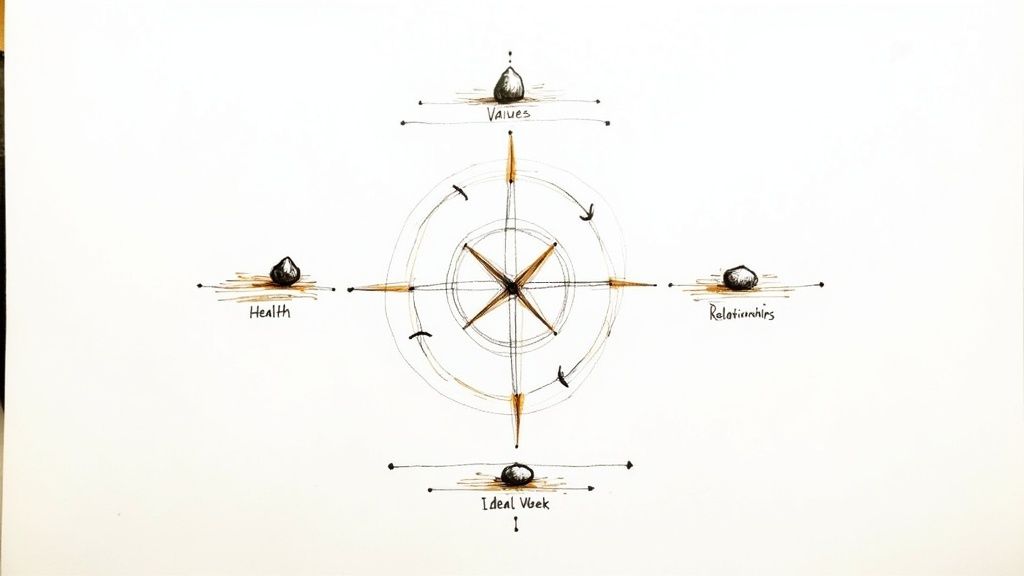
Before you touch your calendar or declutter your closet, the first real step is to organize your purpose. Many people skip this, jumping straight to planners and apps, only to find themselves overwhelmed again a month later. True, lasting organization isn’t about tools; it's about knowing your "why."
Your core values are your internal compass. When your daily actions align with those values, life feels more meaningful and less chaotic. But when there’s a mismatch, you feel drained, stressed, and perpetually disorganized.
Uncovering What Truly Matters
Figuring out your values doesn't have to be a complicated quest. You can get clear answers with a couple of simple, practical exercises.
-
The Ideal Week Visualization: Imagine a perfect, sustainable week. Not a lottery-winning vacation, but a deeply fulfilling one. What are you doing? Who are you with? How do you feel? This reveals what you’re craving—whether it’s more creativity, deeper connection, or just quiet calm.
-
The Value Sorting Method: Find a list of common values online (e.g., "security," "adventure," "community," "growth"). Jot down the top 10 that resonate, then narrow it down to your top five. These are your non-negotiables.
This clarity acts as a powerful filter. Decisions become simpler. An invitation that doesn't align with "family time"? An easy "no." A project that conflicts with "health"? Not even a question. This is how you reclaim your focus and energy for what matters.
From Values to Action: A Real-World Scenario
Let's talk about Alex, a marketing manager who felt like they were constantly drowning in meetings and side projects. They would say "health and family" were their top priorities, but their actions told a different story. Evenings were spent on emails, and workouts were always sacrificed for deadlines.
Through the value sorting exercise, Alex realized their actions were aligned with a perceived value of "ambition" at the direct expense of their true values. This insight was the turning point. They started blocking out non-negotiable family dinners and scheduling workouts with the same importance as a client meeting. The chaos didn't vanish overnight, but for the first time, their actions reflected their purpose.
This is a common struggle. Data shows that only 21% of global employees feel genuinely engaged at work, often because their work feels disconnected from their personal values. When this happens, people naturally struggle to prioritize and stay focused.
Knowing your values gives you permission to protect your time and energy. It’s the difference between being busy and being productive, between a full calendar and a full life.
Creating Your Personal Compass
Once you have your core values, write them down. This simple act makes them real.
You can use a notebook, a digital doc, or the journaling feature in an app like Tracka. This practice of reflection is a powerful tool. In fact, our guide on journaling for personal growth dives deeper into how this simple habit builds the self-awareness you need to stay on track.
With this compass in hand, you're ready to translate these big-picture values into small, daily actions. This is how you build a life that is not just organized on the surface but fundamentally aligned with who you want to become.
Build Your System Around Keystone Habits
You've clarified what matters. Now, it's time to turn that purpose into small, daily actions. It’s tempting to try and reinvent your life overnight—wake up at 5 a.m., meditate, journal, and hit the gym, all starting tomorrow. That’s a surefire recipe for burnout and why so many people struggle with consistency.
The secret isn't a massive overhaul. It’s about finding and locking in your keystone habits. Think of these as the small dominoes that knock over all the other ones. Instead of forcing 20 new behaviors, you focus on one or two that kickstart a chain reaction of positive change, boosting your focus and overall wellbeing.
How to Spot Your First Keystone Habit
A great keystone habit isn't about the action itself, but the momentum it generates. Making your bed, for example, doesn't just give you a tidy room; it starts your day with a small win that can motivate you to tackle bigger things.
To find your own, ask yourself: What's the one small thing that, if I did it consistently, would make the biggest positive difference in my day?
- A 10-Minute Morning Planning Session: Before your phone hijacks your attention, spend ten minutes identifying your top three priorities. This habit puts you in the driver's seat from the moment you wake up.
- A 5-Minute Evening Tidy: Set a timer before bed and spend five minutes clearing your main workspace. This simple act lowers stress the next morning, making it easier to start the day with a clear head.
- Prepping Your Workout Clothes: Laying out your gym gear the night before demolishes one of the biggest barriers to working out. It’s a classic for a reason—it works.
Your mission is to pick just one to three of these micro-habits. The goal is to build a system that feels almost effortless, not another exhausting to-do list.
Design Simple Routines for Your Worst Days
Routines are the guardrails of an organized life, but they need to be built for reality. Rigid, minute-by-minute schedules are fragile; they shatter the second a meeting runs late or you wake up feeling drained.
A better approach is to create simple, flexible "bookend" routines for your morning and evening.
A Simple Morning Bookend:
- Hydrate: Drink a glass of water before anything else.
- Move: Five minutes of stretching or a few push-ups to wake your body up.
- Plan: Look at your top three priorities for the day.
A Simple Evening Bookend:
- Tidy: Do your 5-minute evening clear-out.
- Prepare: Lay out your clothes for tomorrow.
- Reflect: Take two minutes to write down one thing that went well.
These routines are so short you can do them even on your lowest-energy days. That's the key to building consistency and achieving better life outcomes.
Making It Work for a Busy Brain
If you have ADHD or just a brain that struggles to focus, breaking things down is essential. "Plan my day" can feel like a mountain, but "write down my #1 task" is a manageable step. Micro-actions are your superpower.
Don't add "clean the kitchen" to your to-do list. Add "put dishes in the dishwasher." That single action is less intimidating and creates momentum.
Visual cues are also your best friend. Put vitamins next to your coffee maker. Leave your journal on your pillow. Put your gym bag by the door. These triggers reduce your reliance on willpower. As you build your system, it’s smart to learn about developing good work habits that support your brain, no matter how it's wired.
This is where Tracka becomes a partner in the process. The app helps you log these foundational habits without all-or-nothing pressure. You can track your 5-minute tidy or log your morning planning. Over time, Tracka's AI-powered insights connect the dots for you, showing how better habits lead to better life outcomes—like more energy, improved health, and greater productivity. This data turns guesses into concrete knowledge, helping you build a life system truly designed for you.
Master Your Time and Declutter Your Space
Once your keystone habits feel solid, it’s time to tackle the day-to-day chaos that drains your mental energy. An organized life boils down to managing two things: your time and your space. A messy calendar and a cluttered environment create constant, low-level stress, sabotaging your focus.
This isn’t about sterile perfection. It’s about building systems that lower your cognitive load—the mental horsepower needed just to function. Every minute spent hunting for a file or deciding what to do next is a minute you can’t spend on what matters. The bedrock of mastering your time is building your day around intentional routines.
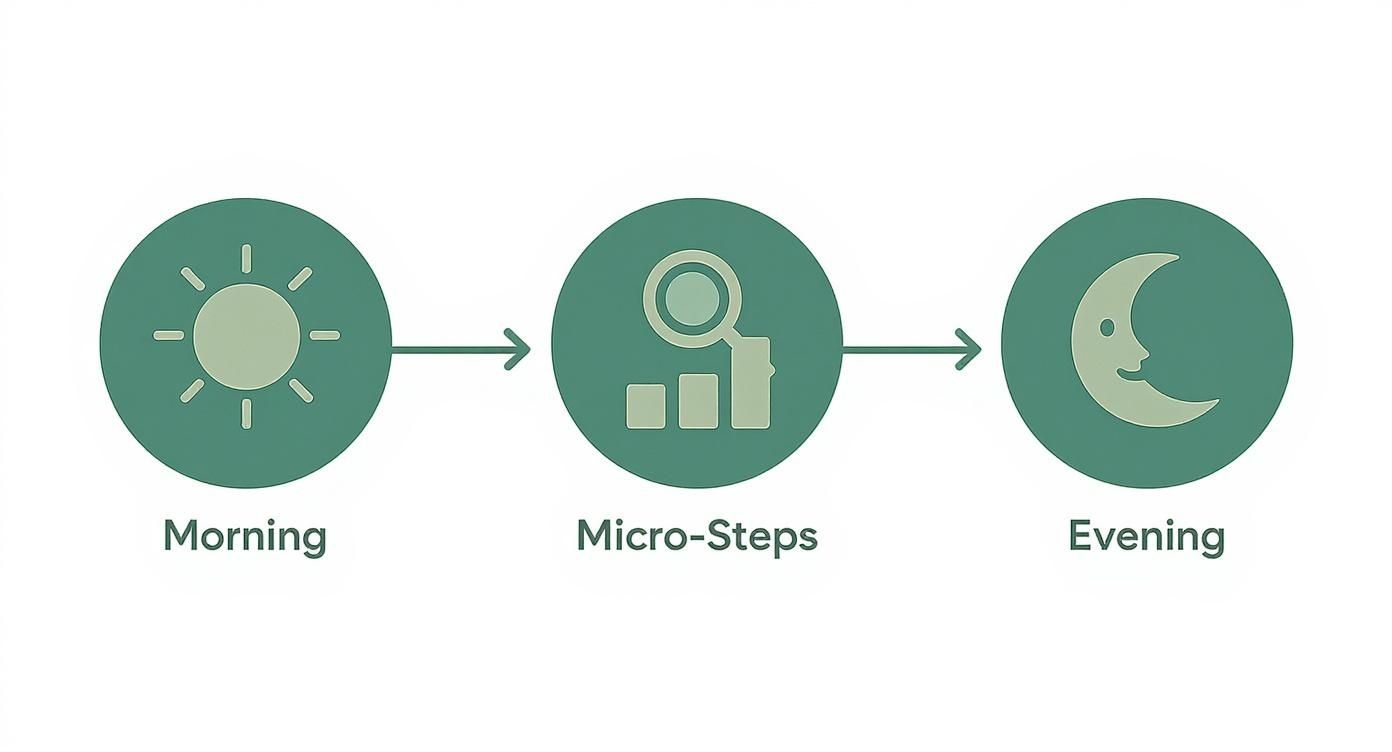
As you can see, simple bookends for your morning and evening, combined with breaking big tasks into tiny steps, gives your day a sustainable structure that boosts focus.
Tame Your Calendar with Smart Time Management
An endless to-do list is a recipe for overwhelm. The goal isn't just to list what you need to do, but to decide when and where you’ll do it. This simple shift puts you back in control.
Here are a couple of proven methods to get you started:
- Time-Blocking: Schedule specific blocks of time for specific tasks on your calendar. Instead of a vague "work on report," you’d block out "9:00 AM – 10:30 AM: Draft report introduction." It forces you to be realistic and fiercely protects your focus time.
- The Pomodoro Technique: Use a timer to break down work into focused sprints, traditionally 25 minutes long, separated by short breaks. It’s a fantastic way to tackle tasks that feel intimidating, because anyone can focus for just 25 minutes.
The real magic happens when you adapt these techniques to your own rhythm. A great way to figure this out is by tracking your energy levels in an app like Tracka alongside your time experiments. You might find you do your best deep work in the morning, making it the perfect time to block out your hardest task.
Choosing Your Time Management Technique
Finding the right method can feel like trial and error. This table breaks down popular techniques to help you find a system that clicks with your brain and your goals.
| Technique | Best For | How It Works | ADHD-Friendly Tip |
|---|---|---|---|
| Time-Blocking | Individuals who need structure and want to protect focus time for deep work. | You schedule every task, meeting, and break into specific time slots on your calendar. | Use color-coding for different types of tasks (e.g., blue for deep work, green for meetings) to make your calendar visually scannable. |
| The Pomodoro Technique | People who get overwhelmed by large tasks or struggle with procrastination. | Work in focused 25-minute intervals separated by 5-minute breaks. After four "pomodoros," take a longer break. | Use a physical timer instead of your phone to avoid getting derailed by notifications. The ticking can also help maintain focus. |
| Eat the Frog | Those who procrastinate on their most important (and often most difficult) tasks. | Identify your single most important task for the day ("the frog") and do it first thing in the morning. | Make your "frog" incredibly specific and small. Instead of "work on presentation," make it "create the first three slides." |
| The Eisenhower Matrix | Anyone who feels busy but not productive and needs to prioritize better. | Categorize tasks into four quadrants based on urgency and importance: Do, Decide, Delegate, Delete. | This is great for visual thinkers. Draw the matrix on a whiteboard so it's a constant reminder of what truly deserves your attention. |
Don't feel like you have to pick one and stick with it forever. The best system is often a hybrid that you tweak over time as your needs change.
Conquer Digital Clutter for Good
Digital mess is just as stressful as physical mess, but it’s easier to ignore—until it becomes a crisis. A chaotic desktop, a nightmare file system, and an inbox with thousands of unread emails are constant, silent distractions that drain your focus.
Start with your email. The goal of ‘Inbox Zero’ isn't a literally empty inbox. It’s about having a system to process messages so they don’t pile up. Use the "archive, reply, or delete" method. If an email takes less than two minutes to deal with, handle it immediately. If it needs more time, move it to a task folder or schedule it on your calendar.
Next, build a simple file system on your computer. Use broad categories like "Work," "Personal," and "Finances," with logical subfolders inside. The test of a good system? You should be able to find any file in under 30 seconds. This one-time effort will save you countless hours.
Declutter Your Physical Space Without Overwhelm
A messy space often leads to a messy mind. But the thought of a massive decluttering project can be paralyzing. The key is to start small and let the momentum build.
The 'One-a-Day' Rule: This is a deceptively powerful habit. Commit to getting rid of one thing every single day. An old magazine, a pen that doesn’t work, or a shirt you haven't worn in a year. This approach slowly clears the clutter without ever feeling overwhelming.
As you clear things out, give everything a "home." When every item has a designated spot, cleaning up becomes a quick, automatic habit instead of a huge ordeal. To really level up your space and create a calmer environment, you can implement some powerful home organization hacks that go way beyond basic tidying. By getting a handle on both your time and your space, you create an external environment that supports your internal goals, freeing up mental energy and boosting your productivity.
How to Refine and Maintain Your System
You’ve built a system to organize your life. That’s a huge win. But the real work begins after the setup. Getting organized is an event; staying organized is a skill that requires consistency.
This isn’t about chasing perfection. It’s about creating a simple rhythm of checking in, making small adjustments, and learning as you go. Think of your system less like a finished project and more like a garden that needs light, consistent tending to thrive.
The Power of a Weekly Review
One of the most effective habits for keeping your life in order is the weekly review. This is a non-negotiable block of time—maybe 20-30 minutes on a Sunday—to step back and look at the big picture. It’s your moment to reset, refocus, and plan the upcoming week with clarity. A simple three-part checklist is all you need:
- Look Back: What went well this past week? Where did you feel in the zone? What threw you off course? Celebrate the wins, no matter how small.
- Look Ahead: Pull up your calendar. Any potential trainwrecks or overbooked days? What are your top 1-3 priorities for the week ahead?
- Clear the Decks: Process stray notes, get your email inbox to zero, and tidy up your main workspace. This simple act gives you a clean slate.
This one ritual prevents the slow, creeping chaos that derails even the best-laid plans. It turns system maintenance from a chore into a powerful, recurring habit.
The Two-Minute End-of-Day Reflection
While the weekly review handles the macro view, a quick end-of-day reflection keeps your daily routines on track. Before you shut down for the night, take two minutes to ask yourself a few questions. You can use a notebook or the journaling feature in an app like Tracka. The tool doesn't matter; the tiny space for self-awareness does.
What was one thing that worked well today? What felt difficult? What small adjustment can I make tomorrow?
This isn’t about being hard on yourself. It’s about collecting data. When you see setbacks as information instead of failures, you’ve unlocked a mindset shift crucial for long-term consistency and a better lifestyle.
Using Data to Drive Your Decisions
This is where tech becomes a massive advantage. While your own reflections are powerful, an app like Tracka can spot hidden patterns your brain might miss. Its AI insights engine is designed to connect the dots between your daily actions, your energy levels, and your overall progress.
For instance, you might feel like you’re randomly skipping workouts. But Tracka’s insights could surface a clear pattern: "You are 80% more likely to skip your workout after a poor night’s sleep."
Suddenly, it’s not a vague willpower problem; it's an actionable piece of data. Now you know that the single best thing you can do for your fitness consistency is to protect your sleep. You’re no longer guessing; you’re using your own data to make smarter tweaks to your system.
Finding a Sustainable Work-Life Rhythm
Refining your system means being realistic about your work patterns. True productivity often comes from working smarter, not just longer. Work-life balance looks different around the globe. The Netherlands, for example, offers a model where employees work an average of just 36.4 hours per week while maintaining incredible productivity. In contrast, American employees average 41.5 hours per week, suggesting that organizing your life around a sustainable pace—rather than more hours—might actually improve your efficiency and wellbeing. You can see more global productivity insights on World Population Review.
The Role of Community and Accountability
Finally, never underestimate the power of accountability. Studies show that it dramatically increases your odds of success. When you share your goals, you create a supportive environment that reinforces your commitment.
This is where a feature like Tracka's community is a game-changer. Unlike generic apps, it provides social accountability that helps people stick to routines. It’s not about competition; it's about gentle nudges and shared celebrations. Knowing a friend might send you a high-five for sticking with your morning routine can be the extra motivation you need on a tough day.
Maintaining an organized life is a continuous journey. By combining regular self-reflection, data-driven insights, and community support, you can build a system that not only works but also evolves with you.
Common Questions About Organizing Your Life
Embarking on a journey to organize your life brings up practical questions. It’s normal to hit roadblocks or wonder how to make these ideas fit your specific situation. Here are straightforward answers to common hurdles.
How Can These Systems Work with ADHD?
The key is to build a system that supports your brain's wiring, not one that fights against it. Traditional organizing advice often relies on memory and internal motivation. Instead, your best friends are external aids and immediate rewards.
Start with one visual habit. For instance, get a brightly colored bowl and make it the only place your keys ever go. Use a physical timer for tasks to make time feel more tangible, and break every goal into tiny, 5-minute steps. Celebrating these micro-wins is everything, because it gives you that essential dopamine boost that helps build momentum and focus.
When you use an app like Tracka, resist tracking everything at once. Pick one or two habits to start. The visual progress charts are designed to give you that immediate, positive feedback your brain craves. The goal isn’t perfection; it’s progress.
What Is the Most Important Organizing Habit?
This varies, but if I had to pick one, the most powerful habit is a 5-minute End-of-Day Reset. It’s the bridge between a chaotic today and a calm tomorrow, and it dramatically cuts down on morning anxiety, leading to more energy and better focus.
Before you shut down for the day, take five minutes to:
- Clear your main workspace (desk or kitchen counter).
- Glance at your calendar for the next day so there are no surprises.
- Jot down your top 1-3 priorities for tomorrow.
This simple routine provides a sense of closure. It lets you walk into the next morning with a clear, proactive plan instead of feeling like you’re already behind.
How Do I Stay Organized When Life Is Unpredictable?
When life feels chaotic, rigid, minute-by-minute schedules are guaranteed to fail. The solution is a flexible system built on routines and principles, not strict timelines. Think of your organizational system as a toolbox, not a fixed blueprint. Instead of a rigid goal like "workout at 6 AM," your objective becomes more flexible: "move my body for 20 minutes today." This gives you the freedom to slot it in whenever an opportunity pops up.
Use time-blocking for your non-negotiables, but leave open buffers in your calendar to absorb the unexpected. A tool like Tracka can help you spot patterns even in the chaos. Its AI might point out that even on your craziest days, you consistently have a reliable 30-minute window in the late afternoon—the perfect time for that walk you keep meaning to take. Flexibility isn't the enemy of organization; it's the secret to making it last and improving your lifestyle balance.
Ready to build a system that adapts to your life? Tracka makes habit change achievable by combining habit tracking, AI-powered insights, and social accountability to keep you moving forward. Start building consistency without the pressure at https://tracka.ai.


