

To learn how to journal for self improvement, start by reframing it as a strategic tool rather than just a diary. The real magic happens when you carve out a 10-minute daily habit dedicated to focused reflection—turning scattered thoughts into clear, actionable steps for growth.
Why Journaling Is a Powerful Self Improvement Tool

If you’ve ever watched good intentions fizzle out, you’re not alone. Research shows that a staggering 80% of people abandon their resolutions within a few weeks. It’s rarely ambition that’s lacking—it’s consistency and a reliable framework to capture ideas, monitor progress, and maintain focus.
Journaling steps in as that framework:
- Mental Clarity: Untangle swirling thoughts and pinpoint what really matters.
- Pattern Recognition: Spot recurring behaviors that help or hinder your progress.
- Accountability: Writing commitments down makes you more likely to follow through, boosting consistency.
Below is a quick summary of the tangible outcomes you can expect from a consistent, brief journaling practice. These benefits link directly to real-life impact, improving your energy, focus, and overall wellbeing.
The Self Improvement Benefits of a 10-Minute Journaling Habit
A quick summary of the tangible outcomes readers can expect from a consistent, brief journaling practice.
| Benefit Area | Expected Outcome |
|---|---|
| Goal Clarity | Clear, prioritized action steps that move you forward |
| Emotional Awareness | Better mood regulation and reduced stress responses |
| Productivity | Increased focus with fewer distractions |
| Self-Confidence | Noticeable boost in self-trust and decision-making |
| Habit Tracking Insights | Data-driven patterns that guide smarter adjustments |
These benefits build on each other. Over time, you’ll find yourself not just recording experiences but actively shaping them for better life outcomes.
The Proven Impact of Consistent Journaling
The advantages go beyond personal anecdotes—they’re backed by solid research. A 2022 study revealed that regular journaling dramatically influenced students’ well-being and achievement. In that survey, 85% of participants reported that journaling helped them achieve their goals, 57% noticed better physical and mental health, and 51% saw a boost in self-confidence. You can read more about these student journaling findings here.
Journaling transforms self-improvement from a guessing game into a deliberate practice. It gives you the raw data—your own thoughts and experiences—to make smarter decisions about your habits, goals, and lifestyle.
When you pair this reflective practice with a tool like Tracka, the impact multiplies. Unlike generic habit apps, Tracka provides personalized insights that turn your journal entries into measurable data points:
- Correlate your journaled moods with your exercise routine.
- Spot links between stress reflections and screen time.
- Leverage AI-powered summaries to surface hidden patterns that drive your behavior.
In just ten minutes a day, you turn fleeting thoughts into fuel for lasting change, making habit change achievable.
Building Your Personalized Journaling System

The only journaling system that actually works is the one you stick with. The goal isn't to add another complicated chore to your list; it's to build a practice that feels so natural it slots right into your life. The biggest barrier to consistency is friction, so your first step is choosing a tool that removes it.
Your first decision point is choosing your tool. This might sound minor, but getting it right removes a huge amount of friction.
Digital Versus Physical Journals
This isn't just a matter of taste—it's about figuring out what's genuinely easier for you.
- Physical Journals (Pen and Paper): The tactile act of writing can be meditative, helping you disconnect from screens. The downside? You have to remember to bring it with you, it isn't searchable, and it can become disorganized.
- Digital Journals (Apps and Notes): Your journal is always with you on your phone or laptop. It’s searchable, easy to organize, and can be integrated with other data. The main risk is getting distracted by notifications and the digital noise on your device.
The right answer is whatever feels most accessible at the exact moment you’re likely to journal. If you're already on your laptop in the evening, a digital tool makes sense. If you crave a quiet, screen-free moment with your morning coffee, a physical notebook is the clear winner.
Introducing the Micro-Prompt Method
Let’s be honest: staring at a blank page is where most journaling habits go to die. It’s just too intimidating.
That's why we recommend the Micro-Prompt Method. It completely sidesteps the blank-page problem by giving you simple, targeted questions. This isn't about writing long, soul-searching essays. It’s about sparking quick, powerful moments of reflection.
The entire method hinges on two key moments in your day:
- Morning Intention-Setting: Kick off your day with a single, forward-looking question. This simple act sets your focus and primes your brain to notice opportunities that align with your goals.
- Evening Reflection: Wind down by processing the day's events with one reflective question. This helps you extract lessons, notice small wins, and mentally clock out before bed.
This simple structure turns journaling from a vague, fuzzy concept into a concrete, actionable task. You can see how these small daily actions fit into a bigger picture by building out a structured day planner that keeps your main priorities front and center.
Putting Micro-Prompts into Practice
The best part about this method is how little it asks of you. Answering just one or two of these questions a day is enough to create a powerful feedback loop for self-improvement.
Here are a few examples to get you started:
Morning Intention-Setting Prompts
- What’s one thing I can do today that moves me closer to my main goal?
- What mindset will serve me best today?
- Where does my energy need to be focused this morning?
Evening Reflection Prompts
- What was a challenge I faced today, and how did I handle it?
- What was a small win I can celebrate?
- What did I learn about myself or my goals today?
Now, here's where you can really level up. When you pair this practice with a tool like Tracka, your journal becomes more than just a collection of thoughts. You can create a "Daily Journal" habit to log your consistency.
Over time, Tracka's AI can start connecting the dots—showing you how your journaled reflections correlate with other habits you're tracking, like mood, productivity, or energy levels. It can offer insights that a physical notebook never could, turning your daily thoughts into a data-driven system for real improvement.
Using Guided Prompts to Accelerate Growth
Staring at a blank page is a surefire way to kill your journaling momentum. This is where guided prompts come in—they transform a vague practice into a targeted tool for actual growth.
Instead of waiting for inspiration, you use specific questions to direct your reflection. This method, often drawing from cognitive behavioral therapy and positive psychology, is a practical answer to the question of how to journal for self-improvement. It provides structure and removes the guesswork.
Goal Deconstruction Template
Big goals can feel paralyzing. The trick is to break them down into something you can actually do today.
- Start with a long-term ambition (e.g., publish a book).
- Ask yourself: What’s the one stepping stone I need to lay this week?
- From there, define a single micro-action you can take today.
This method turns overwhelm into action. It works because it links a long-term vision to an immediate, tangible task, making progress feel achievable.
Weekly Wins and Lessons Review
The weeks fly by, and it's easy to lose track of what you've actually accomplished. Taking a few minutes to review gives you perspective and helps you course-correct.
- List three wins you’re genuinely proud of from the past week.
- Note one challenge you faced and, more importantly, the lesson it taught you.
- Commit to one small tweak you’ll make for the upcoming week based on that lesson.
This regular review builds momentum. One project manager reported a 30% boost in on-time project deliveries after 12 weeks of this practice. Why? Because he was consciously learning and adapting week after week, a habit that directly improved his team's performance.
Seeing your wins on paper turns small, forgotten progress into powerful motivation.
Mental Unload Framework
Sometimes your brain just feels full of noise. This quick framework helps you dump the mental clutter so you can refocus.
- Write down three specific worries that are taking up space in your head.
- Next to each one, counter it with a single, actionable step you can take.
- Wrap up with a quick note of gratitude or something positive to shift your focus.
This process moves you from a state of passive worry to active problem-solving, which can dramatically reduce stress and clear your mind for more productive tasks.
Gratitude and Stress Reduction
Gratitude journaling is more than just a feel-good exercise. Research confirms that gratitude writing can significantly reduce stress and negative feelings, often outperforming traditional expressive writing, especially in high-stress situations. It's a simple tool with a real impact. On a larger scale, the digital journal market is growing fast, projected to expand from $5.69 billion in 2025 to $13.58 billion by 2033, as more people seek out these structured tools. You can read the full report on this growth here.
Here’s a quick breakdown of the templates:
| Template | Purpose | Best For |
|---|---|---|
| Goal Deconstruction | Breaks big goals into tiny actions | Ambitious planners |
| Weekly Wins Review | Reflects on progress and learnings | Project managers, team leads |
| Mental Unload | Clears stress and helps you refocus | Creatives and deep thinkers |
Implementing Prompts With Tracka
Guided prompts give you the "what." Pairing them with a tool like Tracka gives you the "so what." It turns your reflections into usable data.
- Create a new habit in Tracka called “Guided Journaling.”
- When you complete a session, log it and use a tag to note which template you used (e.g., #wins, #goals).
- Over time, check the AI insights to see how your journaling consistency affects your energy and focus trends.
This system connects your internal thoughts to your measurable, real-world behaviors.
Data doesn’t lie. Tracking your journaling consistency will uncover patterns you’d absolutely miss otherwise.
By pairing reflective prompts with AI-powered charts, you create a powerful feedback loop of insight and action. You’ll start to see which prompts give you a burst of energy or a sense of calm, allowing you to tailor your practice to what you actually need.
For even more ideas, check out our guide on journaling prompts for self growth.
To get started tonight, just pick one template and set a ten-minute timer. Answer the prompts without judging yourself. Then, log your session in Tracka and watch as the AI starts to highlight your unique paths to growth.
Structured prompts take the guesswork out of journaling and turn it into a reliable engine for self-improvement. When used consistently, this approach makes your habit sticky, insightful, and powered by your own data.
Connecting Journaling With Habit Tracking
Journaling gives you the ‘why’ behind your actions. Habit tracking shows you the ‘what’. When you put them together, you create something far more powerful than either one alone—a complete feedback loop for genuine self-improvement.
This is where the real magic happens. Instead of your thoughts living in a notebook and your habits living in an app, they start talking to each other. A tool like Tracka can turn your reflections into a source of real data, connecting dots you’d almost certainly miss otherwise.
From Reflection to Data
Imagine you journal about feeling unfocused for a few days in a row. On its own, that’s a useful observation. But when you pair it with a habit tracker, that observation becomes a diagnostic tool.
Tracka’s AI might spot a pattern: every time you mention feeling distracted, it corresponds with a dip in your ‘Deep Work’ habit, a spike in ‘Screen Time’, or maybe a disruption to your ‘7+ Hours of Sleep’ goal. All of a sudden, that vague feeling has a data-backed cause. You’ve moved from just recording your life to actively understanding it.
This process helps you deconstruct your goals, notice your wins, and get all that mental clutter out of your head.
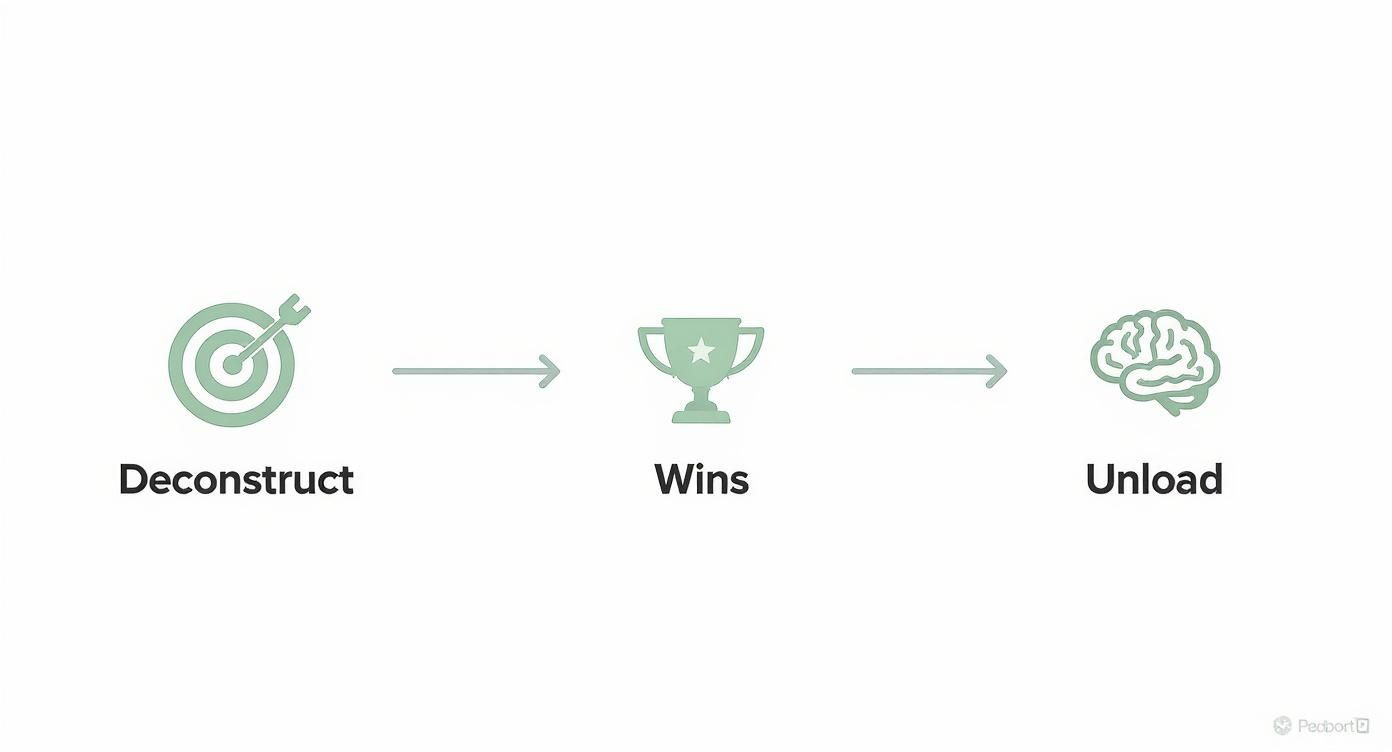
By breaking down your journaling into these smaller, more focused areas, you make the whole process feel less intimidating and far more actionable.
AI-Powered Insights for Deeper Growth
This kind of integration is becoming a huge part of the personal development world. The industry is already valued at $48.4 billion and is expected to hit $67.21 billion by 2030. A huge driver of this is mobile tech, with over 85% of self-improvement content now consumed on our phones.
The demand for effective tools is clear. Research shows that people who journal regularly report a 25% improvement in stress management and a 15% boost in productivity.
This is where Tracka’s AI coaching comes in, analyzing the links between your habits and journal entries.
It might notice you consistently log a 'low energy' day right after skipping your 'Morning Walk' habit. In response, it could offer a personalized prompt: "Reflect on one small thing that energizes you. How can you incorporate it tomorrow?"
This creates a powerful ecosystem for growth where your reflections directly inform your next actions.
Creating a Holistic Self-Improvement System
To make this work in the real world, you need to deliberately align your journaling themes with the habits you’re tracking. This synergy ensures your reflections are always tied to measurable behaviors.
Let’s look at how you can pair specific journaling prompts with habits you might be logging in Tracka.
Pairing Journaling Prompts with Tracka Habits
This table shows how to connect your journaling themes directly to the habits you're building. This makes sure your reflections lead to real-world action.
| Self-Improvement Goal | Suggested Journaling Prompt | Habit to Track in Tracka |
|---|---|---|
| Increase Daily Energy | "What activity today gave me the most energy, and what drained it?" | "Morning Sunlight," "Hydration," "8 Hours of Sleep" |
| Boost Productivity | "When did I feel most focused today? What was my environment like?" | "Deep Work Blocks," "No Social Media," "Daily Planning" |
| Reduce Stress | "What was the primary source of my stress today, and how did I respond?" | "Meditation," "Journaling," "Mindful Break" |
When you log both your thoughts and your actions in one place, you get a complete picture of what's going on. You can finally see how your daily habits influence your mindset (and vice versa), making it so much easier to tweak your routines for better results.
This integrated approach ensures you're not just tracking habits for the sake of it—you're building a system where every single action and reflection works together to get you closer to your goals.
Overcoming Common Journaling Roadblocks
Even the best habits run into friction. When it comes to journaling, it’s easy to get derailed by a few common challenges. But the key isn’t to force your way through them; it’s to adapt your approach so the habit actually serves you, not the other way around.
Don’t let a few off-days convince you the whole thing isn't working. Consistency is a universal struggle in behavior change. A truly effective journaling routine needs to be flexible enough to handle the natural ups and downs of your energy and motivation.
When You Feel Uninspired or Burnt Out
Feeling overwhelmed by your journal is a clear sign to simplify, not quit. If filling a whole page feels like a chore, it's time to scale way back. The goal here is consistent reflection, not perfect prose.
Try stripping your practice down to its absolute minimum:
- One-Sentence Summary: Can you capture the entire day in a single, powerful sentence?
- A Single Word: Pick one word that defines your mood or the day’s biggest lesson.
This micro-approach keeps the habit alive without feeling like another task on your to-do list. You can log these tiny entries in Tracka to maintain your streak, which reinforces the behavior even on your lowest-energy days. This creates a data point that tells a story—Tracka's AI can then show you how these "low-effort" days correlate with other habits, like your sleep or exercise.
Navigating Writer's Block
Staring at a blank page is universally intimidating. When the words just won’t come, stop trying to write paragraphs and switch to lists. This simple format change removes the pressure to craft perfect sentences and gets you straight to the core insight.
A few list-making prompts can break the block almost instantly:
- List three things that gave you energy today.
- List two things you’re looking forward to tomorrow.
- List one thing you can let go of before you sleep.
Your journal is a tool for clarity, not a performance. If one method isn’t working for you, pivot. The most successful journaling practices are the ones that adapt to what you need on any given day.
ADHD-Friendly Journaling Strategies
For neurodivergent minds, traditional long-form writing can feel like putting on a straitjacket. If sitting still to write feels tedious and restrictive, it's time to redefine what "journaling" even means. The real goal is just to get your thoughts out of your head and into a format you can look at later.
Consider a few alternatives that work with your brain, not against it:
- Voice Notes: Grab your phone and just talk. It’s fast, fluid, and captures the raw emotion behind your thoughts better than typing.
- Bullet Points: Ditch full sentences entirely. Use rapid-fire bullet points to capture wins, frustrations, and random ideas as they come.
- Mind Maps: If you're a visual thinker, a mind map can be a much more intuitive way to connect different ideas and explore a theme without being locked into a linear format.
The best way to journal for self-improvement is whichever one lowers the friction enough to keep you coming back. Whether you write, speak, or draw your reflections, logging your consistency in Tracka ensures that every single effort—no matter the format—counts toward your growth.
Frequently Asked Questions About Journaling
Starting a journaling routine comes with its fair share of questions. Below, you’ll find clear, practical answers that help you jump in and keep going without second-guessing yourself.
How Long Should I Journal Each Day
Aim for just 5-10 minutes at first. Consistency matters far more than the duration of a session.
Once you’ve nailed that daily rhythm, feel free to stretch your writing time. But remember: a single, meaningful line counts just as much as a full page.
What If I Miss A Day Of Journaling
A skipped day isn’t a failure—it’s a reminder that life happens. What really counts is getting back to your page.
Resist any urge to feel guilty. Tomorrow is a fresh start and an opportunity to rebuild momentum.
The most successful journaling habits adapt to real life instead of collapsing when things get busy.
Should I Use A Digital App Or A Physical Notebook
It all comes down to which option feels easier to stick with.
- Digital Apps: Tools like Tracka offer quick search, habit integration, and AI-powered insights. Perfect for capturing ideas while you’re on the move.
- Physical Notebooks: A paper journal can feel grounding and distraction-free. You can doodle, sketch, or craft custom layouts exactly how you like.
Give both a trial run and choose whatever you’ll actually use day after day.
Do I Have To Write About My Feelings
Emotions are just one angle. Journaling can also serve as a tactical growth tool.
- Tracking milestones toward your career objectives
- Outlining tomorrow’s priorities for sharper focus
- Noting energy levels or attention shifts
- Highlighting small victories to build confidence
Customize your entries to reflect the outcomes you care about. Your journal should align with your unique path.
Ready to turn your reflections into measurable progress?
Tracka combines journaling with AI-powered habit tracking to give you a complete system for self-improvement.
Get started for free at https://tracka.ai to build habits that stick.


