

Breaking a bad habit isn't about finding a magic bullet. It's about understanding and rewiring your brain's deeply ingrained automated systems. The real secret is to pinpoint the cue that triggers the behavior, swap the unhealthy routine with a better one, and ensure the new routine delivers a similar reward. This is a strategic game, and it’s far more effective than just gritting your teeth and relying on willpower.
Why Willpower Is Not Enough to Break Bad Habits
Let’s be real for a moment. Trying to break a bad habit with willpower alone is like trying to hold back the tide with a bucket. It's frustrating, but that struggle isn't a personal failing. It’s a fundamental misunderstanding of how habits are wired into our brains. Most of us try to "just stop," only to find ourselves right back where we started. It’s no wonder studies show 80% of resolutions are abandoned, often within just a few weeks.
This happens because habits aren't run by our conscious, decision-making minds. They’re managed by the basal ganglia, a part of the brain that acts as an autopilot to save mental energy. This is fantastic for good habits, but it makes bad ones incredibly hard to shake, draining our focus and wellbeing.
This entire process is driven by the habit loop—a simple but powerful neurological cycle that keeps our automatic behaviors on repeat. This visual breaks down the three core components that keep your habits locked in place.
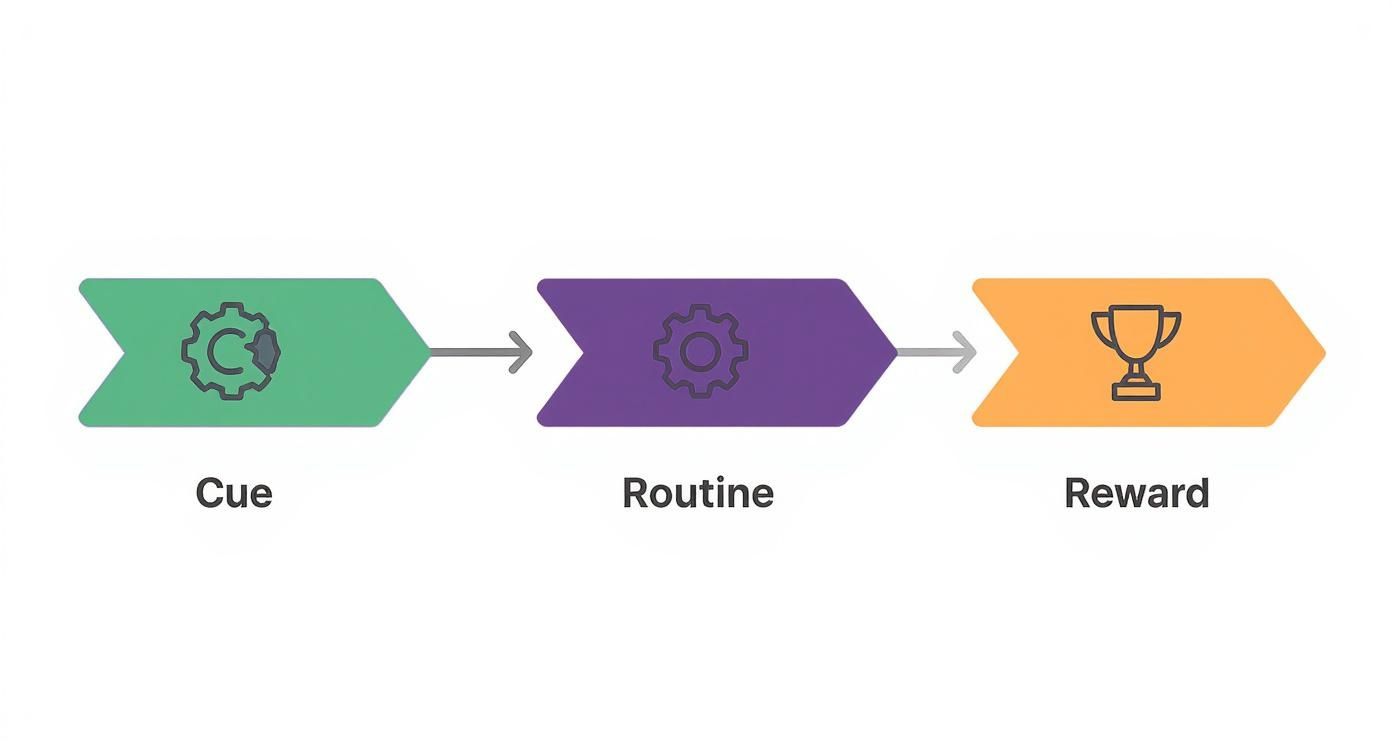
As you can see, every single habit follows this pattern: a cue triggers a routine, which leads to a reward. That reward reinforces the whole cycle, making it more likely to happen again. If you want to genuinely learn how to break bad habits, you have to interrupt that loop by changing the routine.
The Real Impact of Our Daily Routines
The stakes are much higher than just personal frustration. A staggering 70% of global deaths are linked to lifestyle behaviors like poor diet, lack of exercise, and smoking. These aren't just abstract statistics; they're the daily patterns that drain our energy, kill our focus, and impact our overall wellbeing. You can explore more on the connection between habits and public health over at weforum.org. Better habits lead to better life outcomes, from enhanced productivity to reduced stress.
Lasting change isn't about shaming yourself for past attempts. It’s about equipping yourself with a proven framework to dismantle unwanted behaviors and build a life you’re truly proud of.
A Smarter Path to Lasting Change
This is where a strategic approach, backed by the right tools, makes all the difference. Instead of fighting a constant battle against your own brain, you can learn to work with its wiring. Understanding this framework is your first step toward real, lasting change—but it’s a journey that takes time and consistency. You can dive deeper into the science of how long this really takes in our article exploring the 21-day myth.
Unlike generic habit apps, Tracka makes habit change achievable by combining habit tracking, AI-powered insights, and social accountability. By making it easy to log your actions and see the patterns, you can finally connect the dots between the cues and rewards that drive your behavior. This data-driven method replaces guesswork and guilt with clarity and personalized insights, making better habits something anyone can achieve, whether you’re tracking fitness, screen time, or personal growth.
Find the Real Triggers Behind Your Habits
To break a bad habit, you have to play detective with your own behavior. Before you can change a routine, you need to understand what kicks it into gear. Every single habit—good or bad—is sparked by a specific cue. It's the signal that tells your brain, "Okay, time to run this program," and sends you into autopilot.
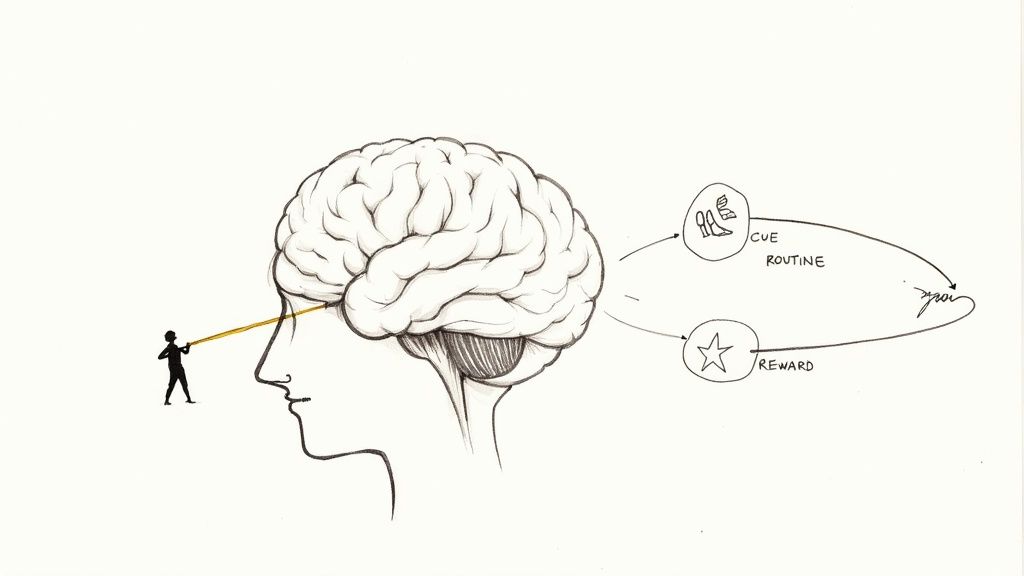
Take the classic afternoon mindless snacking habit. Is the real trigger the fact that it's 3:00 PM? Or is it a creeping sense of boredom? Maybe it's the pressure of a looming deadline. The reward you're actually chasing isn't the food itself, but the feeling it gives you—a quick distraction, a moment of comfort, or a little dopamine boost. If you don't know the true cue, trying to change the habit is just a shot in the dark.
This is where self-tracking becomes your secret weapon. Instead of guessing or feeling guilty, you start collecting data on yourself.
Conducting a Personal Habit Audit
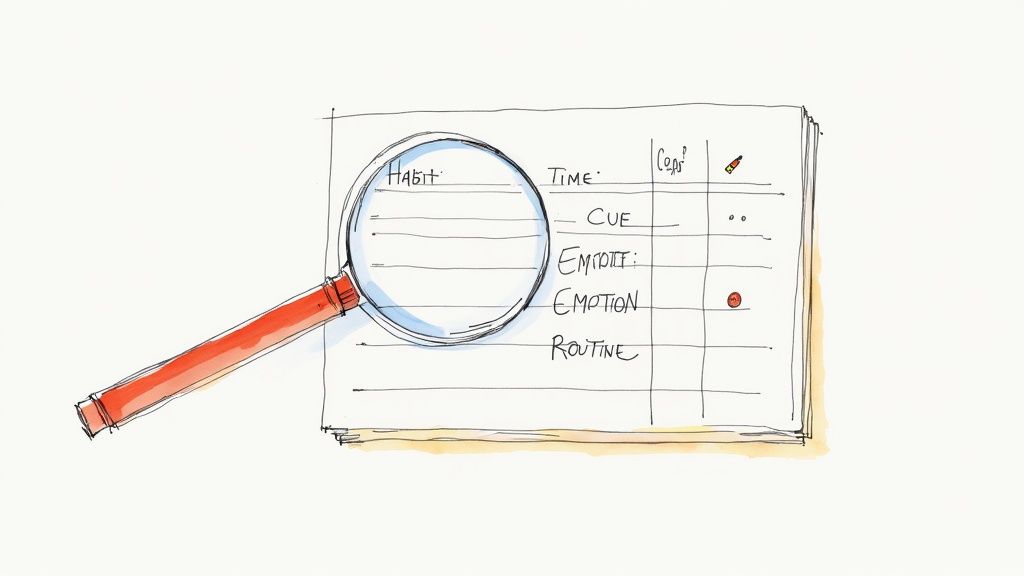
For the next week, just observe. Your only job is to watch and record what happens right before and after you do the habit you want to change. Don't try to stop yourself yet; just notice the patterns. Every time you catch yourself doing it, jot down the details. This simple act shifts you from being a passive participant in your own life to an active, curious observer.
This data is gold because most triggers fall into one of five categories. Nailing down which one (or which combination) is at play gives you a clear target.
- Location: Where are you when the urge hits? (The kitchen? Your desk? The car?)
- Time: What time is it? (That 3:00 PM slump? Right after dinner? Late at night?)
- Emotional State: How are you feeling just before? (Stressed, bored, anxious, lonely, tired?)
- Other People: Who are you with? (A certain coworker? Your family? Or are you alone?)
- Preceding Action: What did you just do? (Finish a tough report? Open social media? End a stressful call?)
You can use a simple notebook, but an app like Tracka.AI makes this much easier. A quick log lets you capture the context in seconds without derailing your day. The whole point is to collect enough evidence to see the connection: If [this trigger happens], then I [do the bad habit].
From Raw Data to Actionable Insights
After just a few days of this, you’ll start seeing things you never noticed before. You might realize your late-night doomscrolling isn't just a symptom of being tired; it's how your brain tries to escape the anxiety of an unfinished to-do list. Or that hitting the snooze button isn't about needing more sleep—it's about avoiding the wave of stress you feel when you think about your workday.
By identifying the cue, you stop fighting the habit itself and start addressing its root cause. This shift from battling willpower to strategic problem-solving is the foundation of lasting change.
Let’s get this down on paper. The "Cue-Routine-Reward" loop is a classic for a reason—it works. Use this table to break down one of your habits. This simple exercise helps you see all the moving parts you have to work with.
Decoding Your Habit: The Cue-Routine-Reward Framework
Use this framework to break down a bad habit into its core components. Identifying each part is the first step to changing the routine.
| Habit Component | What It Is | Example: Mindless Snacking |
|---|---|---|
| Cue | The specific trigger that initiates the behavior. | Feeling overwhelmed by a work project. |
| Routine | The automatic action you take in response to the cue. | Walking to the pantry to find chips. |
| Reward | The craving you satisfy by performing the routine. | A brief mental escape from the stress. |
Once you’ve mapped these three parts out, you have a blueprint for change. You now know the exact moment to intervene and the specific reward your brain is actually craving. This clarity is what separates failed attempts from real, lasting transformation. Now, let’s use this insight to design a new routine.
It's About Finding a Better Routine, Not Just a New One
Once you’ve figured out the cue that kicks off your bad habit and the reward you're really after, the interesting part begins. You're not trying to blow up the whole habit loop; you're just hijacking it for your own good. The secret is to swap out your old, unhelpful routine with a new one that gives you a similar—or even better—payoff. This is the exact spot where most people get stuck, because they try to eliminate the bad habit instead of replacing it.
Let's say stress (the cue) sends you into a social media scroll-hole for a mental break (the reward). Just telling yourself to "stop scrolling" is a recipe for failure. Your brain is still screaming for that escape. What you need is a substitute. Could a five-minute walk, a quick meditation, or even listening to one of your favorite songs give you that same feeling of release? Almost always, the answer is yes.
This swap is so much more effective than relying on sheer willpower because it works with the brain's existing pathways. You're giving it the reward it craves, just through a healthier, more intentional route.
Build Your Library of Replacement Habits
Think of every bad habit as a clumsy solution to a real need. Your job is to find better, smarter solutions. Let's break down some common struggles and brainstorm practical replacements you can slot right into your old habit loop.
- Fighting Procrastination (The Reward: Distraction): You find yourself endlessly browsing news sites to avoid a challenging task. The reward here is a temporary escape from mental effort. A much better routine could be the Pomodoro Technique—work for 25 minutes, then take a planned 5-minute break to stretch or grab some water. This boosts focus and reduces stress.
- Kicking Nail-Biting (The Reward: Sensory Stimulation): This is often a go-to for anxiety or boredom. The reward is a physical release for that nervous energy. Try keeping a stress ball, a fidget toy, or even a smooth stone in your pocket to give your hands something to do when the urge hits.
- Curbing Excessive Screen Time (The Reward: Dopamine): That infinite scroll delivers a steady, low-effort drip of novelty. You can replace it with something that offers a more satisfying mental payoff, like reading one chapter of a book, working on a puzzle, or listening to a short podcast. This can lead to better sleep and more energy.
Finding the right replacement is all about experimentation. For more ideas and strategies to make these changes stick, check out our other articles on behavior change.
Make Your New Habit Impossible to Ignore
Okay, so you know what you should do. But actually doing it in the heat of the moment is a whole different ballgame. To really make it stick, you have to make the new routine ridiculously easy to start. This is where a couple of powerful concepts come into play.
The real goal is to crowd out the old habit with a better one. You're not fighting an urge anymore; you're just choosing a more rewarding path that creates a lasting shift in how you operate day-to-day.
First up is habit stacking. This is all about anchoring your new routine to a habit you already have locked in. For example, "After I pour my morning coffee (existing habit), I will do two minutes of stretching (new habit)." It cleverly links the new behavior to something your brain already does on autopilot.
The second piece is starting incredibly small, a concept often called tiny habits. Your new routine should be so easy it feels almost silly not to do it. Instead of a 30-minute meditation, just start with "take one deep breath." Instead of "go to the gym," your first step is simply "put on my workout clothes." These tiny actions sneak past your brain's resistance and build real momentum.
This approach honors a hard truth about building new habits: it takes time. Research shows that forming a new, healthy habit can take anywhere from 18 to 254 days. That huge range is exactly why consistency with tiny, manageable actions works so much better than big, infrequent efforts.
This is where a tool like Tracka can be a game-changer. You can log that "one deep breath" in seconds, giving your brain a little hit of reinforcement and creating a visual record of your progress. That consistent tracking is what helps turn a small, intentional action into a powerful, automatic routine.
Design an Environment That Supports Your Goals
If you're trying to break a bad habit by gritting your teeth and relying on pure willpower, you're fighting an uphill battle you'll probably lose. Willpower is a finite resource. On a good day, you might have plenty, but on a stressful day? It's the first thing to go.
A much smarter, more sustainable approach is to become the architect of your own environment. You need to consciously rig the game in your favor, designing your surroundings to make good choices feel automatic and bad ones feel like a chore.
Think of it as adding or removing friction. Your physical space, your phone, and even your social circle are constantly sending you cues. The real secret is to reshape those cues so they point you toward your goals without you even having to think about it.
Make Your Bad Habits More Inconvenient
The easiest way to stop a bad habit is to make it a pain to do. When an action requires even a little extra effort, your brain is far less likely to choose it on autopilot. This isn't just a clever trick; it's a practical application of behavioral science you can put into place right now.
A few simple tweaks can make a massive difference:
- Mindless Snacking: Stop leaving junk food on the counter. Move it to a high shelf in the back of the pantry. If you have to grab a stool just to reach the cookies, that extra step gives you a crucial moment to ask, "Do I really want this?"
- Social Media Rabbit Holes: Is Instagram or TikTok eating your focus? Get the apps off your home screen. Bury them in a folder on the very last page of your phone. That extra swipe-and-search can be just enough to break the impulsive tap.
- Cutting Back on Drinks: If you're trying to drink less alcohol, stop suggesting the bar as the default hangout spot. Propose meeting friends for coffee, a hike, or a walk in the park instead. Change the venue, and you change the behavior.
By adding these tiny barriers, you disrupt that automatic habit loop. You're forcing yourself to make a conscious choice, and that's where you regain control.
Make Your Good Habits Ridiculously Easy
On the flip side, you want to make your new, positive habits as frictionless as possible. The less resistance you face, the more likely you are to actually stick with them. Your environment should be a launchpad for your goals, not an obstacle course.
This is all about setting up your future self for a win. Make the right choice the most obvious one.
The most successful people don't have more willpower than you; they have better-designed environments. They make good habits the path of least resistance.
Here’s how you can pave the way for good habits to form:
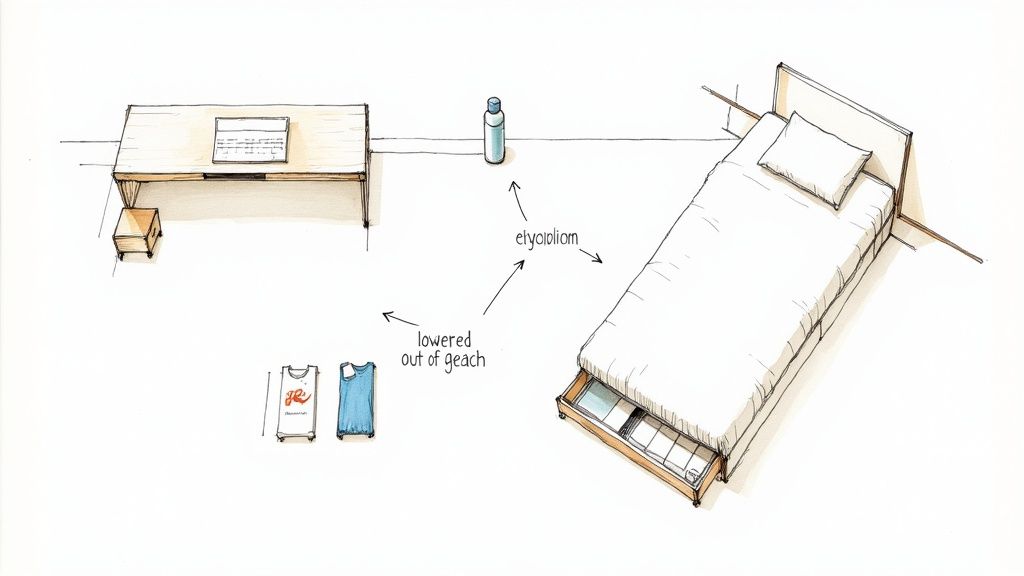
- Prep Like a Pro: Want to work out in the morning? Lay out your gym clothes, shoes, and water bottle the night before. When your alarm goes off, there’s no thinking involved—you just get dressed and go.
- Keep Your Tools Visible: Trying to drink more water? Don’t hide your bottle in a cabinet. Keep a full one on your desk all day long. Want to read more? Leave a book on your pillow. These visual cues are incredibly powerful reminders.
- Automate Everything You Can: Set up automatic transfers to your savings account so you don't have to think about it. Use an app like Tracka to send you a simple nudge to log your progress, making consistency a natural part of your day.
These small adjustments remove the decision fatigue that so often kills our best intentions. When the right thing to do is also the easiest thing to do, you've built a system that truly works for you.
Curate Your Digital and Social Worlds
Don't forget that your "environment" goes way beyond your physical space. The information you consume and the people you spend time with have a massive influence on your habits.
Start with your digital world. Unfollow social media accounts that trigger envy, anxiety, or bad habits. Fill your feed with people and pages that inspire you and reflect the person you want to become. If your phone is a major distraction, use its built-in focus modes or apps that block certain websites while you're trying to work.
Your social environment is just as critical. Studies show that a large portion of our daily actions are habits performed almost unconsciously, often shaped by the people we're around. Sharing your goals with a supportive friend can be a game-changer. Better yet, using the community-driven features in Tracka provides the encouragement and social accountability you need to stay on track. When your community is cheering you on, sticking with a new habit becomes exponentially easier.
Use Data to Stay Motivated and Overcome Setbacks
Let’s be honest: the road to breaking a bad habit is never a straight line. You’re going to have days where the old routine wins. You'll skip the workout, grab the junk food, or lose an hour scrolling through social media. It happens.
When it does, the absolute worst thing you can do is let one slip-up convince you to give up entirely.
The goal was never perfection. It’s all about consistent, forward momentum. This is exactly where tracking your journey becomes your secret weapon, turning the messy, emotional rollercoaster of change into a clear, data-driven mission.
Your Progress Is Your Greatest Motivator
Motivation is a fickle friend. It shows up when it wants to and disappears when you need it most. What you can rely on, however, is the proof of your work.
Seeing a visual record of your progress—no matter how small the wins—creates a powerful psychological feedback loop. Every checkmark on the calendar or logged success reinforces the new identity you're building.
You gradually stop seeing yourself as someone trying to work out and start seeing yourself as someone who works out. That identity shift is infinitely more powerful than a fleeting burst of inspiration. It's the difference between "I'm trying to run" and "I am a runner."
This is where a dedicated tool like Tracka.AI really shines. It gets all that progress out of your head and onto a screen, creating a tangible record of your effort. Logging a win takes just a few seconds, but the little dopamine hit and visual reinforcement provide the fuel you need to keep going, especially on the days you feel like throwing in the towel.
Turn Your Setbacks into Strategy
A slip-up feels like a failure, but it’s not. It’s just a data point.
When you're consistently tracking your habits, a missed day isn't a reason for shame—it’s a massive opportunity to learn. It’s your system sending you a signal that something needs a small adjustment.
Instead of spiraling into guilt, you can get curious and ask some clarifying questions:
- What was the trigger? Did a stressful meeting at 3 PM send me straight to the vending machine?
- Was my new habit too hard? Is a 30-minute meditation session just too ambitious to start with?
- Did my environment betray me? Were there cookies sitting on the counter when I walked in tired and hungry?
This mindset shift is everything. You're no longer a victim of your impulses; you're a scientist experimenting with your own behavior. You can analyze the patterns and make smart adjustments instead of just trying to "be better" with the same broken strategy.
A setback isn't a moral failing. It is simply feedback. Use it to refine your approach, not to abandon your goal. Your ability to get back on track is a far better indicator of long-term success than your ability to be perfect.
For example, the AI-powered insights in Tracka can connect the dots for you, providing personalized coaching. It might highlight something like, “You’re 80% more likely to skip your morning walk on days you get less than six hours of sleep.” That’s not a criticism; it’s an incredibly valuable, actionable insight. Now you know that protecting your sleep is a core part of your habit-breaking strategy.
The Never-Miss-Twice Rule
One of the most practical and powerful principles for handling setbacks is the “never-miss-twice” rule. It’s beautifully simple: you might miss one day, but you never, ever let it become two in a row.
One missed day is an accident. Two missed days is the beginning of a new, unwanted habit.
This rule gives you a clear, manageable plan for recovery. It cuts through the paralysis that often follows a setback and gives you a single, immediate action to focus on. It acknowledges that life is messy while ensuring one disruption doesn't undo weeks of hard work.
Ultimately, tracking your habits is about so much more than streaks and charts. It’s about building a system of self-awareness and continuous improvement. It gives you the clarity to see what’s working, the data to fix what isn’t, and the motivation to keep showing up. That consistent effort, guided by data, is how you truly break bad habits for good.
Common Questions About Breaking Bad Habits
When you start trying to change your habits, it's totally normal for questions and doubts to creep in. Feeling like you've hit a wall or wondering if you're even doing it right is part of the process. Let's walk through some of the most common hurdles people face so you can navigate them with confidence.
What if I Don’t Know My Triggers?
Sometimes a habit is so automatic that you can't even tell what sets it off. The trigger isn't always a big, obvious event; it can be subtle, like the feeling of boredom that hits mid-afternoon.
If you're stuck, just start observing. For the next few days, don't try to change anything. Simply note when the habit happens. Using a quick-log feature in an app like Tracka is perfect for this. Just tap a button when the urge strikes or the action occurs. After a bit of data collection, personalized insights can act like a detective, piecing together clues and revealing patterns—like trends and health links—you never would have spotted on your own. You might discover your snack cravings spike right after a stressful weekly call or that you only doomscroll when you're in a specific room.
Why Do I Keep Failing After a Few Good Days?
This classic slump happens to almost everyone, and it usually boils down to two culprits: leaning too heavily on willpower or trying to do too much, too soon.
Think of willpower as a phone battery—it starts full in the morning but drains with every decision, stressful moment, and temptation you face. If your entire strategy relies on "just being strong," you're setting yourself up to fail when your battery is low.
The other common pitfall is going from zero to one hundred. We get a burst of motivation and decide to overhaul our lives overnight. But big, sudden changes are brittle. Instead, lean into the tiny habits approach. Your goal isn't to run a 5k tomorrow; it's just to put your running shoes by the door. These small, almost laughably easy wins are what build real, lasting momentum and boost consistency.
You're not starting over from scratch after a setback. You're starting again with experience. Each attempt teaches you something new about your patterns and what strategies work best for you.
Can You Ever Truly Erase a Bad Habit?
From a neuroscience perspective, the neural pathways for old habits don't just vanish. They're like old, overgrown trails in a forest. This is why a powerful trigger, even years later, can sometimes make you want to take that old path again.
But don't let that discourage you. The goal isn't to dynamite the old trail; it's to build a new, paved superhighway right next to it. Every time you choose your replacement behavior, you're strengthening that new pathway. Eventually, it becomes so smooth and easy to travel that taking the old, rickety path feels like too much work. It’s not about deletion; it's about making the better choice the path of least resistance.
How Long Does It Really Take to Break a Habit?
Forget the old "21 days" myth. That number came from a misinterpretation of a plastic surgeon's observations about patients getting used to a new face, not about behavioral change.
Modern research shows that the timeline is all over the map. For some people and some habits, it might take a couple of months. For more ingrained behaviors, it could take the better part of a year for the new routine to feel completely automatic. There's no magic number.
This is exactly why your focus should be on the process, not the timeline. Don't get obsessed with maintaining a perfect streak. Instead, adopt the "never miss twice" rule. If you slip up today, that's okay—it happens. Your only job is to get back on track tomorrow. Consistency is far more powerful than perfection.
You don't need more willpower; you need a better system. Tracka.AI provides the tools to understand your triggers, track your progress without pressure, and get the AI-powered insights and social accountability you need to make change stick. Start building a better routine today by visiting https://tracka.ai.
Article created using Outrank


