

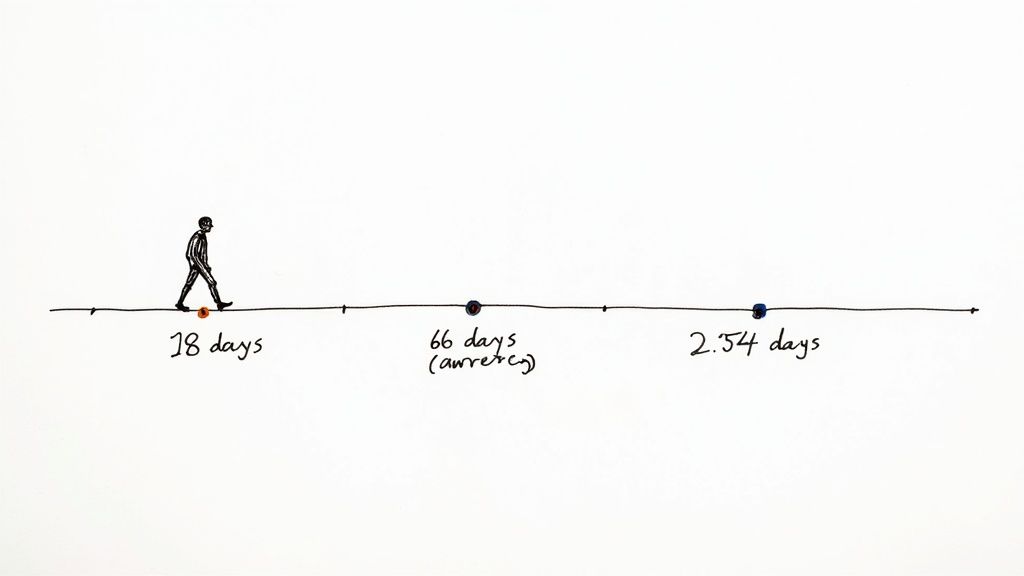
Let's get one thing straight: the idea that it takes 21 days to form a new habit is a catchy myth, not a scientific fact. The truth is, the journey to making a new behavior feel automatic can take anywhere from 18 to 254 days. The most widely cited average? Around 66 days.
The Real Timeline for Building a New Habit
If you've ever tried to build a new routine, hit that three-week mark, and wondered why it still felt like a chore, you're not alone. The 21-day myth sets an unrealistic expectation, leading countless people to feel like they’ve failed when they were just getting started. It's a key reason why nearly 80% of people abandon their resolutions.
The reality is that building a habit is a personal marathon, not a universal sprint. Understanding the real timeline helps you trade self-criticism for a patient, evidence-based approach. That huge range—from just over two weeks to more than eight months—isn’t a flaw in your willpower; it’s a feature of being human. Your timeline is unique to you and the habit you’re trying to build.
Why Timelines Vary So Much
Think about it. A simple habit, like drinking a glass of water when you wake up, is pretty low-lift. It’s easy to tack onto your existing morning routine and lands on the shorter end of that spectrum.
But what about something more complex? A recent study found that establishing a consistent gym habit takes, on average, about six months to become automatic. That’s a far cry from 21 days. In contrast, a simpler health habit like regular handwashing can lock in within just a few weeks. If you want to dive deeper, you can read more about the research behind these timelines.
This all points to one crucial takeaway: there is no magic number. Your progress is shaped by real-world factors, including:
- Complexity: How hard is the new behavior, really?
- Consistency: Are you showing up most days, even when you don't feel like it?
- Environment: Does your space make the habit easier or harder to do?
- Motivation: What’s your "why"? How badly do you want this change?
The real goal isn't hitting some arbitrary number on a calendar. It’s reaching a state of 'automaticity'—that tipping point where doing the new behavior feels more natural than not doing it. That's the true sign of a habit that has stuck, leading to real-life impact like better focus and more energy.
Let's break down how the popular myth stacks up against reality.
Habit Formation Timelines: Fact vs Myth
This table shows just how different the common perception is from the research-backed averages for different types of habits.
| Habit Type | Mythical Timeline | Research-Backed Average Timeline |
|---|---|---|
| Drinking a glass of water every morning | 21 Days | 20-30 Days |
| Eating a piece of fruit with lunch | 21 Days | ~50 Days |
| Going for a 15-minute walk daily | 21 Days | 50-60 Days |
| Doing 50 sit-ups after your morning coffee | 21 Days | ~66 Days |
| Going to the gym 4 times per week | 21 Days | ~6 Months |
As you can see, the more effort a habit demands, the longer you need to stick with it before it becomes second nature.
The infographic below really drives home the difference between the 21-day fiction and the 66-day average.
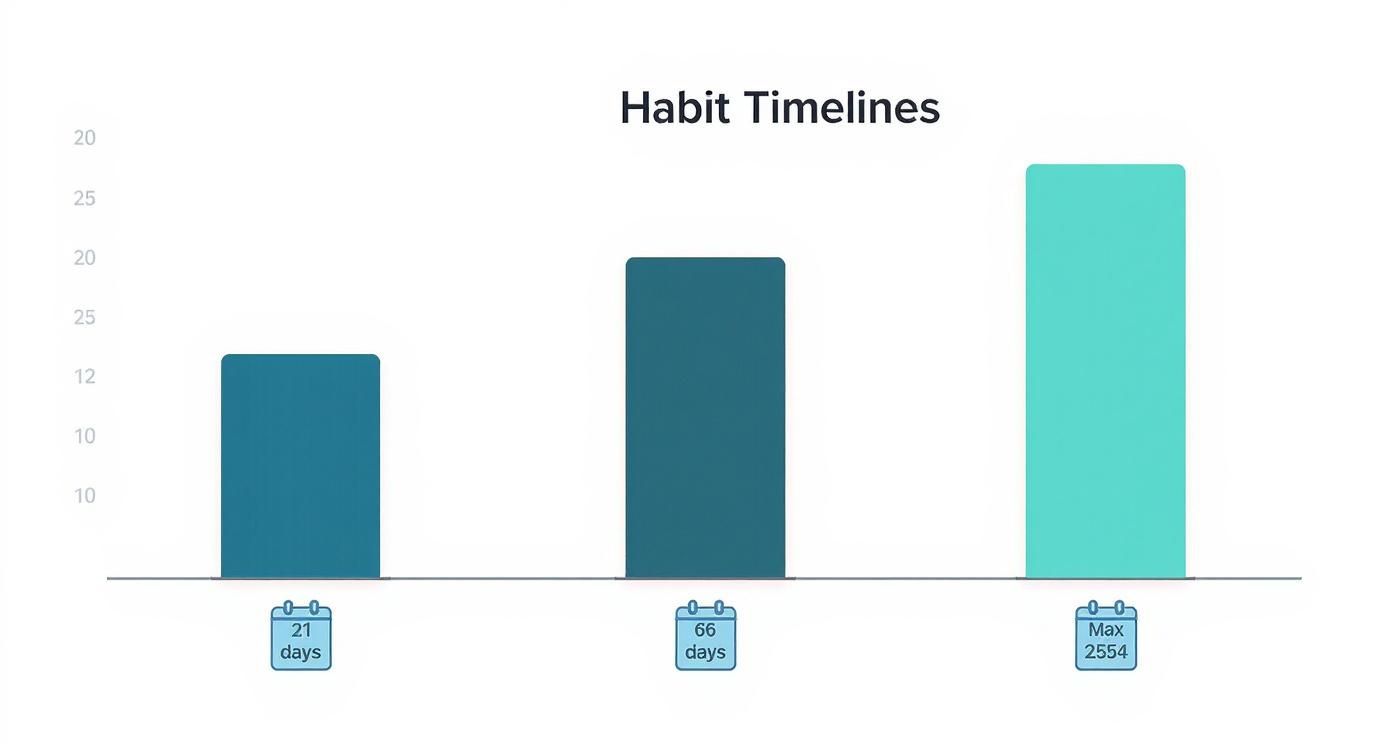
This visual contrast makes it crystal clear: patience isn't just a virtue in habit formation, it's a requirement.
A Smarter Approach to Building Habits
Instead of gearing up for a 21-day sprint, build a system that can support you for the long haul. This is where the right tool can make all the difference.
A habit-tracking app like Tracka is designed for this realistic journey. Unlike generic apps, it provides personalized, AI-powered insights that help you see your progress unfold over weeks and months, not just days. With gentle reminders and data on your trends, it turns the daunting challenge of habit formation into a manageable, and even enjoyable, process. By embracing a realistic timeline and the right support, you’re setting yourself up to build habits that actually last.
Why Do Some Habits Take Longer to Build?
Now that we’ve thrown out the one-size-fits-all timeline, let's get into the why. Why does drinking a glass of water every morning click into place so easily, while a 20-minute meditation practice feels like a constant battle? The answer has little to do with willpower and everything to do with the nature of the habit itself.
Think of it like forging a path. A simple habit—like putting your keys in a bowl by the door—is like walking across an open field. It only takes a few trips before a clear trail starts to form. But a complex habit, like learning a new language for 15 minutes a day, is like hacking a new trail through a dense forest. It takes more tools, more effort, and a lot more repetition to clear the way.
Once you understand these variables, you can stop blaming yourself for slow progress. Instead, you can design your habits strategically for success from day one.
Habit Complexity and Required Effort
The single biggest factor dictating your habit timeline is complexity. This isn't just about how difficult the action is, but how many steps it involves and how much mental and physical energy it drains from you.
A low-complexity habit is usually a single, simple action. A few good examples are:
- Taking a vitamin with your breakfast.
- Changing into workout clothes the second you get home.
- Writing one sentence in a journal before turning off the light.
These actions require almost no decision-making, so there's very little friction. The neural pathways form pretty quickly. On the other hand, high-complexity habits are packed with multiple decisions, demand significant effort, or even require you to shift your identity.
For a habit to become automatic, your brain has to learn to run a whole sequence of actions without your conscious input. The more complicated that sequence is, the more practice runs your brain needs.
This is exactly why tracking your progress is so important. Using a tool like Tracka, you can break a big, complex goal down into smaller, more manageable actions and log each time you show up. This provides the positive feedback needed to keep going, even when the path feels long and the end isn't in sight.
Emotional Connection and Your "Big Why"
Your motivation is the fuel in your habit-formation engine. A habit that's tied to a deep-seated personal value or a powerful emotional goal will always form faster than one you feel you should be doing.
A vague "why," like "I want to be healthier," is flimsy and hard to stick with. But a specific and emotional "why," like "I want to have enough energy to chase my kids around the park without feeling winded," is a powerful anchor that can pull you through on tough days. This direct link to real-life impact—more energy, less stress—creates a much stronger reward signal in your brain's habit loop, which helps speed up the whole process. This is a key piece of many effective goal setting strategies.
Consistency Trumps Perfect Attendance
Consistency is what makes the habit-building engine run, but let's be clear: it doesn't mean perfection. Missing one day won't send you back to square one, but long and frequent gaps will definitely slow you down. Every single repetition strengthens that neural connection, making the behavior a little more automatic next time.
The real goal is to be "mostly consistent." As long as you're performing the new habit on most days, you're actively rewiring your brain for success. Apps like Tracka are great for this because they help you visualize your consistency with streaks and progress charts. You can see that one missed day is just a tiny blip in a much larger pattern of success, which helps you stay objective and motivated for the long haul.
Navigating the Three Phases of Habit Formation
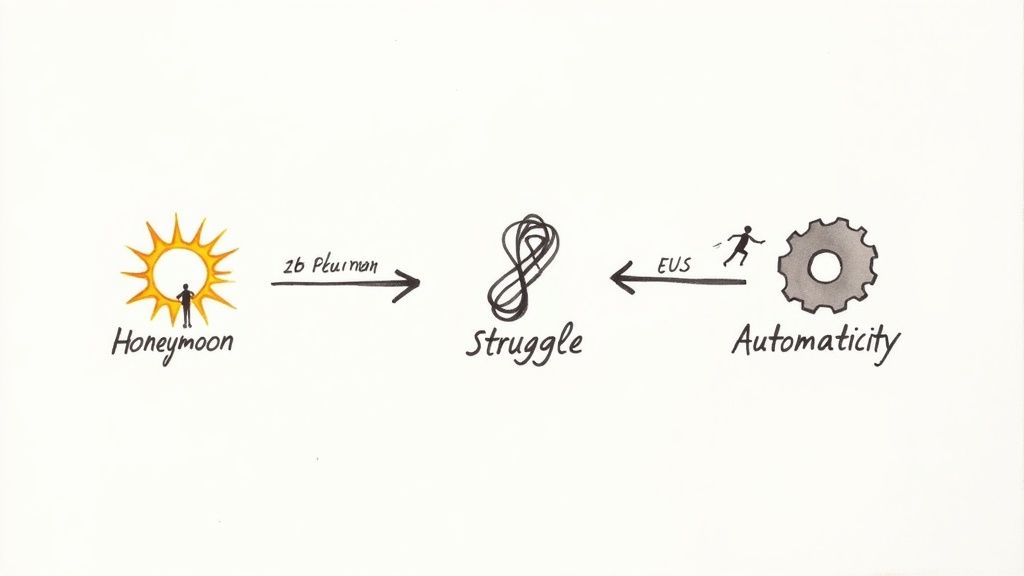
Building a new habit isn't just a mad dash to the finish line; it’s a predictable journey with a clear roadmap. Once you understand this path, you can anticipate the bumps, manage your expectations, and pull out the right strategies exactly when you need them. The whole process unfolds across three distinct phases, each with its own unique feel and set of challenges.
Think of it like learning to drive a car. At first, every single action—checking your mirrors, using the turn signal, braking smoothly—demands intense, focused concentration. Then you enter that awkward stage where you know all the steps, but they still feel clumsy and unnatural. Before you know it, you're driving home from work and realize you can't even remember the trip because it was just so automatic. That's exactly how habit formation works.
Phase 1: The Honeymoon
This is the launch phase, running purely on a fresh wave of motivation and excitement. You've just decided you’re going to meditate for ten minutes every day, and the whole idea feels energizing. You eagerly open your app, find a quiet spot, and get a real sense of accomplishment after every session.
During this phase, the action itself takes a lot of conscious effort. You’re leaning heavily on willpower and external nudges to make it happen. The real challenge here isn’t a lack of motivation, but simply building the initial framework for the routine. It’s incredibly easy to forget or just slip back into old patterns.
This is the perfect moment to set up your support system. In a habit-tracking app like Tracka, you can create clear, specific reminders and schedule your new habit right into your calendar. The goal is simple: make it as easy as possible to show up while your enthusiasm is at its peak.
Phase 2: The Struggle
And here we are, in the messy middle. This is where the initial buzz wears off and reality kicks in. That ten-minute meditation session suddenly feels less like a gift to yourself and more like another chore on your endless to-do list. Your motivation takes a nosedive, and that little voice of resistance gets a lot louder, whispering excuses like, "I'm just too tired today," or the classic, "I'll do it tomorrow."
This phase is the true test of your consistency. It’s where most people give up on their goals, usually because they mistake this friction for failure. It's not. This struggle is a completely normal and necessary part of rewiring your brain. The biggest trap to avoid is "all-or-nothing" thinking, where missing a single day feels like a perfectly good reason to quit altogether.
The struggle phase is where habits are truly forged. Success isn't about being perfect; it's about being persistent. Your only goal is to show up more often than you don't.
This is where having some data becomes your secret weapon. Seeing your progress laid out visually in Tracka can be a powerful motivator. Unlike generic apps, Tracka's AI-powered insights show you trends and patterns, helping you understand why you're struggling. Watching your streak grow—or realizing that one missed day is just a tiny blip in an otherwise solid record—gives you the objective feedback you need to push through the dip. For more ways to stay on track, check out our other productivity tips that can help you maintain momentum.
Phase 3: Automaticity
After pushing through the struggle, you finally reach the destination: automaticity. This is the point where the behavior becomes second nature. You no longer have to debate with yourself or drain your willpower to get it done. The habit is now your new default setting.
You'll know you've hit this phase when you find yourself doing the action without even thinking about it. You just sit down to meditate after your morning coffee because that’s simply what you do now. In fact, not doing the habit starts to feel weird. You've successfully wired the new behavior into your identity.
Once a habit becomes automatic, it frees up a ton of mental energy that you can now aim at your next goal. You’ve built a solid foundation, and you can use that momentum to start tacking on another positive routine—a process known as habit stacking. This is the ultimate payoff for all your hard-earned consistency and the key to improving your lifestyle, focus, and overall well-being.
Navigating the Three Phases of Habit Building
To make this journey even clearer, let's break down each phase, its biggest challenge, and how a tool like Tracka can help you navigate it successfully.
| Phase | Key Challenge | Strategy with Tracka |
|---|---|---|
| 1. The Honeymoon | Forgetting or getting sidetracked. Your motivation is high, but the routine isn't established yet. | Set up your scaffolding. Use reminders, scheduling, and clear goal-setting in the app to make showing up effortless. |
| 2. The Struggle | Waning motivation and the "all-or-nothing" trap. This is where most people quit when they miss a day. | Visualize your progress. Use streaks and AI-powered insights to see how far you've come, providing the encouragement to push through the dip. |
| 3. Automaticity | Maintaining and building momentum. The habit is ingrained, but now what? | Solidify and stack. Use the app to track your now-effortless habit and use that success as a launchpad to build your next one. |
By recognizing which phase you're in, you can stop fighting against the current and start using the right tools to move forward.
How Your Brain Rewires Itself for New Habits
Knowing the timeline for building a habit is one thing, but understanding what’s actually going on inside your head is the real key to making it stick. Every single time you repeat a new behavior, you are physically changing your brain’s wiring. This isn’t just a cool metaphor—it’s actual neuroscience at work.
Think of your brain like a dense forest. The first time you try a new action, it’s like trying to forge a path through thick, untouched wilderness. It’s tough, it takes a ton of effort, and you have to be completely focused. But the next time you walk that same path, it’s a little easier. Over time, that rough trail becomes a well-worn path that’s almost effortless to follow.
That process of creating and strengthening pathways is called neuroplasticity. Your brain is fundamentally built for efficiency; it loves to automate things to save mental energy for bigger, more complex problems. Knowing this helps you see that every repetition, no matter how small, genuinely counts. It reframes those days when progress feels slow—you’re not just trying to do something, you’re actively building a neurological superhighway.
The Science of the Habit Loop
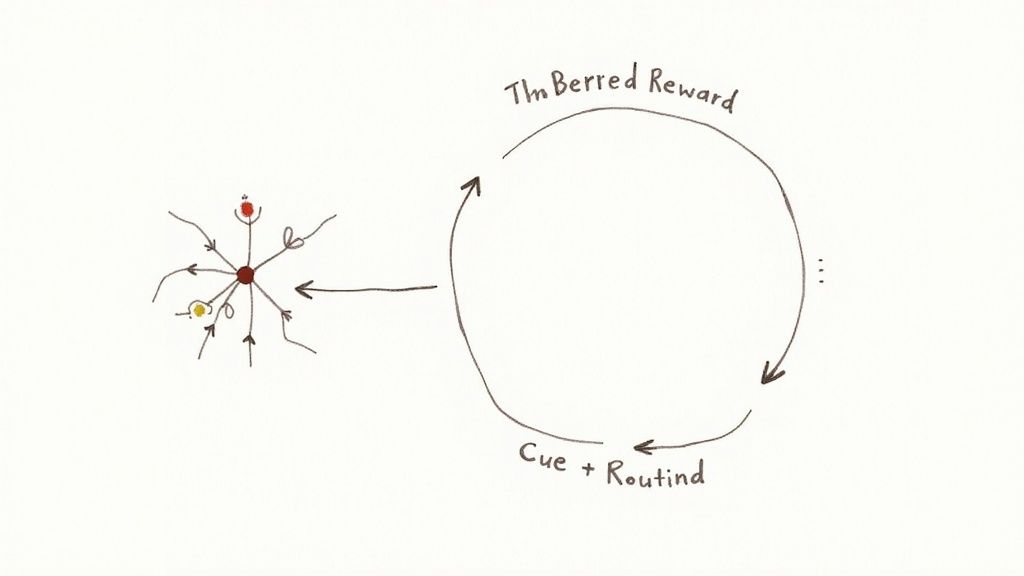
At the heart of all this rewiring is a simple but powerful pattern called the Habit Loop. This three-step neurological cycle is the engine behind every habit you have, from brushing your teeth to scrolling on your phone. If you can understand its components, you can learn to build better habits on purpose.
Here’s how the loop breaks down:
- The Cue: This is the trigger that kicks your brain into automatic mode. It’s the signal for which habit to use. Cues can be a time of day (your morning alarm), a specific place (your desk), an emotional state (feeling stressed), or even the action that just came before (finishing dinner).
- The Routine: This is the actual behavior, whether it’s physical, mental, or emotional. It’s the habit itself—lacing up your running shoes, meditating for five minutes, or grabbing a cookie.
- The Reward: This is the payoff. It’s the part that tells your brain, "Hey, this whole loop was worth it. Let's remember it for next time." The reward is what makes the habit stick.
The reward is the most crucial piece of the puzzle. It triggers a release of dopamine, a brain chemical linked to pleasure and motivation. That dopamine hit reinforces the connection between the cue and the routine, essentially telling your brain, "Do this again!"
Engineering Your Habits for Success
This brain science shows exactly why consistency beats intensity every time. A two-minute meditation session every day for a month builds a much stronger neural pathway than a single, hour-long session that you never repeat. Small, consistent actions are what carve those deep grooves in your brain.
This is also the principle that smart habit-tracking apps are built on. They help you consciously design and strengthen your own habit loops. For example, using an app like Tracka lets you engineer each part of the process:
- The Cue: You can set a specific reminder on your phone. That notification becomes your external trigger to start the routine.
- The Routine: You do the action, then immediately check it off in the app. The simple act of tracking becomes part of the routine itself, reinforcing your commitment.
- The Reward: Seeing your progress visualized—a growing streak, a completed circle, an encouraging message—delivers an instant dose of satisfaction. Tracka's personalized insights go a step further, showing how your efforts link to better focus or health outcomes, which acts as a powerful reward that motivates your brain to keep the cycle going.
By working with your brain's natural process instead of against it, you can stop relying on willpower alone. You start building a system that makes good habits feel less like a chore and more like an automatic, rewarding part of who you are.
The Hidden Factors That Speed Up or Slow Down Your Progress
Building a new habit never happens in a vacuum. Beyond just repeating an action, there's a whole ecosystem of influences working behind the scenes. These hidden forces can act like a tailwind, pushing you forward, or a headwind, holding you back. Learning to see and manage them is the real secret to making a habit stick.
Success isn't just about what you do; it’s about the environment—both internal and external—where you do it. Once you start shaping these factors, you can dramatically shorten the timeline for forming a habit and make consistency feel a whole lot less like a battle.
Your Internal Environment: Mindset and Stress
Some of the most powerful forces shaping your progress come from within. Your internal state—your thoughts, beliefs, and especially your stress levels—can either fuel your efforts or sabotage them before you even get started.
First, let's talk about your mindset. If you come from a fixed mindset, you tend to see your abilities as set in stone. Missing one workout feels like proof that you "just don't have the willpower," which makes it easy to give up. This perspective turns every minor setback into a final verdict on your character.
On the flip side, a growth mindset treats challenges as chances to learn and get better. When you miss a day, you don't see it as a failure but as useful data. You can ask yourself, "Okay, what got in the way, and how can I plan for that next time?" This approach builds resilience, which is absolutely essential for long-term change.
Then there's stress. When you're constantly stressed out, your brain gets flooded with cortisol, a hormone that's hardwired for short-term survival, not long-term goals. This makes it incredibly difficult to find the energy for self-control and stick to a new, demanding routine. Managing stress isn't just a nice-to-have for your well-being; it's a core strategy for building habits.
Your External Environment: Space and Social Circles
Your physical and social surroundings are constantly sending you cues that either support your new habit or undermine it. The good news? You have more control over these external triggers than you might think.
Start with your physical environment. The trick is to design your space for success by making the right habits easy and the wrong ones hard.
- Want to drink more water? Don't just wish for it. Put a water bottle on your desk, another by your bed, and one in your car.
- Trying to cut down on screen time? A simple fix is to move your phone charger out of the bedroom.
- Building a fitness habit? Take two minutes to lay out your workout clothes the night before.
Each small adjustment removes a little bit of friction, making your desired action the path of least resistance.
Your environment is the invisible hand that shapes your behavior. When you consciously design your surroundings to align with your goals, you stop relying on finite willpower and start leveraging the power of context.
Just as important is your social environment. The people you spend time with have a massive influence on your behavior. This is the power of social accountability in action. When you share your goals with supportive people, you create a network that offers encouragement when you need it most.
The data backs this up. People are far more likely to hit their goals when they have an accountability partner. In fact, one study found that making a commitment to a person you see regularly can boost your success rate to an incredible 95%. It's no wonder so many people struggle in isolation; we're fundamentally wired for connection and community.
This is where a tool like Tracka makes a real difference. It’s designed to help you manage both your internal and external worlds. The AI-powered insights can help you spot patterns tied to stress or mindset, turning roadblocks into learning opportunities. Plus, its community features let you tap into social accountability by sharing your progress with friends who can cheer you on. By helping you design an environment for success, Tracka makes sure your surroundings are working for you, not against you.
Practical Answers to Common Habit Questions
Even when you have the perfect plan, questions and bumps in the road are just part of the process. Let’s tackle some of the most common challenges people run into when building a new habit.
What Happens If I Miss a Day?
Don't panic. Missing a single day won’t erase all your hard work or send you back to square one. What really matters is what you do next.
The real danger isn't the single slip-up; it's letting that one day snowball into two, three, or a week. Research actually shows that a single miss has a pretty negligible effect on forming a habit long-term. Your goal is consistency, not a flawless, unbroken streak. For a deeper dive, our guide on getting back on track after a setback has some great, practical tips.
Is It Better to Build One Habit at a Time?
For almost everyone, the answer is a resounding yes. Focusing on one key habit at a time is almost always the smartest way to go. Think about it: building a new routine takes a lot of mental horsepower and willpower, especially in the beginning.
When you try to overhaul your entire life overnight—start meditating, go to the gym, quit sugar, and learn a new language all at once—you’re setting yourself up for burnout. Instead, lock in one new behavior until it feels natural. Once it's on autopilot, you can use that success as a springboard to tackle the next one. It's a strategy known as "habit stacking," and it works because it builds a solid foundation for lasting change.
A habit is truly formed when it reaches 'automaticity.' You'll know you’re there when you perform the behavior without conscious debate or willpower. It simply becomes your new default.
How Do I Know When a Habit Has Stuck?
You'll feel it. The real signal is when the habit becomes easier to do than to not do. It just feels like part of your day, and it might even feel a little "off" if you skip it.
Maybe you find yourself lacing up your running shoes without having to give yourself a pep talk, or you grab a bottle of water instead of a soda without even thinking about it. That's automaticity in action.
A tool like Tracka can help you see this progress clearly. When the reminders become less necessary and checking off your habit feels more like a simple confirmation than a chore, you know you've made it.
Ready to stop guessing and start building habits that last? Whether you want to improve your fitness, nutrition, screen time, or personal growth, Tracka provides the tools you need—from intelligent tracking to community accountability—to navigate every phase of your journey. Turn your goals into automatic routines, one day at a time. Start your journey with Tracka today.
Article created using Outrank


