

To gamify your life is to apply the elements that make games so compelling—points, levels, rewards—to your everyday tasks. It's about transforming the often mundane process of building good habits into a challenge you actually want to conquer. This isn't just about making things fun; it's a strategic way to engineer motivation and drive real-world results.
Turn Your Goals Into a Game You Can Win
Imagine if finishing a workout felt like leveling up, or completing a major project at work felt like defeating a final boss. That’s the core principle of gamification: using simple game mechanics to make your daily life more engaging.
Let's face it, consistency is a huge struggle for most people. Studies show that a staggering 80% of people abandon their New Year's resolutions, often because motivation fades when goals feel abstract and distant. Willpower alone is a finite resource, and daily distractions drain our focus and wellbeing.
Gamification short-circuits this problem by providing immediate, tangible feedback for your efforts. Instead of chasing a far-off objective, your focus shifts to winning the small challenges you face today. This approach is incredibly effective for beating procrastination and finally building the consistency needed for a better life. You can find more strategies in our guide on tackling productivity and procrastination.
The Psychology Behind the Fun
Why does this work so well? It’s not a gimmick. Gamification taps directly into the psychological triggers that make video games so addictive.
- Instant Feedback: Earning points or extending a streak delivers an immediate dopamine hit, reinforcing positive behavior and making you want to repeat it.
- Clear Progress: Levels, badges, and progress bars offer a visual representation of how far you’ve come, which is deeply satisfying and motivating.
- Achievable Quests: Breaking a massive goal into smaller "quests" makes the entire process feel less intimidating and far more manageable.
This isn’t just a trend; it's a booming field. The global gamification market was valued at USD 9.1 billion in 2020 and is projected to skyrocket, proving its power in driving engagement. You can discover more insights about the gamification market and its massive growth.
Before building your own system, let's look at the core mechanics you can use.
Core Gamification Mechanics for Daily Life
This table breaks down common game mechanics and shows how you can apply them to your own goals for a real psychological boost.
| Game Mechanic | Real-World Application | Psychological Benefit |
|---|---|---|
| Points | Assigning points for completing tasks like "10 points for a workout" or "5 points for meditating." | Provides immediate, tangible feedback and a sense of accomplishment. |
| Levels | Creating "levels" that you unlock after reaching a certain point threshold (e.g., Level 5: Health Novice). | Creates a clear sense of progression and long-term achievement. |
| Streaks | Tracking consecutive days you complete a habit, like a 10-day workout streak. | Leverages loss aversion—the desire to not "break the chain" is a powerful motivator. |
| Quests & Missions | Defining specific, short-term goals like "Quest: Read one chapter of a book every day this week." | Makes large goals feel less daunting by breaking them into manageable chunks. |
| Badges & Achievements | Awarding yourself a digital (or real) badge for hitting a milestone, like "30 Days of No Sugar." | Acts as a visual trophy, celebrating your wins and reinforcing your new identity. |
These mechanics are the foundation, but the magic happens when you combine them in a way that feels personal and exciting to you.
The real power of gamification is that it reframes your relationship with your to-do list. Tasks are no longer chores you have to do, but challenges you get to conquer.
Using an app like Tracka.AI makes this process seamless. It automates the scorekeeping—tracking points, managing streaks, and visualizing progress—so you can focus on playing the game. This system turns the hard work of self-improvement into an adventure, helping you build habits that lead to more energy, better focus, and improved wellbeing.
How to Design Your Personal Game System
Building a game out of your life starts with a clear rulebook. To gamify your life effectively, you must first define your "main quest"—the big, overarching goal you're aiming for. This could be getting in shape, mastering a new skill, or improving your sleep. Think of this quest as the north star of your game; it gives every action a sense of direction and purpose.
Once you have your main quest, break it down into smaller, repeatable "side quests." These are the daily or weekly habits that will actually get you to the finish line. If your main quest is fitness, your side quests might be ‘walk for 30 minutes’ or ‘drink 8 glasses of water.’ This process transforms a massive, intimidating goal into a series of small, manageable wins you can celebrate every day.
Assigning Points and Levels
Now the fun begins. Assign points to each side quest based on its difficulty. A quick 10-minute meditation might be worth 10 points, while a challenging gym session could net you 50 points. This system provides immediate feedback and a tangible way to measure your effort.
From there, you can set up levels. For instance, every 500 points you earn, you "level up." It sounds simple, but that feeling of progression is incredibly powerful for staying engaged.
Don't forget about streaks. Tracking consecutive days you complete a key habit taps into the deep-seated desire not to break the chain—a surprisingly effective psychological nudge.
The best game systems make your progress impossible to ignore. Seeing your points add up and watching your streak count grow provides the motivational fuel you need to keep going, even on days you don't feel like it.
This setup—defining a goal, breaking it into tasks, and setting up rewards—is the bedrock of any solid gamified system.
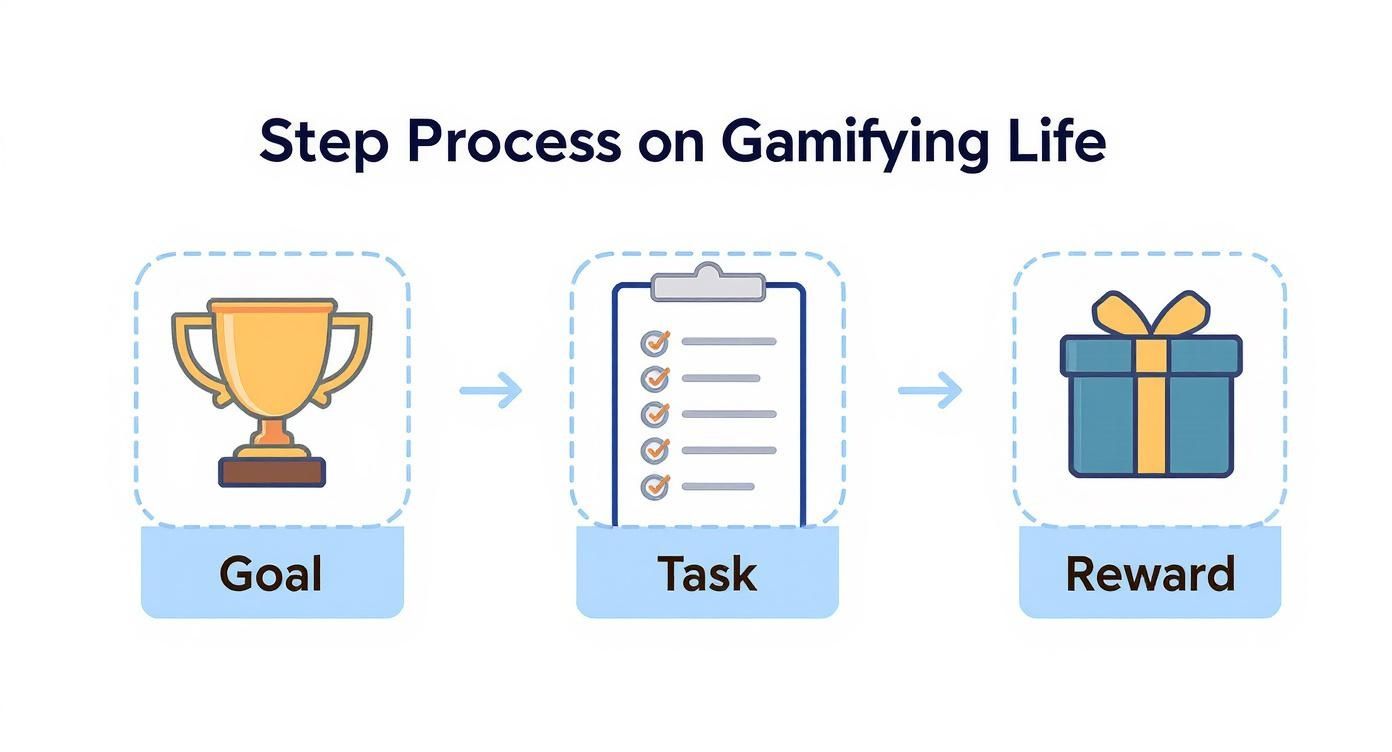
As you can see, successful gamification isn't complicated. It’s a straightforward loop: set goals, do the work, and earn rewards that make you want to do it all over again.
Making It Stick with Tracking and Rewards
Let's be honest: keeping score by hand can quickly become a chore, defeating the whole purpose. Using an app like Tracka automates the entire process—logging habits, tallying points, tracking streaks—so you can focus on playing the game, not on being the scorekeeper. But if you prefer a hands-on approach, you can find great bullet journal tracker ideas to get started.
Finally, set up your rewards. This is critical. Cashing in 500 points should unlock something you genuinely want, like a new book or an hour of guilt-free relaxation. This transforms self-improvement from a duty into a victory lap.
This isn't just a niche productivity hack. The gamification market is projected to be worth nearly USD 191 billion by 2034. It's a massive shift in how we approach motivation on a global scale.
Choosing Quests and Rewards That Actually Motivate
The system you build to gamify your life lives or dies on two things: quests that you genuinely care about and rewards you actually want. A well-designed game is personal. It must reflect your own aspirations and what truly motivates you, turning obligations into challenges you’re excited to tackle.
Vague goals like ‘be more productive’ are impossible to win because there’s no finish line. You need specific, measurable ‘quests’ with a clear definition of "done." For example, turn that fuzzy goal into ‘Complete three high-priority work tasks before noon.’ This simple shift removes the guesswork and makes your victories feel real.
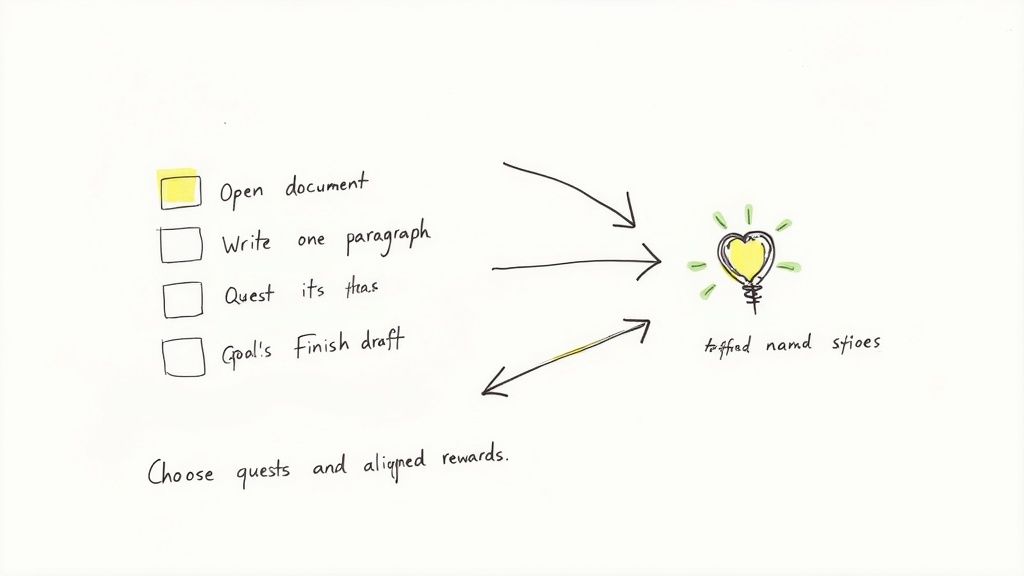
Making Quests Achievable
This specificity is a lifeline for anyone managing conditions like ADHD, where large, undefined tasks can feel overwhelming. Breaking quests into ‘micro-tasks’ is a game-changer. Instead of a daunting quest to ‘write the report,’ create a series of smaller, winnable missions:
- Quest 1: Open the document and write the title.
- Quest 2: Write one complete paragraph.
- Quest 3: Find one statistic to include.
Each tiny step becomes a quick win, providing a small dopamine hit that builds momentum. This is precisely where a tool like Tracka excels. Unlike generic habit apps, it's designed for defining custom habits and goals, making it simple to log micro-wins and build satisfying streaks, all while providing personalized insights.
Aligning Rewards with Your Goals
When it comes to rewards, there’s one golden rule: avoid anything that sabotages your main quest. If your goal is to get fit, celebrating a week of workouts with a junk food binge is counterproductive. It sends mixed messages to your brain, undermining the very progress you're working to make.
Your rewards should feel like a celebration of your new identity, not an escape from it. Choose rewards that reinforce the positive changes you're making, amplifying your sense of accomplishment and fueling your motivation for the next challenge.
Instead, align your rewards with your goals to create a powerful, self-reinforcing loop. This strategic alignment makes the process feel more cohesive and meaningful.
Quest and Reward Pairing Examples
To help you get this right, here’s a look at poor alignment versus a system built for success.
| Goal Area | Poorly-Aligned Reward | Effectively-Aligned Reward |
|---|---|---|
| Fitness | Binge-watching a TV series all night, sacrificing sleep. | Investing in new workout gear or a high-quality yoga mat. |
| Productivity | Rewarding a focused morning with mindless social media scrolling. | A guilt-free 20-minute walk outside to recharge your mind. |
| Financial Savings | Celebrating hitting a savings goal with an impulse purchase. | Subscribing to an audiobook service for your commute. |
By being thoughtful about your quests and rewards, you’re not just playing a game—you’re designing a better, more intentional lifestyle one win at a time.
Leveraging Community for Accountability and Fun
Humans are social creatures. Weaving a community element into your game can be the difference between fizzling out and long-term success. When you gamify your life, you don't have to go it alone. In fact, research shows that adding social accountability can make you up to 95% more likely to achieve your goals.
This isn’t about creating intense competition. It’s about building a supportive network that celebrates your progress and offers encouragement when motivation dips. A solo journey is tough to sustain, but a shared adventure feels more meaningful—and a lot more fun.
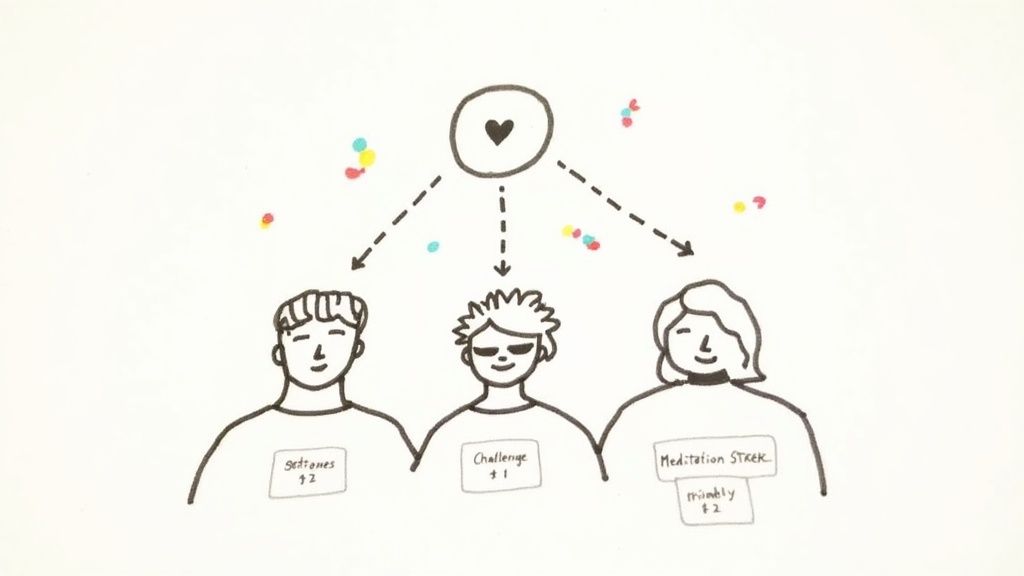
Turning Solo Quests into Team Missions
The easiest way to get started is by sharing your ‘main quest’ with a trusted friend or family member. Simply telling someone your goal creates a powerful layer of accountability. Knowing someone else is aware of what you're working toward often provides the gentle nudge needed to stay on track.
Another great approach is to introduce friendly, collaborative challenges. Instead of competing against each other, you can work together toward a shared objective or cheer on one another's individual streaks.
- Shared Streaks: Team up with a friend to see who can maintain a meditation streak the longest, sending daily check-ins for encouragement.
- Weekly Check-ins: Schedule a quick five-minute call each week to talk about your wins and challenges.
- Team Goals: Set a collective goal, like walking a certain number of steps together in a month, and track your combined progress.
This social dynamic transforms a personal chore into a connected experience, making victories feel bigger and setbacks less isolating.
Adding community to your game creates a positive feedback loop. Seeing others succeed provides inspiration, while knowing others are watching your journey provides the accountability needed to keep showing up.
Finding Your Crew in the Digital World
Modern habit-tracking apps are built with this principle in mind. Tracka, for example, has community features baked in, allowing you to connect with others, share your progress, and celebrate milestones without adding pressure. It’s a community-driven approach that helps people stick to routines, a key differentiator from generic solo apps.
Whether you're joining a dedicated community within an app or creating a small accountability group with friends, the effect is the same. It reinforces the idea that your efforts matter—not just to you, but to others. This social connection is often the missing ingredient that turns inconsistent effort into an unbreakable habit.
Using Data to Level Up Your Strategy
A game is pointless without a scoreboard. The same goes for gamifying your life. Consistent tracking is the engine that keeps you going, giving you the feedback you need to see your progress and stay engaged.
Forget tallying points on a notepad. Tools like Tracka.AI automate the entire scorekeeping process. The app serves up clean, visual charts of your streaks, completion rates, and points, turning your daily efforts into tangible data.
But this data isn’t just for show—it’s your strategic playbook.
From Simple Tracking to Smart Insights
The real power move is using AI-powered insights to analyze and refine your game. Tracka's engine doesn't just count your wins; it learns from them. It sifts through your data to spot hidden patterns you’d almost certainly miss on your own.
For instance, the AI might notice you consistently miss your 'morning run' quest on Mondays. Instead of just marking it as a failure, it might suggest adjusting the difficulty, shifting the time, or swapping it for a different activity. This is the kind of personalized insight that helps you adapt before burnout sets in.
This intelligent feedback loop is what separates a basic habit tracker from a genuine performance tool. It offers personalized coaching, suggests new 'quests' based on what you’ve already succeeded at, and helps you see how habits impact your energy and focus. If you're looking for ideas, explore these life-changing habits to track in your daily routine.
Evolve Your Game with Regular Reviews
Your game should never be static; it needs to evolve with you. Set aside time for a regular review—weekly or monthly—to look at your progress and use data-driven insights to make smart adjustments.
- Is a quest too hard? Lower the point value or slice it into smaller micro-tasks.
- Are you getting bored? Introduce a new ‘challenge’ or a surprise ‘bonus reward’ for a long streak.
- Did you discover a new goal? Add a whole new questline to your game to reflect your changing priorities.
This adaptive approach has a massive impact in the real world. A huge 90% of employees report that gamified elements at work make them more productive, driving home just how effective these mechanics are for sustained motivation.
The goal isn't just to play the game—it's to become a better player. Use your data not as a report card, but as a map that shows you exactly where to go next to keep winning.
Building a Life You Genuinely Enjoy
So, what does it mean to gamify your life? It’s about consciously designing a system that makes self-improvement feel less like a chore and more like an adventure. You shift your mindset from obligation to curiosity, turning the long haul of personal growth into a series of winnable levels. This approach works because it gives you immediate feedback for your efforts, building momentum that pure willpower can't sustain alone.
Remember, this is your personal game. You make the rules, and more importantly, you can change them whenever you want.
The Goal Is Progress, Not Perfection
If your system isn’t working, don’t scrap the whole game—just tweak the rules. Is a quest too hard? Break it down into smaller steps. Is a reward not motivating anymore? Swap it for something you actually want. The real objective isn't flawless execution; it's consistent, sustainable progress. This mindset turns setbacks from failures into useful data points that help you refine your strategy.
The power of this approach is in its flexibility. By treating your habits like a game, you give yourself permission to experiment, adjust, and find what truly clicks for you. That’s how you achieve long-term success.
Start small. Pick one or two key habits to turn into your first 'quests' and build from there. With a well-designed system, especially one supported by tools like Tracka that automate the scorekeeping, you can build a more focused, energized, and fulfilling life—one small win at a time.
Got Questions? We've Got Answers
When you start turning your life into a game, a few questions always pop up. It's normal to hit snags or wonder if you're doing it "right." Let's clear up some common hurdles so you can get back to playing.
Can You Really Gamify Your Life Without an App?
Absolutely. You don't need anything fancy to get started. A simple notebook, a whiteboard, or a basic spreadsheet can work. The magic isn't in the tool; it's in the system you build—defining quests, assigning points, and setting up rewards that mean something to you.
The big advantage of using an app like Tracka, though, is automation. It handles the tedious work of tallying points, tracking streaks, and visualizing progress. This frees you to focus on playing the game, not being the scorekeeper. Plus, its AI-powered insights and community features offer a level of support that's hard to replicate on your own.
What if I Lose Motivation and Stop Playing?
It happens to everyone. The key is to treat it as data, not a failure. Get curious and figure out why you stopped.
- Were the quests too hard? Dial down the difficulty. Break bigger goals into tiny, almost laughably easy micro-tasks.
- Were the rewards not exciting enough? Ditch them and pick something you genuinely look forward to earning.
- Feeling burnt out? That's a sign your game is too intense. Build in a planned "rest day" where you can recharge without feeling like you're breaking your progress.
Sometimes a tiny tweak is all it takes to make the game fun again. The point isn't perfection; it's building a system flexible enough to handle your off days.
How Do I Choose the Right Game Mechanics?
The best mechanics are the ones that tap into what already motivates you. The only way to find out what works is to experiment. Start simple and add new elements as you go.
You're not just a player in this game; you're also the lead designer. If a rule isn't working, change it. If a mechanic feels boring, swap it out. The most effective system is the one you build for yourself.
Think about what drives you. If you love seeing visible progress, lean into points, levels, and badges. If your main goal is consistency, make streaks your number one focus. If you get bored easily, design a game with different "worlds" or themes (like a Fitness World and a Career World). And if you're powered by people, team challenges and accountability partners are your secret weapons.
Ready to stop chasing willpower and start winning at your goals? Tracka.AI gives you the tools to design a life game you actually want to play, combining habit tracking, AI-powered insights, and social accountability to help you build consistency and improve your life. Start building your best habits today.


