

Building consistency and boosting focus doesn't need to be impossible. Use the best free habit tracking apps and make a difference.
You’ll feel overwhelmed if you start searching for the best free habit tracking apps. There are hundreds of them, with every Instagram fitness influencer seemingly jumping on the trend of releasing a new tracker that they promise is the best. And we can promise you, they’re not all good.
What they do all have in common, however, is promising transformation. The reality is that the best app isn’t the one with the most features—it’s the one that makes consistency achievable. It should be a tool designed to help you show up every day, long enough for your small efforts to compound into real, life-changing results.
Why Consistency is so Hard (and How to Fix It)
That initial surge of motivation can feel intoxicating – and most of us will have recently had that during the first weeks of the New Year. It couldn’t be more shortlived, with 80% of people failing by February. And in general, 92% of people who attempt to change habits fail within three months
This isn’t a personal failure; it’s a battle against human nature. Our brains are wired for immediate gratification, but the real benefits of good habits—like increased energy, sharper focus, and better health—take time to appear. This delay creates a “consistency gap” where even our best intentions get lost to distraction and old patterns.
Committing to a new habit—daily meditation, consistent workouts, eating healthier, or reading more books—feels so exciting in your mind. But that’s exactly where it often stays, in your mind. Actually putting a habit into action feels so much less fun.
And what happens after a week? For most people, that motivation fades, and the routine falls apart.
That said, don’t think of it as a personal failure. Think of it as a battle against human nature. Our brains are wired for immediate gratification, but the real benefits of good habits—such as increased energy, sharper focus, better health, or weight loss—take time to appear.
This delay creates a “consistency gap”, and our best intentions quickly become lost within the distraction of old patterns.
The Psychological Hurdles to Lasting Change
Without a support system, willpower alone is rarely enough to overcome the mental roadblocks to consistency. Instead, you’ll find:
- Lack of Visibility: When you can’t see your progress, it’s easy to feel like your effort isn’t making a difference. You’ll be so much more tempted to quit.
- Decision Fatigue: Simply remembering to perform and track a new habit adds mental load to your day. You’re adding friction that drains motivation faster.
- The “All-or-Nothing” Trap: Missing one day can feel like a total failure, but never abandon the goal entirely. It’s essential to understand how long it takes to truly form a habit and to embrace the imperfect process of building a routine.
This is where a powerful habit-tracking app works so well. It provides the external structure needed to bridge the consistency gap.
An app like Tracka is engineered to counteract these common failure points by making progress visible, automating reminders, and providing the AI-powered insights and accountability you need to make new behaviors stick.
What to Expect from a Great Free Habit Tracker
If you use a few, you’ll definitely realize that not all free apps are created equal. What you will find is that many are little more than digital checklists.
Think of it as your essential checklist for finding a tool that genuinely helps you build momentum for a better life.
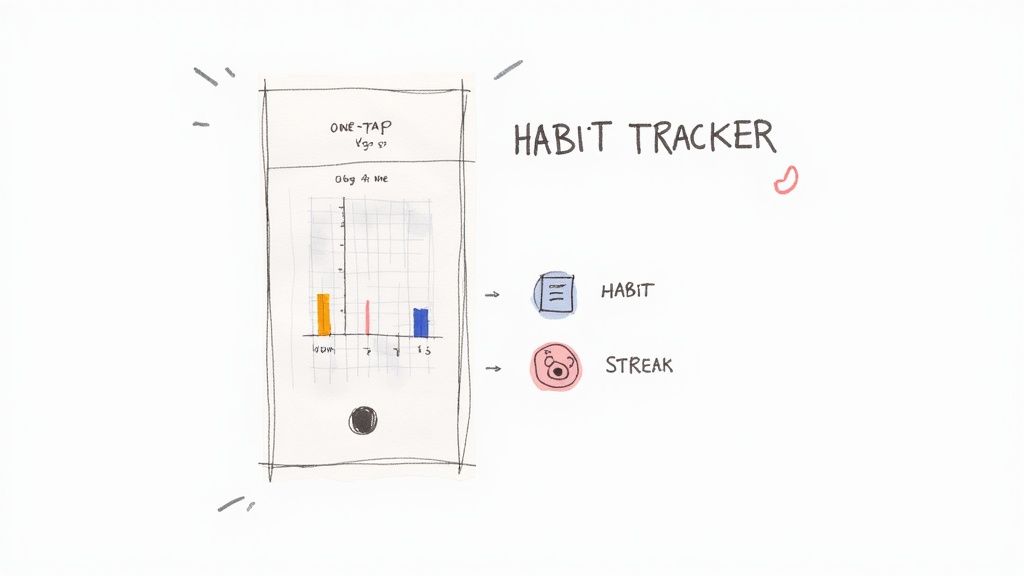
The best free habit-tracking apps are built on the science of behavior change. They are designed to:
- Reduce friction
- Sustain motivation
- Provide the structure that willpower alone can’t
Think of it as your essential checklist for finding a tool that genuinely helps you build momentum for a better life.
The single most important feature is a frictionless logging interface. If it takes more than a few seconds to mark a habit complete, you won’t do it consistently. We think the process must be simple and satisfying—that quick tap should feel like a small win, reinforcing the positive action you just took.
Equally important is customizable scheduling. Life isn’t a simple daily checklist, so your habits shouldn’t be either. A great app lets you set habits for specific days (“Workout Monday, Wednesday, Friday”) or target a frequency (“Meditate 4 times per week”).
What Really Creates Consistency?
A few essential features separate a simple tracker from a powerful behavior-change tool. These features tap into core psychological drivers that keep you on track long after the initial motivation has faded.
A truly effective app should offer:
- Clear visual progress
- Actionable reminders with smart notifications.
- Meaningful data insights with s simple reports on completion rates and trends
This table breaks down the must-have features in any free app you’re considering, explaining not just what they are, but why they’re essential for building life-improving habits.
Essential Features in a Free Habit Tracking App
| Core Feature | Why It Matters | Look For This |
|---|---|---|
| Effortless Logging | Reduces the mental barrier to tracking. If it’s not quick and easy, you won’t stick with it. | A one-tap completion process; an intuitive and clean user interface. |
| Flexible Scheduling | Your habits need to fit your life. Daily, weekly, or specific-day scheduling is non-negotiable. | Options for “X times per week” or setting habits for specific days (e.g., M-W-F). |
| Visual Progress (Streaks/Calendars) | Creates a visual feedback loop. Seeing your success motivates you to keep the chain going. | A calendar view showing completed days and a clear streak counter. |
| Customizable Reminders | Nudges you at the exact moment you need it, turning intention into action. | The ability to set specific times for notifications for each habit. |
| Simple Analytics & Reports | Helps you understand your own patterns and see how small efforts add up over time. | Basic charts showing completion rates, streaks, and trends. |
If an app has these core components, you know you’re using a system designed to support the rewarding process of building a better life. Apps like Tracka integrate these essential features into a clean, supportive interface, laying the solid foundation you need for a successful journey.
Advanced Tools That Actually Drive Results
Yes, streaks and calendars are a solid foundation, but the best free habit tracking apps go deeper. They log what you did and, perhaps more essentially, they help you understand why your habits stick or fall apart. These advanced tools are what separate a simple digital checklist from a true partner in your personal growth.
One of the most powerful differentiators on the Tracka app is AI-powered insights. Instead of just showing you a streak, our smart app analyzes your behavior to spot hidden patterns.
For example, it might find you’re 80% more likely to complete your morning meditation on days you also go for a walk. What you’re getting is personalized coaching that you can use to structure your day for success.
This is what makes a tool like Tracka so effective. It transforms your daily check-ins into actionable insights.
Going Beyond the Checkmark
You need to see how they connect to the bigger picture of your life to build habits that last—your energy, focus, and health.
Advanced apps achieve this by integrating features that boost self-awareness and give a more holistic view of your progress.
Here are a few features to look for:
-
- Integrated Journaling: A space to add quick notes helps you connect the dots between a missed workout and a stressful workday, or a productive week and a positive mindset.
- Mood Correlation: Logging your mood alongside habits is powerful. Over time, you can see which routines genuinely improve your mental health.
- Social Accountability: Sharing your goals with a supportive community dramatically increases your chances of success.
These features help you see that a broken streak isn’t a failure—it’s a data point providing valuable information for your next attempt.
The entire habit-tracking market is evolving to meet this demand for smarter tools. It’s a niche valued at $13.06 billion in 2025 and is expected to reach $50.21 billion by 2035.
A key driver of this growth is AI, with over 60% of new apps including AI-powered insights to offer a more personalized, effective experience.
Why Community Can Do So Much For You
Social connection is so powerful. When you share your goals, your commitment level rises. The best apps build this in, creating spaces where you can find encouragement and celebrate wins together.
Tracka’s community features, for example, create a supportive ecosystem to keep you going on days when willpower is low. It doesn’t matter if you’re tracking fitness, nutrition, screen time, or alcohol intake; knowing others are on the same journey makes the process feel less lonely and far more achievable.
Using our calendar habit tracker within a community creates a powerful feedback loop.
The Hidden Costs of Free Apps
The word “free” is always attractive – who doesn’t love a freebie? But with apps, free usually comes with a catch. You might have restricted use or be forced to pay after one month, etc.
Or, a common tactic is limiting the number of habits you can track. Hitting a hard limit of three or five habits can stall your momentum just as you’re ready to build on your success. That said, the goal isn’t to avoid free apps, but to understand the trade-offs so you can choose a tool that empowers you, not one that gets in your way.
Then there’s the user experience. Free tiers are often cluttered with ads, which are more than just a minor annoyance. Imagine finishing a calming meditation only to have a jarring banner ad shatter your focus. It directly undermines the positive state you worked to achieve.
Your Data Is the Real Price
Beyond limitations and annoying ads, the highest hidden cost is often your privacy.
You have to remember that you’re logging sensitive data about your life—your sleep, mood, exercise, or alcohol consumption—and you’re creating an intimate personal record. You’re then giving it out to third parties without understanding how it’s used, which is a major risk.
Many free apps generate revenue by selling aggregated user data to third parties. This makes reading the privacy policy non-negotiable.
Here’s what to look for:
- Third-Party Sharing: Does the policy clearly state if they share or sell your data? Vague language is a red flag.
- Data Anonymization: Do they promise that any shared data is fully anonymized and aggregated, making it untraceable to you?
- App Permissions: Does the app request unnecessary permissions, like access to your contacts or microphone?
A trustworthy app makes its privacy policy easy to find and understand.
Choosing a platform like Tracka, built on a foundation of user trust and data privacy, lets you bypass these concerns. Your personal growth journey is just that—personal. Your data is never sold as a product.
Finding the Right App for Your Personality
The best habit tracker is the one you’ll actually use every day. Never go for the most popular one with the most downloads.
A one-size-fits-all approach to habit-building fails because our motivations are deeply personal. You need to understand your personality and choose an app that feels like a natural extension of your goals.
When you match an app’s features to what drives you, you set yourself up for long-term success. Always remember that the right tool should feel energizing and supportive.
What Kind of Habit Builder Are You?
Most of us fall into a few key archetypes when it comes to self-improvement. Identifying yours can tell you what you need from a free habit tracking app.
- The Data-Driven Optimizer: You love digging into numbers. Progress, for you, is measured in detailed analytics, trend lines, and completion percentages.
- The Social Achiever: You thrive on encouragement and friendly competition. Knowing others are on a similar journey and can see your progress is a powerful motivator. You need an app with community features for support and accountability.
- The Simplicity Seeker: You need a clean, minimalist interface free of clutter. Too many features or complex menus are overwhelming. Your ideal app is intuitive and fast.
Of course, many of us are a blend of these types. That’s why a versatile app like Tracka is designed to cater to all three. It provides deep, AI-powered insights for the Optimizer, a supportive community for the Achiever, and an ADHD-friendly, intuitive design for the Seeker.
But remember that the most effective habit tracker doesn’t force you into its system. Instead, it adapts to your unique motivational style, making the path to consistency feel intuitive and rewarding.
The infographic below offers a simple decision tree to help you evaluate free apps based on a few critical, often overlooked, factors.
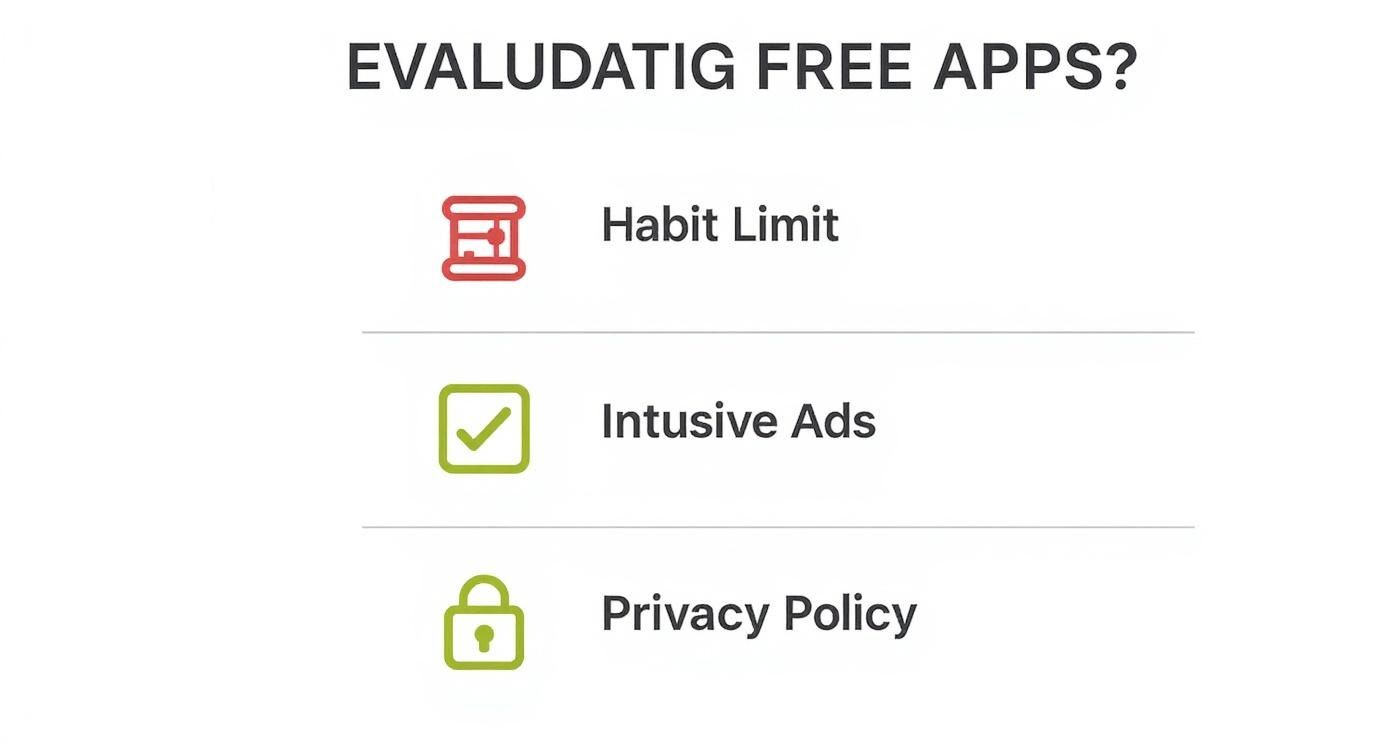
This visual guide shows you that the best tools offer generous habit limits, a distraction-free experience, and a strong commitment to privacy. These factors are just as important as the features themselves.
Whether you’re motivated by data, community, or turning goals into a fun challenge, finding an app that respects your focus is crucial. If you’re intrigued by making self-improvement more engaging, learn more about how to gamify your life and make building habits feel like play.
At the end of the day, a great habit-tracking app is a partner in the messy, rewarding work of self-improvement. It’s a tool designed to make consistency possible even when motivation runs low.
As you search for the right fit, keep the essentials in mind:
- A clean interface that reduces friction
- Insights that offer real value
- A privacy policy you can trust
Your focus should remain on building routines that lead to real-life impact: more energy, sharper focus, and improved well-being.
Your journey to a better life starts with a single, consistent action. We will admit that even the right technology doesn’t create the change for you, but it does give you the structure, motivation, and insight to make that change stick.
Ultimately, tracking your habits is an investment in yourself. Choosing a system like Tracka is about adopting a framework that supports real, lasting change. With AI that spots patterns you’d miss and a community to keep you accountable, Tracka is designed to help you turn small daily efforts into the kind of life transformation you’re aiming for.
A Few Common Questions
It’s normal to wonder if you’re choosing the right tool or the best approach. Let’s clear up some of the most common concerns.
Are Free Habit Tracking Apps Actually Any Good?
Yes, but with a major caveat. The effectiveness of any app, free or paid, depends on your commitment and the app’s design. You don’t need to spend money to build good habits; you need a tool that makes consistency easier.
How Many Habits Should I Take On at Once?
It’s tempting to overhaul your entire life at once, but this is a classic burnout recipe. The science of behavior change points to starting small to build momentum without overwhelming yourself.
As a general rule, start by tracking just one to three core habits and don’t overwhelm yourself.
Is My Data Safe with a Free App?
This is a great question. While many free apps are trustworthy, some generate revenue by selling user data. As discussed earlier, you must review an app’s privacy policy before committing.
Look for clear, plain-language statements that your data will not be sold and will be anonymized for internal analytics. Reputable developers are transparent about this. Platforms like Tracka, for example, are built around user privacy, ensuring your personal growth journey remains private.
Ready to build habits that stick without compromising your privacy? Tracka combines AI-powered insights, a supportive community, and an ADHD-friendly design to help you achieve your goals. It’s time to start your journey toward a more focused, consistent, and fulfilling life.
Get Started with Tracka for Free


